
Browse Items (38 total)
- Collection: Emergence of Modern America
Lesson Plan - Woman Suffrage Movement in Virginia

The American woman suffrage movement is traditionally dated to the first women's rights convention held in Seneca Falls, New York, in 1848, where Elizabeth Cady Stanton, Lucretia Mott, and others called for women's equality in the home, education,…
Richmond Federal Reserve Headquarters on Capitol Square, 1939.
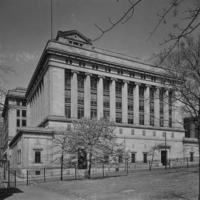
The Federal Reserve System, sponsored by Virginia Senator Carter Glass, was signed into law on December 23, 1913, by President Woodrow Wilson. In 1914, the city of Richmond was selected to be the home to one of 12 central bank locations and was to…
The Young Crusader, Woman’s Christian Temperance Magazine for Children, 1934

"Agitate – Educate – Legislate” was the slogan of the Woman’s Christian Temperance Union, which advocated the prohibition of alcohol. Established in 1874 in Ohio, the union became a national movement and Virginia women established a state chapter in…
Old City Hall, Glass Plate Negative, Richmond, 1931

Richmond's former city hall building, known as Old City Hall, is located on Broad Steet with one side facing Capitol Square and another facing the current city hall building. The building stands out as a remnant of the Gothic Revival style popular…
High School Attitudes Towards Prohibition, 1930

At the turn of the twentieth century, the call for Prohibition had become a national issue, espoused by many politicians and pushed by several strong organizations. The American Temperance Society, started in 1826, acted as a support group for…
Maggie Lena Walker, Photograph Portrait, ca. 1930

Maggie Lena Mitchell Walker was an entrepreneur, a banker, and a community leader. In 1903, she was the first African American woman to establish a bank in the United States, the St. Luke Penny Savings Bank, in Richmond. She was also the first…
John Mitchell Jr. Obituary Announcement, Richmond, 1929

John Mitchell Jr., was the determined and pioneering force behind the success of the Richmond Planet newspaper. Mitchell was born into slavery at Laburnum near Richmond on July 11, 1863. He was the son of John Mitchell and Rebecca Mitchell, who were…
Public Assemblages Act for the Separation of Races, 1926
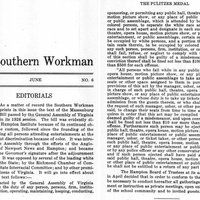
After the U.S. Supreme Court determined in 1896 that “separate but equal” was not unconstitutional in Plessy v. Ferguson, southern state legislatures passed a flurry of segregation laws. In truth, Virginia had already begun codifying segregation in…
Buck v. Bell, Supreme Court of Appeals of Virginia, Brief for Appellee, September 1925

What is known as the Progressive Movement in the United States lasted from the late 19th century until the 1940s. While many positive social reforms occurred, there were also laws enacted in which people who were thought to be “inferior” in some way…
Virginia Health Bulletin: The New Virginia Law To Preserve Racial Integrity, March 1924
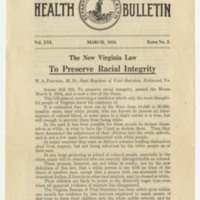
In 1924, Virginia's General Assembly passed the Racial Integrity Act, which was designed to stop the “intermixture” of white and Black people. The act banned interracial marriage by requiring marriage applicants to identify their race as "white,"…