
Browse Items (42 total)
- Collection: Revolution and the New Nation
Virginia Constitution of 1776
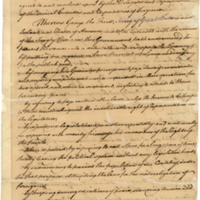
The last of Virginia's Revolutionary Conventions met from early May through July 5, 1776, to establish a new government for the independent Commonwealth of Virginia. In this session, the delegates unanimously passed the Virginia Declaration of Rights…
Declaration of Independence, 1776
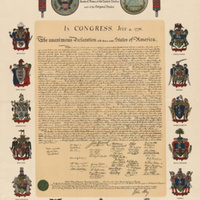
The Revolutionary War erupted with battles at Lexington and Concord and at Bunker Hill in 1775, but throughout the following year many colonists continued to believe reconciliation with Great Britain was possible. Some members of the Continental…
Address to the Ladies, Poem, 1767
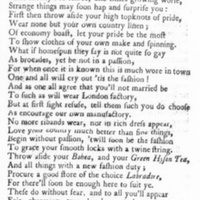
During the 1760s, many Americans came to believe that the British government was imposing unfair taxes on goods coming into the colonies. Parliament levied its first direct tax on the colonists in 1764 to help pay for the costs of fighting the Seven…
Call for a Convention to Meet in Williamsburg, 1774
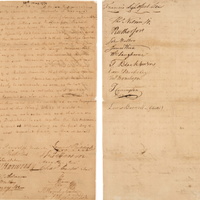
The Sons of Liberty threw hundreds of tea chests into Boston harbor in December 1773 to protest the passage of the Townshend Acts, which taxed a number of goods, including tea. The next year, Parliament responded to this destruction of about $1.7…
Proclamation Against Patrick Henry, 1775
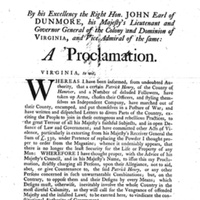
Patrick Henry (1736–1799) could be considered Virginia’s most outspoken revolutionary. Born in Hanover County, Henry studied law on his own and was admitted to the bar in 1760. In 1763, he spoke out against the action of the king's Privy Council,…
Siege at Yorktown, Map, 1781
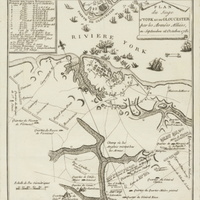
By 1780, the Continental Army had been battling British forces for five years during the American Revolution. Although the Americans had secured some key victories in places as far-flung as New York and South Carolina, the British still held…
An Act to Naturalize the Marquis de Lafayette, General Assembly of Virginia, 1785
The Marquis de Lafayette (1757–1834) was a French aristocrat whose family fortune ranked him among the wealthiest in France, but he was also one of America’s best-known Revolutionary heroes. Gilbert de Motier de Lafayette inherited his title at the…
Petition of 10,000 Dissenters for Religious Freedom, 1776
With the establishment of the Virginia colony in 1607, the Church of England (Anglican) was the only religious denomination recognized by the government for more than 250 years. Anyone not worshipping with the recognized church was labeled a…
James Lafayette Petition for Freedom, 1786

James Lafayette was born enslaved about 1748. He lived on a plantation owned by William Armistead in New Kent County. Although he is sometimes identified as James Armistead, he never signed his name or self-identified as having the surname Armistead.…
Lord Dunmore’s Proclamation, 1775

John Murray, fourth earl of Dunmore, was the last royal governor of Virginia. Assuming office in September 1771, he won support during what became known as Lord Dunmore’s War in 1774. Ostensibly to protect white settlers in the Ohio Valley region…