
Browse Items (226 total)
Drawing of Shellfield, Westmoreland Co., Edward A. Darby, 1932-37
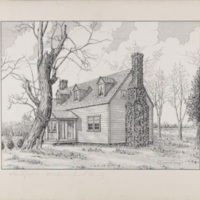
In the 1930s, the Virginia State Commission on Conservation and Development’s Division of History and Archaeology received funds from the Works Progress Administration’s (later known as the Work Projects Administration) Federal Art Project to…
Pres. Truman presents Congressional Medal of Honor to Cpl. Desmond T. Doss, Photograph, 1945
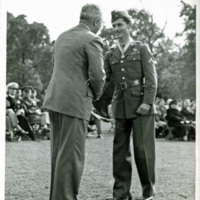
Lynchburg native Desmond T. Doss (1919–2006) was the first conscientious objector to receive the Congressional Medal of Honor. A conscientious objector is one who is opposed to serving in the armed forces and/or bearing arms on the grounds of moral…
Harry F. Byrd, Painting on Canvas, 1947
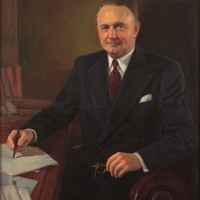
Harry Flood Byrd (1887–1966) served as state senator from 1915 to 1926, governor from 1926 to 1930, and as a United States Senator from 1933 to 1965. Byrd hailed from Winchester, Virginia, and came from a prominent and politically connected family.…
Local 12103 on Strike in Hopewell, Photograph, 1956

Hopewell, Virginia, was like many small towns in the south that benefited financially from outside industrial development early in the 20th century. At the outbreak of World War I in 1914, the E.I. DuPont de Nemours Company began producing guncotton…
John L. Wilkes of Bedford County, Personal War Service Record Photograph, 1944
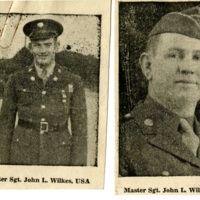
On June 6, 1944, soldiers of the Allied Expeditionary Force stormed the beaches of Normandy as part of Operation Overlord, often referred to as D-Day. Approximately 156,000 American, British and Canadian forces landed on five beaches along a 50-mile…
This is the Enemy (No. 44), War Poster, Artists for Victory, 1943
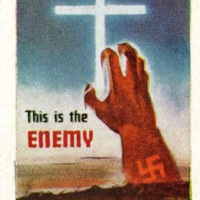
Based in New York, N.Y., 1942-1946. Artists for Victory, Inc. was a non-profit organization of more than ten thousand artists formed to assist in the war effort. Their activities included a British-American goodwill exhibition, sponsorship of…
Coal Piers, Norfolk, Photographs
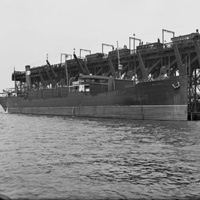
Historically, coal has been one of Virginia’s most valuable natural resources. The first coal mines were developed after coal deposits were discovered early in the 1700s west of the falls of the James River in the area that is now Midlothian, in…
Antonio Sansone, Sansone Fruit Co., Norfolk, Photograph, c. 1915
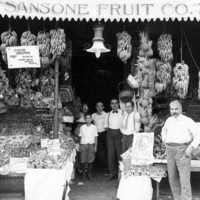
Antonio Sansone was born in 1856 in Termini Imerese, Sicily. He immigrated to the United States in 1880 at the start of a wave of Italian immigration to America that lasted until about 1920. By 1899, he had established Antonio Sansone & Company,…
Invitation to the formal opening of the Jamestown Tercentennial Exposition, 1907
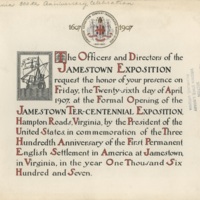
Late in the 19th century, some Virginians became interested in preserving historic buildings and landscapes that documented the state's illustrious past. White women led the effort to establish the Association for the Preservation of Virginia…
Maggie Lena Walker, Letter, c. 1920s
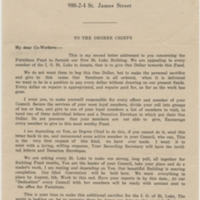
Like many “race leaders” in the early 20th century, Maggie L. Walker rose to prominence from modest beginnings as a result of her intellect, education, and business acumen. Her mother was a formerly enslaved woman and her father had served in the…