
Browse Items (235 total)
Robert Dinwiddie Bookplate, circa 1750s

A bookplate is a small-sized, decorative label that is adhered to the inside front cover of a book. They are used to identify the owner of a book for personal use or for use in a library. Bookplates are designed to reflect a person’s interests or to…
Lord Dunmore’s Proclamation, 1775

John Murray, fourth earl of Dunmore, was the last royal governor of Virginia. Assuming office in September 1771, he won support during what became known as Lord Dunmore’s War in 1774. Ostensibly to protect white settlers in the Ohio Valley region…
The Richmond Planet, Masthead, Richmond, 1893

The Richmond Planet was first published in 1882, seventeen years after the end of the Civil War. The thirteen founders (including James H. Hayes, James H. Johnston, E.R. Carter, Walter Fitzhugh, Henry Hucles, Albert V. Norrell, Benjamin A. Graves,…
John Mitchell Jr. Obituary Announcement, Richmond, 1929

John Mitchell Jr., was the determined and pioneering force behind the success of the Richmond Planet newspaper. Mitchell was born into slavery at Laburnum near Richmond on July 11, 1863. He was the son of John Mitchell and Rebecca Mitchell, who were…
Spanish/English Bilingual entries under development

Bilingual entries are under development - check back soon.
Old City Hall, Glass Plate Negative, Richmond, 1931
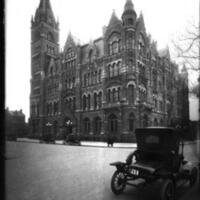
Richmond's former city hall building, known as Old City Hall, is located on Broad Steet with one side facing Capitol Square and another facing the current city hall building. The building stands out as a remnant of the Gothic Revival style popular…
Chesapeake Ferry Company, Travel Brochure, circa 1935

Waterways provided the people of the Eastern Shore and Hampton Roads regions with access to food, supplies, and transport long before English colonists arrived in 1607. As English settlements displaced and removed Indigenous people from the land near…
Virginia Ferry Company, Travel Brochure, circa 1955

Waterways provided the people of the Eastern Shore and Hampton Roads regions with access to food, supplies, and transport long before English colonists arrived in 1607. As English settlements displaced and removed Indigenous people from the land near…
James Lafayette Petition for Freedom, 1786

James Lafayette was born enslaved about 1748. He lived on a plantation owned by William Armistead in New Kent County. Although he is sometimes identified as James Armistead, he never signed his name or self-identified as having the surname Armistead.…
Clara Robinson, Petition to Remain in Virginia, 1848

In 1806, Virginia's General Assembly passed a law that required enslaved people who had been freed after that date to leave the state within one year's time. Those who remained in the Commonwealth more than a year could be re-enslaved and sold.…