
Browse Items (224 total)
Proclamation in recognition and honor of our beloved president, Franklin D. Roosevelt, 1945
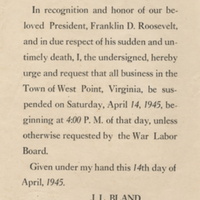
On April 14, 1945, U.S. President Franklin Delano Roosevelt was buried in Hyde Park, New York, following funeral services at the White House. Roosevelt had been elected four times to the office of president, a feat never matched, and one that is now…
Public Assemblages Act for the Separation of Races, 1926
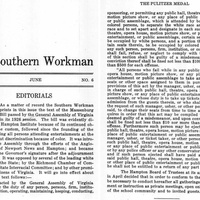
After the U.S. Supreme Court determined in 1896 that “separate but equal” was not unconstitutional in Plessy v. Ferguson, southern state legislatures passed a flurry of segregation laws. In truth, Virginia had already begun codifying segregation in…
Racial Violence Reported in Norfolk Newspapers, 1866
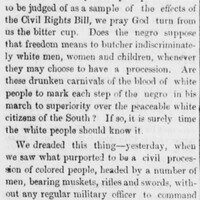
Emancipation at the end of the Civil War did not bestow citizenship or legal protections on formerly enslaved men and women. Concerned that the newly freed African Americans would not be treated equally in courts of law, Congress passed a Civil…
Remember Dec. 7th!, World War II Poster, 1942
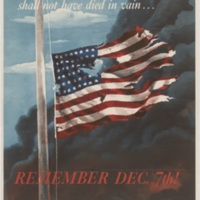
From September 1939 to December 1941, the United States was not officially at war with any of the Axis powers. While the government provided to the Allies through programs such as Lend-Lease, Americans generally held a strong isolationist sentiment…
Rep. James Barbour, Slavery in Missouri, Speech, 1820
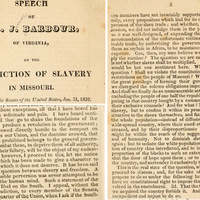
The Missouri Compromise of 1820 represented an uneasy agreement that temporarily preserved the peace between leaders in pro-slavery and in free states. Although it resolved the controversy over Missouri’s entrance to the United States, it signaled…
Requisition Order to Washington County Slaveholders, Abingdon Virginian, Feb. 20, 1863
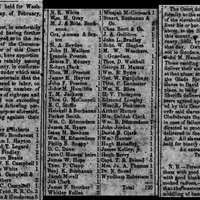
From the beginning of the Civil War, the Confederate government attempted to requisition needed goods and services from private citizens. In March 1863, the Confederate Congress passed an Impressment Act that allowed them to requisition crops,…
Resolutions Adopted by a Meeting of the People of Powhatan County, 1865
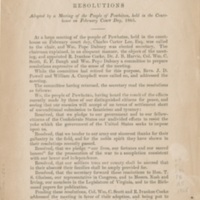
On February 3, 1865, Confederate Vice President Alexander H. Stephens and two other commissioners met with United States President Abraham Lincoln on the steamship River Queen near Fort Monroe in Hampton to discuss a potential treaty to end the Civil…
Richmond Federal Reserve Headquarters on Capitol Square, 1939.
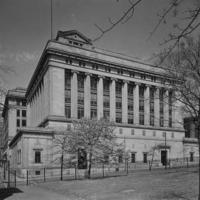
The Federal Reserve System, sponsored by Virginia Senator Carter Glass, was signed into law on December 23, 1913, by President Woodrow Wilson. In 1914, the city of Richmond was selected to be the home to one of 12 central bank locations and was to…
Richmond Streetcar Boycott, Newspaper Articles, 1904
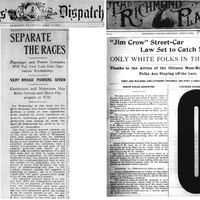
The Supreme Court’s 1896 decision in Plessy v Ferguson that “separate but equal” accommodations did not violate the rights of Black citizens paved the way for states across the South to pass formal segregation laws. In 1902, Louisiana passed the…
Roanoke County Cohabitation Register, 1866
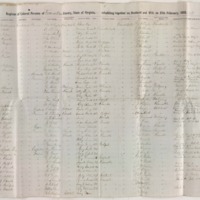
Prior to the Civil War, enslaved men and women were not legally allowed to marry. However, many enslaved couples considered themselves married, despite the lack of legal protection and recognition. Often, families were split apart by enslavers who…