
Browse Items (224 total)
Tuskegee Airmen in World War II, Photographs, ca. 1943
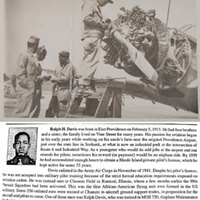
During World War II, Black Americans took the opportunity to point out the hypocrisy of engaging in a war effort to save democracy abroad while maintaining segregation laws at home. Spurred by the national newspaper, Chicago Defender, the Black…
Twelve Reasons Why Mothers Should Have the Vote, Equal Suffrage League Flyer, 1910's
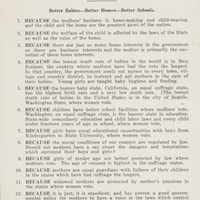
Founded in 1909, Virginia's Equal Suffrage League sought support for the vote in many ways. Members lobbied legislators, gave public speeches, and published editorial letters, broadsides, and pamphlets. They advanced many arguments about why women…
Two Virginia Newspapers Respond to the Supreme Court's Brown v. Board of Education Decision, May 1954
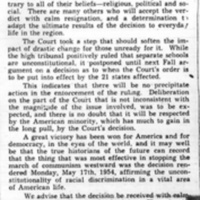
On May 17, 1954, the United States Supreme Court ruled in Brown v. Board of Education of Topeka, Kansas that racial segregation in public schools was unconstitutional. Virginia's school system had been segregated since it was established in 1870, and…
Typus Orbis Terrarum (Map of the World), 1607
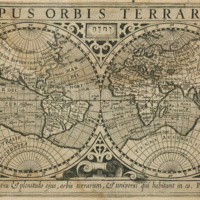
Gerardus Mercator (1512–1594) was born in Flanders, now known as Belgium. The son of a shoemaker, he graduated in 1532 from the University of Louvain, where he studied astronomy, geography, and mathematics. Afterwards he worked as a calligrapher,…
Union Burial Ground Society Constitution, 1848
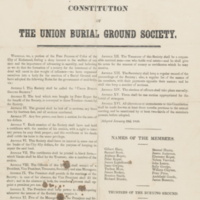
Beginning in the 18th century, cemeteries in Richmond were racially segregated. Deceased residents of African descent were interred in the Burial Ground for Negroes (also known as the African Burial Ground) alongside the city’s Shockoe Creek. The…
View of Girls Processing a Hydraulic Bridge Erecting Crane, Hampton Roads Port of Embarkation, U.S. Army Signal Corps Photograph, 1944
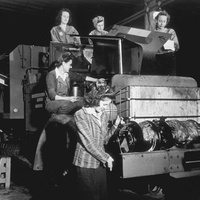
World War II fundamentally altered the workforce of the United States as the nation shifted from a peacetime consumer-focused economy to one centered on war production. While industries shifted their production lines to munitions and supplies for the…
Virginia Association Opposed to Woman's Suffrage, Broadside, 1910's

For a significant portion of American history, women did not have the right to vote. State legislatures determined who could vote, and Virginia did not extend voting rights to all white men until 1851. The Fifteenth Amendment to the U.S.…
Virginia Constitution of 1776
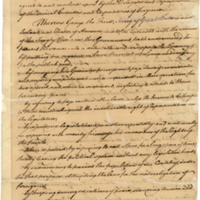
The last of Virginia's Revolutionary Conventions met from early May through July 5, 1776, to establish a new government for the independent Commonwealth of Virginia. In this session, the delegates unanimously passed the Virginia Declaration of Rights…
Virginia Health Bulletin: The New Virginia Law To Preserve Racial Integrity, March 1924
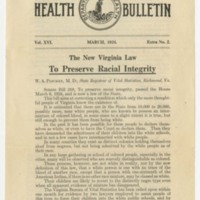
In 1924, Virginia's General Assembly passed the Racial Integrity Act, which was designed to stop the “intermixture” of white and Black people. The act banned interracial marriage by requiring marriage applicants to identify their race as "white,"…
Virginia Indian Tribes Pay Tribute Taxes to Governor Baliles, Photograph, 1989
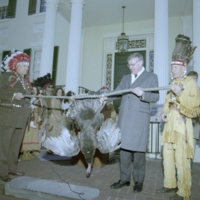
The annual payment of tribute by Virginia's Indians has been a long-standing practice that still occurs today. In 1646, Necotowance, "the King of the Indians" as the English referred to him, signed a treaty to end the third Anglo-Indian War. Annual…