
Browse Items (235 total)
Abraham Skipwith, Petition for Freedom, 1785
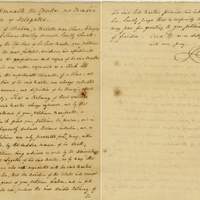
Abraham Skipwith was the first Black man documented as a property owner in Richmond’s historic Jackson Ward district. Skipwith became a wealthy landowner after emancipating himself in the years following the American Revolution. His story illustrates…
Act for Establishing Religious Freedom, January 16, 1786

When the first English settlers arrived in 1607, the Church of England served as the official church of the Virginia Colony. Under the 1689 English Act of Toleration, Protestants who were not members of the Church of England were still required to…
James Lafayette Petition for Freedom, 1786

James Lafayette was born enslaved about 1748. He lived on a plantation owned by William Armistead in New Kent County. Although he is sometimes identified as James Armistead, he never signed his name or self-identified as having the surname Armistead.…
The Federalist Papers, Number 10, 1787
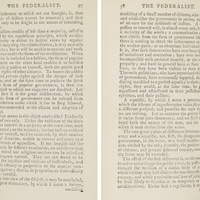
Delegates to the Constitutional Convention approved a new constitution for the United States on September 17, 1787. But before it could be adopted, nine states had to ratify the document. It had the support of some of America's brightest statesman…
George Washington, Statue, 1788

George Washington was born in 1732 in Westmoreland County, Virginia, to a relatively prosperous family. His father died when he was eleven and so he was not sent to school in England like his older half-brothers, but studied with tutors. He trained…
The Federalist Papers, Number 51, 1788
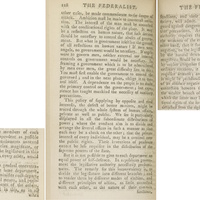
Delegates to the Constitutional Convention approved a new constitution for the United States on September 17, 1787. But before it could be adopted, nine states had to ratify the document. Despite it having the support of America's brightest statesman…
A Planter’s Address to His Fellow Citizens, Broadside, 1790's

In February 1790, the Pennsylvania Abolitionist Society, led by Benjamin Franklin, submitted a plea to Congress to debate the issue of slavery and abolish the slave trade. Congress considered the petition and formed a committee for further…
The Bill of Rights to the U.S. Constitution, December 15, 1791

The struggle for the ratification of the United States Constitution convinced some political leaders that amendments were needed to protect individual liberties from the strengthened national government created by the Constitution. During the First…
Steering a Bateau, Watercolor, 1798

Benjamin Henry Latrobe (1764–1820) was born in England, where he worked for an engineer and an architect before immigrating to the United States. He became one of the young nation's most significant architects and designed the U.S. Capitol. While…
Gabriel's Conspiracy, Testimony of Solomon, 1800

Gabriel’s Conspiracy illustrated the lengths to which some enslaved people were willing to fight for freedom in pre-Civil War America. In 1800, a group of enslaved men living in the vicinity of Richmond planned a conspiracy to take over the capital,…