
Browse Items (235 total)
Portrait of Black Hawk, 1833
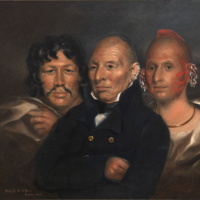
Black Hawk, born in 1767 and known in his native language as Makataimeshekiakiak, was a Sauk warrior and tribal leader. The Sauk lived on the Rock River, a tributary of the Mississippi, in what is now Illinois, and fought against the United States…
William Albright, Runaway Slave Record, Kanawha County, 1834
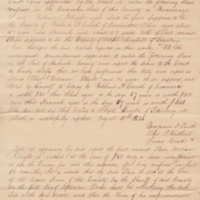
Virginia's economy was based on slavery until the Civil War and emancipation. In 1860, Virginia was home to 500,000 enslaved people, more than any other state. Although most Virginians were not enslavers, farmers and planters used enslaved laborers…
American Anti-Slavery Society, Broadside, 1836
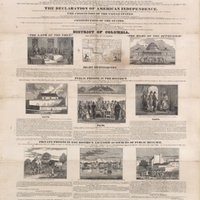
In December 1833, a group of about sixty Black and white men met in Philadelphia and organized the American Anti-Slavery Society to seek the immediate emancipation of enslaved people. The Society viewed slavery as a violation of the principle of…
Jerry Armstrong, Registration of Free Status, 1840
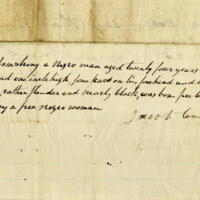
Before the end of slavery, free Black Virginians found their liberty in constant jeopardy because they were not considered citizens. After Gabriel's attempted slave rebellion in 1800, the General Assembly passed an act in 1801 requiring county…
Petition of King William County Freeholders, 1843

On January 20, 1843, a petition from residents of King William County was presented to the House of Delegates. The men who signed it asked the General Assembly to sell the lands that the royal government had set aside for the Pamunkey Indians by…
Pamunkey Indian Tribe, Counter Petition, 1843
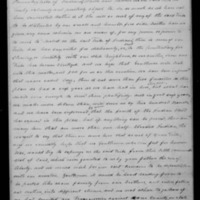
After a public notice appeared in a Richmond newspaper in October 1842 that a petition would be presented to the Virginia General Assembly to sell King William County property known as "Indian town lands," members of the Pamunkey tribe took action.…
"The Bottle," Illustrated Panels, George Cruikshank, 1848
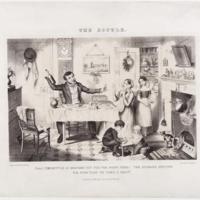
The temperance movement, or the movement to make alcohol consumption illegal, became widespread in nineteenth-century America. Since the European settlement of North America, alcohol consumption had been common. By the 1830s, Americans consumed an…
Lucy Jarvis Pearman Scott, Freedom Paper, 1848

In 1801, following Gabriel's failed slave rebellion, the Virginia General Assembly decreed that county commissioners of the revenue were to return a complete list of all free Black men and women in their districts on an annual basis. The list was to…
Clara Robinson, Petition to Remain in Virginia, 1848

In 1806, Virginia's General Assembly passed a law that required enslaved people who had been freed after that date to leave the state within one year's time. Those who remained in the Commonwealth more than a year could be re-enslaved and sold.…
Union Burial Ground Society Constitution, 1848
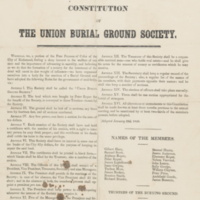
Beginning in the 18th century, cemeteries in Richmond were racially segregated. Deceased residents of African descent were interred in the Burial Ground for Negroes (also known as the African Burial Ground) alongside the city’s Shockoe Creek. The…