
Postwar United States
1945 - 1970s
The Cold War pitted the United States and its allies in NATO against the Soviet Union and other communist nations, particularly China, Korea, and Vietnam. During this period campaigns were fought not only on the battleground, but in the political arena and social consciousness as well. The fall of the Nazi regime opened the door to the Iron Curtain and Soviet dominance of Eastern Europe. Through the Truman Doctrine and the Marshall Plan the U.S. sought to halt the spread of communism further west. The defeat of Japan enabled previously occupied counties the chance to choose new leaders, many of whom sided with communism over capitalism. The United States would spend much of this period adhering to the “Domino Theory” foreign policy to contain the spread of communism.
Learn more in the National U.S. History Content Standards
Recently added items
Lesson Plan - Cold War Politics and Culture in the 20th Century United States
After the Soviet Union launched a test nuclear missile in 1949, the "Cold War" between the U.S. and U.S.S.R. intensified. As each superpower stockpiled more nuclear weapons, the United States fashioned scenarios about what might happen if the…
Segregation in Public Transportation, Broadside, No date

The 1896 US Supreme Court decision in Plessy v. Ferguson that established the so-called "separate but equal" doctrine gave rise to segregation laws throughout the southern United States. Often called Jim Crow laws, these laws mandated the separation…
Monacan Education and the Pupil Placement Board, Amherst County, 1963
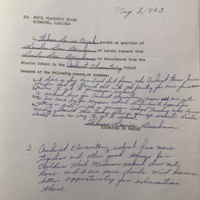
After the U.S. Supreme Court ruled in Brown v. Board of Education (1954) that racial segregation in public schools was unconstitutional, Virginia resisted desegregating its schools for years. One tactic was the creation of a state Pupil Placement…
Lesson Plan – Urban Renewal in Virginia
In the second half of the twentieth century, many U.S. cities undertook a series of “urban redevelopment” projects with federal funds that leaders claimed would modernize and upgrade their cities’ infrastructure. These urban renewal projects often…