
Browse Items (226 total)
Joshua Fry and Peter Jefferson, A Map of the Most Inhabited Part of Virginia, 1755
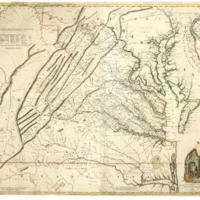
The Fry-Jefferson map was first published in 1753. It was, at the time, the most comprehensive map of 18th century Virginia. Joshua Fry and Peter Jefferson were two of the most successful surveyors in the Virginia colony. They collaborated and…
Portrait of Thomas West, Baron De la Warr
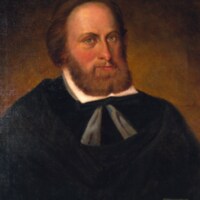
Thomas West (1576–1618), the twelfth Baron De La Warr, was appointed by King James I in 1606 to be part of the royal council that oversaw the Virginia Company of London. He monitored the situation in the Virginia colony from England and may have…
Paramount Chief Powhatan Presents Deer-Skin Mantle to Captain Christopher Newport, Photograph, date unknown
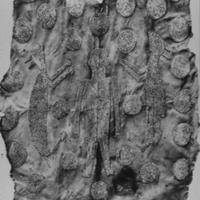
This photograph shows a deerskin mantle that was believed to have been presented by Paramount Chief Powhatan (whose given name was Wahunsonacock) to Captain Christopher Newport of the Virginia Company in 1608. The mantle is embroidered with shells…
Sebastian Münster, Early Map of North and South America, 1545
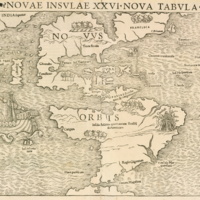
Sebastian Münster (1488–1552) was a German cartographer, cosmographer, and scholar. In 1544, he published Cosmographia, the earliest description of the world written in German, although editions were also published in English, French, Italian, and…
Map of the Americas, 1596
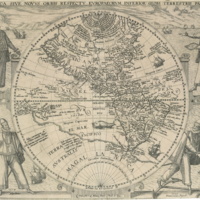
Theodore de Bry (1528–1598) was born in Liege, Flanders (now part of the Netherlands), to a wealthy Protestant family and was trained as a goldsmith and engraver. As the Spanish and British began to explore North and South America, de Bry became…
John Smith, Bust, circa 1905
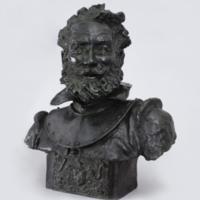
In 1906, Robert Baden-Powell presented this bust of John Smith to the Commonwealth of Virginia. Although best known as the founder of the Boy Scout movement, Baden-Powell was also an artist of considerable skill. The family of Baden-Powell's mother…
Captain John Smith, Map of Virginia
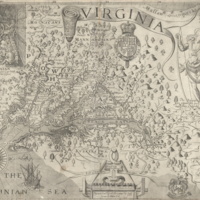
This map is attributed to Captain John Smith (1580–1631) and is one of the earliest representations of Virginia. Smith began a three-month exploration of the Chesapeake Bay and its adjacent waterways in June 1608. He interacted with Indigenous…
Sir Walter Raleigh, Portrait
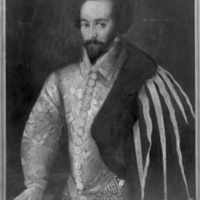
Sir Walter Raleigh (ca. 1552–1618) was an English explorer, soldier, writer, and a favorite at the court of Queen Elizabeth I, who granted him a charter to explore North America. Although he sponsored the attempts in the 1580s to colonize Roanoke…
Americae Pars, Nunc Virginia Dicta (That Part of America, Now Called Virginia) Map, 1590
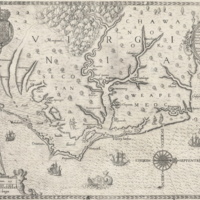
This map engraved by Theodor de Bry (1528–1598) was published in 1590 to accompany his reprint of Thomas Harriot's A Brief and True Report of the New Found Land of Virginia, which he issued in Latin, German, French, and English to ensure the book…
Typus Orbis Terrarum (Map of the World), 1607
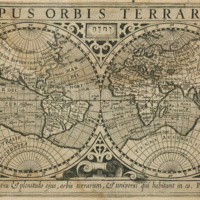
Gerardus Mercator (1512–1594) was born in Flanders, now known as Belgium. The son of a shoemaker, he graduated in 1532 from the University of Louvain, where he studied astronomy, geography, and mathematics. Afterwards he worked as a calligrapher,…