
Browse Items (235 total)
Act for Establishing Religious Freedom, January 16, 1786

When the first English settlers arrived in 1607, the Church of England served as the official church of the Virginia Colony. Under the 1689 English Act of Toleration, Protestants who were not members of the Church of England were still required to…
The Bill of Rights to the U.S. Constitution, December 15, 1791

The struggle for the ratification of the United States Constitution convinced some political leaders that amendments were needed to protect individual liberties from the strengthened national government created by the Constitution. During the First…
Portrait of James Madison

James Madison (1751–1836) was one of the most influential and successful Virginians of the Revolutionary generation. His service in the House of Delegates and in the Continental Congress taught him to be a pragmatic politician, something that served…
The Virginia Declaration of Rights (George Mason's 1778 Draft)
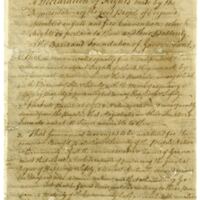
Virginia's Fifth Revolutionary Convention met at the Capitol in Williamsburg from May 6 to July 5, 1776, and declared independence from Great Britain. The delegates also voted to prepare a constitution for Virginia as well as a statement of rights.…
Female Charitable Society of Portsmouth, Virginia, Broadside, 1804

During the 19th century, local and state governments provided few social programs and women's benevolent activities provided food, shelter, education, and alms for the poor. Often, wealthy white women established charitable or religious-based…
A Petition on Behalf of an Enslaved Person Accused of Treason, 1781

By 1775 more than half a million Black Americans, most of them enslaved, were living in the thirteen colonies. Thousands participated in the American Revolution. They often gave their loyalty to the side which offered the best path to freedom from…
Monument Listing Names of the Members of the First General Assembly
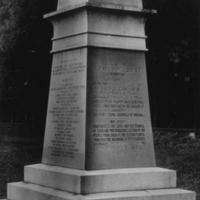
The first representative assembly in English North America met in the church at Jamestown on July 30, 1619. Following instructions from the Virginia Company of London, the governor was empowered to call a general assembly to handle public matters…
Final Meeting of the House of Burgesses, 1776

Virginia's General Assembly first met in July–August 1619. At that time twenty-two burgesses representing eleven settlements assembled in Jamestown with the royal governor and his councilors, or advisors. They approved legislation related to tobacco…
Parade Celebrating the Anniversary of the Emancipation Proclamation in Hampton Roads, 1944

The Emancipation Proclamation, issued by President Abraham Lincoln on January 1, 1863, declared freedom to enslaved people within states that were in rebellion against the United States. All enslaved people in areas of Virginia that were not…
Bacon's Rebellion, Grievances, 1676–1677
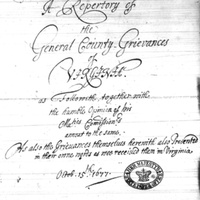
In late seventeenth-century Virginia, the wealth gap grew as wealthy plantation owners amassed land and consolidated political power while the middle and lower classes found themselves with few opportunities for advancement. The political power in…