
Browse Items (224 total)
Virginia Health Bulletin: The New Virginia Law To Preserve Racial Integrity, March 1924
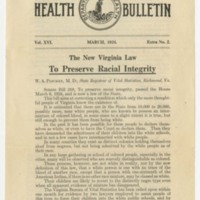
In 1924, Virginia's General Assembly passed the Racial Integrity Act, which was designed to stop the “intermixture” of white and Black people. The act banned interracial marriage by requiring marriage applicants to identify their race as "white,"…
Home Rule and Local Self Government During Prohibition, 1914
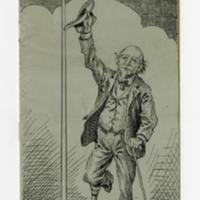
After the Civil War, the temperance movement swept the nation. Starting with Maine in 1851, states and localities around the country held referendums to let its citizens vote on whether or not to ban alcohol. In 1886, Virginia adopted the “Local…
"The Bottle," Illustrated Panels, George Cruikshank, 1848
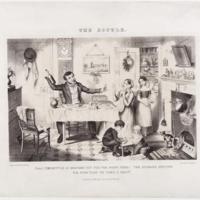
The temperance movement, or the movement to make alcohol consumption illegal, became widespread in nineteenth-century America. Since the European settlement of North America, alcohol consumption had been common. By the 1830s, Americans consumed an…
Letter from Ainslee B. and Alvin R.L. Dohme, Front Royal, 1959
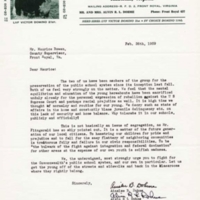
After the United States Supreme Court ruled in 1954 that school segregation was unconstitutional in the landmark case Brown v. Board of Education, Virginia's white political leaders at the state and local levels led a Massive Resistance movement,…
Governor Stanley's Address to Virginians after the Supreme Court’s Brown v. Board of Education Decision, May 17, 1954

On May 17, 1954, after nearly two decades of legal challenges against racial segregation in public schools and higher education, the United States Supreme Court ruled in Brown v. Board of Education of Topeka, Kansas that school segregation was…
Interposition and Massive Resistance, 1955
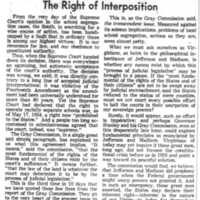
When the United States Supreme Court issued its ruling on May 17, 1954, in Brown v. Board of Education of Topeka, Kansas, it declared that racial segregation in schools was unconstitutional. The ruling overturned the “separate but equal” doctrine…
Robert Kennedy, Visit to Prince Edward County Schools, May 11, 1964
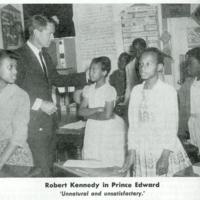
On May 17, 1954, after nearly two decades of legal challenges against racial segregation in public schools and higher education, the United States Supreme Court ruled in Brown v. Board of Education of Topeka that school segregation was…
Pamunkey Schoolhouse Photograph, May 31, 1937
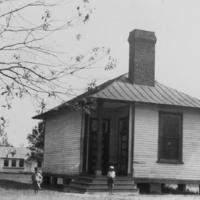
Indigenous peoples, including Virginia Indian tribes, were not considered American citizens even after ratification of the Fourteenth Amendment. Between 1880 and 1920, many tribes established their own schools, as Black citizens did, likely for…
J. Lindsay Almond School Integration Speech, January 20, 1959
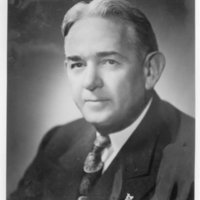
On May 17, 1954, after nearly two decades of legal challenges against racial segregation in public schools and higher education, the United States Supreme Court ruled in Brown v. Board of Education of Topeka, Kansas that school segregation was…
Letter from Baptist Ministers Conference to Governor James Lindsay Almond, January 19, 1960
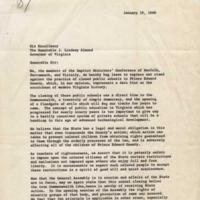
On May 17, 1954, after nearly two decades of legal challenges against racial segregation in public schools and higher education, the United States Supreme Court ruled in Brown v. Board of Education of Topeka that school segregation was…