
Browse Items (224 total)
Molly Pitcher at the 1778 Battle of Monmouth, Engraving (1859)
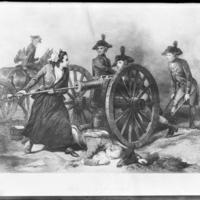
Women served in many capacities during the American Revolution. Thousands of women traveled with their husbands when they served in the Continental Army. Known as "camp followers," they marched with the supply wagons, set up camps nearby. These women…
Monacan Education and the Pupil Placement Board, Amherst County, 1963
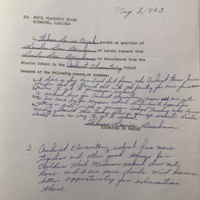
After the U.S. Supreme Court ruled in Brown v. Board of Education (1954) that racial segregation in public schools was unconstitutional, Virginia resisted desegregating its schools for years. One tactic was the creation of a state Pupil Placement…
Monument Listing Names of the Members of the First General Assembly
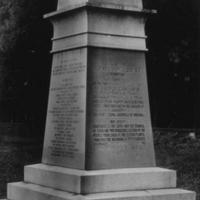
The first representative assembly in English North America met in the church at Jamestown on July 30, 1619. Following instructions from the Virginia Company of London, the governor was empowered to call a general assembly to handle public matters…
Nova Britannia Title Page, 1609

By the seventeenth century, England was becoming a leader in the intercontinental trade of goods. Wealthy merchants created joint-stock companies which promoted exploration and increased trade routes. Investors in these companies pooled their…
Old City Hall, Glass Plate Negative, Richmond, 1931
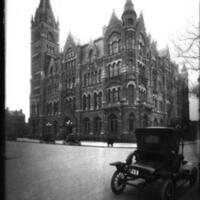
Richmond's former city hall building, known as Old City Hall, is located on Broad Steet with one side facing Capitol Square and another facing the current city hall building. The building stands out as a remnant of the Gothic Revival style popular…
Opening of the Skyline Drive, Photograph, 1934
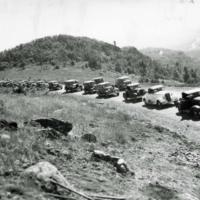
Skyline Drive is the main road that traverses the length of Shenandoah National Park. Shenandoah National Park was created in 1926 to preserve the beauty of the Blue Ridge Mountains for recreational use and for future generations. The creation of…
Painting of Pocahontas, copy by W. L. Sheppard
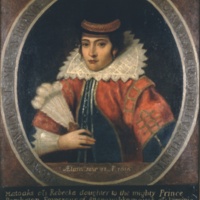
Pocahontas was the daughter of Powhatan, the powerful paramount chief of the Algonquin Indians in eastern Virginia, which the Indigenous Virginians called Tsenacomoco. She was about eleven years old when the English colonists arrived in 1607.…
Pamunkey Employment, Petition, 1711
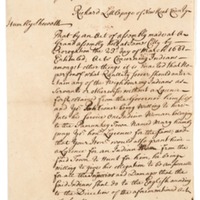
Relations between Virgina's Indigenous peoples and the colonists who wanted to settle on their land were often contentious and violent. Virginia's colonial government passed multiple laws in the 17th century to regulate the actions of settlers and…
Pamunkey Indian Tribe, Counter Petition, 1843
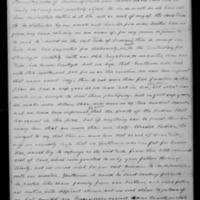
After a public notice appeared in a Richmond newspaper in October 1842 that a petition would be presented to the Virginia General Assembly to sell King William County property known as "Indian town lands," members of the Pamunkey tribe took action.…
Pamunkey Schoolhouse Photograph, May 31, 1937
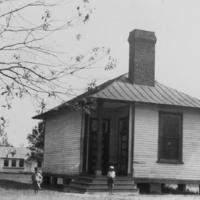
Indigenous peoples, including Virginia Indian tribes, were not considered American citizens even after ratification of the Fourteenth Amendment. Between 1880 and 1920, many tribes established their own schools, as Black citizens did, likely for…