
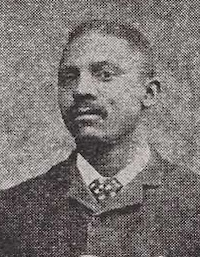
 William Horace Ash (15 May 1859–14 February 1908), educator and member of the House of Delegates, was born into slavery in Loudoun County, the son of William H. Ash and Martha A. Ash. In 1880, calling himself Horace Ash, of Leesburg, he entered Hampton Normal and Agricultural Institute (later Hampton University). He had already attended a school operated by a Mrs. Martha C. Reed under the auspices of the Pennsylvania Abolition Society. He graduated from Hampton in 1882.
Ash taught for one term in Southampton County before moving to Nottoway County to teach at Ingleside Seminary at Burkeville, a school for African American girls supported by the United Presbyterian Church in the U.S.A. (later Presbyterian Church, U.S.A.). He was a successful teacher and regularly petitioned friends at Hampton for donations of reading matter and other classroom materials. At a summer institute at Farmville in 1884, Ash participated in founding the Teachers Reading Circle, the first statewide organization of African American educators, and he was elected president of the short-lived group.
By then Ash was involved in politics. Interested in the local Republican Party from the time of his arrival in Nottoway, he served as a county delegate to the state party convention in 1884. Three years later the party nominated him for the House of Delegates from the district comprising Amelia and Nottoway Counties. The Democrats offered only token opposition, but divisions within the Republican Party forced him to act cautiously, for Ash supported the party's powerful leader, William Mahone, who had alienated many other Republicans. In the senatorial district that included Amelia County, Samuel P. Bolling, of Cumberland County, ran as an independent candidate against Nathaniel Matthew Griggs, a Mahonite. Ash explained to Mahone that he had refrained from campaigning in Amelia in order to avoid publicizing his support for Griggs and thereby possibly losing votes. His caution proved excessive, for he carried both counties by wide margins.
In the legislature Ash voted with the Republican minority and served on the standing Committees on Propositions and Grievances and on Printing. He remained concerned with education, proposing an investigation of student complaints at Virginia Normal and Collegiate Institute (which became Virginia Normal and Industrial Institute in 1902 and Virginia State University in 1979), in Ettrick, near Petersburg, and introducing an unsuccessful bill concerning appointments of teachers in the public schools. He also began to study law and later identified himself as a lawyer, although he is not known to have practiced.
Meanwhile, Ash's political career came to a sudden end. In 1888 John Mercer Langston ran against Mahone's handpicked candidate for Congress. Ash warned Mahone of Langston's popularity in his district but stood by his leader. After the bitter election, another Black Republican, Henry Johnson, of Amelia County, replaced him in the General Assembly. Ash returned to teaching.
On 29 May 1889 Ash married Sallie B. Miller, a native of Nottoway County and a fellow teacher. They had no children. In 1891 they moved to Leesburg in Ash's native Loudoun County and taught there, although he owned twenty acres of land in Nottoway County. They had returned to Nottoway by the beginning of 1904, when Ash tried to purchase a defunct school for young white women. He intended to turn it into a school for African American boys, modeled after Ingleside Seminary. That venture fell through, and in September 1904 Ash accepted a post at Swift Memorial Institute in Rogersville, Tennessee, where he taught nine classes ranging from Latin to beekeeping.
In 1907 Ash accepted an offer to teach agriculture and oversee the farm at the Virginia Normal and Industrial Institute in Ettrick. On 14 February 1908, after six days of illness, William Horace Ash died at the college from kidney failure. Funeral services took place at his home in Burkeville.
Sources Consulted: Feature article in Petersburg Lancet, 23 Aug. 1884; Hampton Agricultural and Normal Institute catalogs, 1880/1881–1881/1882; Ash's correspondence with Hampton Agricultural and Normal Institute, 23 Nov. 1885–1 Oct. 1907, alumnus file, Hampton; Twenty-Two Years' Work of the Hampton Normal and Agricultural Institute (1893), 180; Luther Porter Jackson, Negro Office-Holders in Virginia, 1865–1895 (1945), 1 (frontispiece portrait); Virginia General Assembly, House of Delegates, Journal of the House of Delegates of the Commonwealth of Virginia, 1887–1888 sess., 56, 58, 103, 337; nine letters from Ash to William Mahone, 31 Oct. 1887–22 Oct. 1888, William Mahone Papers, David M. Rubenstein Rare Book and Manuscript Library, Duke University, Durham, N.C.; Marriage Register, Nottoway Co., Bureau of Vital Statistics, Commonwealth of Virginia Department of Health, Record Group 36, Library of Virginia; obituaries in Petersburg Daily Index-Appeal, 15 Feb. 1908, and Virginia Normal and Industrial Institute, V. N. & I. I. Gazette 14 (Apr. 1908): 3.
Photograph in Jackson, Negro Office-Holders in Virginia, 1865–1895 (1945).