
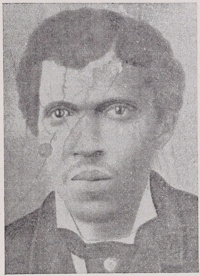
 Edward David Bland (October 1848–13 February 1927), member of the House of Delegates, was the son of Frederick Bland and Nancy Yates Bland. He was born into slavery, probably in Dinwiddie County. After the Civil War the family resided in Petersburg, where his father was a shoemaker and a preacher, although apparently never the pastor of his own church. Bland learned the shoemaker's trade working with his father and probably also attended one of the local night schools organized by northerners for Blacks. On 18 December 1872 he married Nancy Jones, of Petersburg. Their nine children included two sons and four daughters who survived him.
About 1874 Bland and his wife moved to City Point in Prince George County, where he worked as a shoemaker. Using oratorical skills, Bland became involved in local politics. During the 1870s the issue of how to deal with Virginia's huge public debt divided the Democratic Party into Funders, who insisted that the debt be paid in full, and Readjusters, led by William Mahone. Bland was one of those African American Republicans who advocated an alliance with the white Readjusters. On 3 October 1879 a mass meeting of Black Republicans in Petersburg divided on that question, and those favoring the Readjusters withdrew to hold their own meeting, at which Bland delivered one of the speeches.
The Readjusters in Prince George organized on 9 October without naming their own candidate to represent Prince George and Surry Counties in the House of Delegates. Instead, they threw their support to Bland, the Republican candidate. Meanwhile the Funders unsuccessfully tried to nominate several men before Robert E. Bland, the white incumbent, finally agreed to run less than a week before the election.
On 17 October 1879 E. D. Bland joined Mahone and others on the speaker's platform at a Readjuster barbecue in Prince George County. Three days later county Republicans, disgruntled by Bland's Readjuster apostasy, called for his removal as the party's nominee. Bland marshaled his supporters for the meeting that ensued at the courthouse on 29 October. Amid so much confusion and crowding that a voice vote could not be taken, everyone went outside to line up for or against Bland. So many men went to his side that his opponents did not bother to form ranks.
Bland and the other ten African American Republicans elected to the House of Delegates in 1879 held the balance of power between the Funders and Readjusters. Their votes gave the Readjusters control of the legislature and sent Mahone to the United States Senate, but the coalition remained shaky. White Readjusters failed to back measures that the blacks introduced, and they, in turn, remained loyal to the national Republican Party. Bland served on the Committees on Executive Expenditures and on Schools and Colleges.
In 1880 Bland was a delegate to the Republican Party's state and national conventions and supported the party's national candidates rather than Mahone's slate of uncommitted electors. Needing votes from Blacks to carry the next year's legislative elections, Mahone promised federal patronage positions and support for legislation in return for a coalition. Bland was one of the leaders who met on 14 March 1881 in Petersburg to endorse the Readjusters, and he easily won reelection in November. He served on the Committees on Agriculture and Mining, on Claims, and on Retrenchment and Economy. During the session of 1881–1882 Blacks obtained legislation creating a state-supported college and an insane asylum for African Americans as well as improved funding for their public schools. Conservatives responded in 1883 with a blatant white supremacy campaign through which they regained control of the General Assembly, although Bland won reelection for a third term. He was appointed to the influential Committee on Propositions and Grievances and the less consequential Committees on Enrolled Bills and on Officers and Offices at the Capitol. Bland also benefited from Mahone's control of federal patronage in Virginia and worked for a time as a gauger, assessing the tax on whiskey and other goods, for the Internal Revenue Service at City Point.
Bland stepped down after the regular legislative session of 1883–1884. Surry County Republicans made known their desire to have one of their own as the party's next nominee, and he accordingly gave way to William Faulcon. Bland did not retire from politics, however. On 30 September 1885 he complained to William Mahone about the inaction of Republicans in a neighboring district, contrasting it with his own well-organized district, in which he spoke somewhere every night. Bland contemplated another run for the legislature in 1887. On September 6 of that year he requested Mahone's support but promised to step aside if Mahone preferred another man. Goodman Brown, of Surry County, became the party's successful candidate that year. Possibly disenchanted by this snub, Bland supported John Mercer Langston against Mahone's candidate in the 1888 congressional election. By then white Democrats were intent on eliminating Blacks from Virginia politics, a process that culminated in the disfranchisement measures of the Constitution of 1902.
Edward David Bland continued to live in Prince George County and moved from City Point to a farm about the turn of the century. He suffered from chronic nephritis during his last years and died on 13 February 1927. Because the local church had recently burned, his large funeral took place at Gillfield Baptist Church in Petersburg, and he was buried at Providence Cemetery, since renamed People's Memorial Cemetery, in that city. A housing project in Hopewell, opened in December 1954, was named the Edward D. Bland Courts in his memory.
Sources Consulted: Luther Porter Jackson, Negro Office-Holders in Virginia, 1865–1895 (1945), vi (portrait), 3; United States Census Schedules, Dinwiddie Co. (1870), Prince George Co., 1880, 1900 (which gives month and year of birth), 1910, Records of the Bureau of the Census, Record Group 29, National Archives and Records Administration, Washington, D.C.; Marriage Register (with birth place of Dinwiddie Co.), Petersburg, Bureau of Vital Statistics (BVS), Commonwealth of Virginia Department of Health, Record Group 36, Library of Virginia (LVA); Personal Property Tax Returns, Prince George Co., Auditor of Public Accounts, Record Group 48, LVA; Bland letters in William Mahone Papers, David M. Rubenstein Rare Book and Manuscript Library, Duke University, Durham, N.C.; political career reported in Richmond Whig, 1870s–1880s; James T. Moore, "Black Militancy in Readjuster Virginia," Journal of Southern History 41 (1975): 167–186; BVS Death Register (with birth place of Nottoway Co), Prince George Co.; obituary and report of funeral in Petersburg Progress-Index, 14 Feb., 17 Feb. 1927.
Photograph in Jackson, Negro Office-Holders in Virginia, 1865–1895 (1945).