
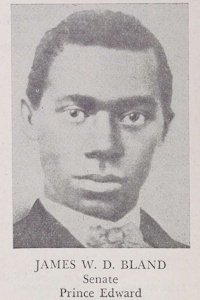
 James William D. Bland (27 February 1844–27 April 1870), member of the Convention of 1867–1868 and member of the Senate of Virginia, was born in Prince Edward County, the son of Hercules Bland and Mary Bland. Bland's father was a free man and a cooper who purchased his wife to ensure their children's freedom. Bland was taught to read and write by an enslaved worker in the household of his mother's former owner. He worked with his father as a cooper and carpenter until 1864, when he entered an American Missionary Association school in Norfolk. For two years he studied there and also taught reading, geography, and arithmetic. Although the school refused to license Bland to teach because of alleged smoking and profanity, he was permitted to continue as a substitute.
Bland returned to Prince Edward County and on 21 November 1867, married Mary E. Clarke. A few weeks earlier, on 22 October 1867, Bland and a white former United States Army officer, Edgar Allan, had been elected to represent Appomattox and Prince Edward Counties at a state constitutional convention that met from 3 December 1867 to 17 April 1868. Both men won overwhelming support from African Americans, who were voting for the first time, and they each received the support of only one white voter. Considered one of the convention's most intelligent Black members, Bland served on three of the major standing committees: the Elective Franchise and Qualifications for Office, Revision and Adjustment, and Rules and Regulations. He recommended amending the preamble to the constitution by replacing "men" with "mankind, irrespective of race or color." Other Black delegates opposed the suggestion because they preferred to keep any references to color or race out of the constitution. Bland voted with the Radical reformers on most major issues that came before the convention. In an attempt at racial conciliation, however, while defending the new constitutional provisions granting full political rights to Blacks, he denounced other sections requiring test oaths of former Confederates and denying some of them the right to vote and hold public office. Both white and African American Republicans objected to Bland's comments. Even so, he was vindicated to some extent in 1869 when state voters rejected the provisions of the constitution that disfranchised former Confederates and when Virginia's senators and representatives won admission to Congress a year later despite this defeat of the disfranchisement provision.
Bland attended every state Republican convention held in 1867, 1868, and 1869. He was appointed assistant assessor of internal revenue for Charlotte and Appomattox Counties in May 1869, and later that year he won election to the Senate of Virginia from the district consisting of Charlotte and Prince Edward Counties. Taking his seat in October 1869, Bland served on the Committee for Courts of Justice. He supported public education as the state's highest priority and sponsored one major bill that passed a month after his death. The measure incorporated Hampton Normal and Agricultural Institute, enabling it to receive federal land-grant funding. Tall, graceful, and modest in demeanor, Bland was popular among his constituents and with the press. Respected by both races as a conscientious legislator, he was a voice of compromise and impartiality in an age of turmoil and partisanship. Political supporters and allies characterized him as an orator of extraordinary ability, and he made a strong impression when he met with members of Congress on the readmission of Virginia to the Union. Detractors accused him of emulating the speech, attire, and mannerisms of the Senate president. In the spring of 1870 Bland may have switched, or contemplated switching, from the Republican to the Democratic Party.
On 27 April 1870 Bland was in a large crowd attending a morning session of the Supreme Court of Appeals in the State Capitol during the appeal of a case concerning Richmond's contested mayoral election. Shortly after eleven o'clock the floor collapsed, killing James William D. Bland and about sixty other people. The Senate passed resolutions in his memory, and the General Assembly appropriated $52 for funeral expenses. Bland was buried in Farmville, where two hundred mourners attended his interment.
Sources Consulted: Luther Porter Jackson, Negro Office-Holders in Virginia, 1865–1895 (1945), 3–4, 60 (portrait); birth date in Bland to George Whipple, 16 May 1865, American Missionary Association Papers, Amistad Research Center, Tulane University, New Orleans; Prince Edward Co. Marriage Register; Bland letter, 15 Mar. 1868, in Elihu Washburne Papers, Library of Congress, Washington, D.C.; Robert C. Morris, Reading, 'Riting, and Reconstruction (1981), 99; Richard Lowe, Republicans and Reconstruction in Virginia, 1856–70 (1991), 78, 133, 135, 137, 215, 224; Secretary of the Commonwealth, Election Records, 1776–1941, no. 427, State Government Records Collection, Record Group 13, Library of Virginia; Richard L. Hume, "The Membership of the Virginia Constitutional Convention of 1867–1868: A Study of the Beginnings of Congressional Reconstruction in the Upper South," Virginia Magazine of History and Biography 86 (1978): 461–484, esp. 481; Debates and Proceedings of the Constitutional Convention of the State of Virginia (1868), 1:250 (quotation); extended references to Bland's politics in Richmond Whig, 20 Oct. 1869, 7 Jan., 29 Apr. 1870, Washington New Era, 3 Mar., 21 Apr. 1870, and New Orleans Louisianian, 24 Sept. 1871; A Full Account of the Great Calamity, Which Occurred in the Capitol at Richmond, Virginia, April 27, 1870 (1870), 47; obituaries in Washington New Era, 12 May, 2 June 1870; funeral reported in Richmond Daily Dispatch, 2 May 1870; Senate memorial resolution and eulogies in Petersburg Daily Index, 3, 4 May 1870.
Photograph in Jackson, Negro Office-Holders in Virginia, 1865–1895 (1945), 60.