
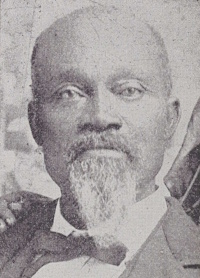
 William Henry Brisby (August 1836–16 November 1916), member of the House of Delegates, was born in New Kent County to Roger Lewis, a free African American, and Marinda Brisby, who was of Pamunkey Indian origins. Lewis was much older than Marinda Brisby and died before March 1838. She returned to her family, who had not approved of Lewis, and the boy took his mother's name. Little else is known of his early life. He had a brother and probably sisters; a nephew and a niece lived with him at one time.
Brisby may have inherited land from his father in New Kent County. Ambitious and industrious, Brisby soon established himself in that free Black community. He worked on the construction of the Richmond and York River Railroad and used his wages to purchase a set of blacksmith's tools. With a partner, Brisby set up a blacksmith shop at Talleysville in 1859. The following year he bought his partner's tools and on 29 January 1860 purchased the lot where his shop was located. One year later he acquired thirty-two acres of land nearby.
The advance toward Richmond of the Union army during the Peninsula campaign of spring 1862 brought war to New Kent County. Free people of color were being forced to work on Confederate fortifications near Yorktown. To avoid impressment Brisby served for several months as a blacksmith for a troop of Confederate cavalry stationed in the county. He traveled with the cavalry but at least could still oversee his farm and smithy.
On his own again in 1863, Brisby expanded his enterprises in April by purchasing for $900 in inflated state currency a large net for catching fish, which he salted and packed in barrels. He often traveled to Richmond to sell fish and crops and to buy iron and other goods. His cargo on the return trips sometimes included fugitive enslaved workers and escaped Union prisoners. Confederate authorities twice imprisoned him for short periods at Castle Thunder on suspicion of aiding the enemy. When Union troops under Major General Philip H. Sheridan commandeered his property in May 1864, Brisby showed Sheridan a testimonial by three Union officers whom he had helped escape, and Sheridan ordered Brisby's three cows returned to him.
Brisby later testified that the slave regime's withholding of education made him a Unionist, and as late as 1860 he signed with his mark. Somehow, though, Brisby learned to read and write. The 1863 note for the fishing net bears his own signature. Thereafter he continued to study and obtained books, and he took a special interest in the law.
In April 1867 Brisby was one of three delegates from New Kent County who attended the Union Republican State Convention in Richmond. After a constitutional convention organized a new state government, Republicans in New Kent County nominated him for the House of Delegates in 1869. Brisby won the election by just nineteen votes and was assigned to the Committee on Officers and Offices at the Capitol. During his two-year term in the General Assembly he voted with the Republican minority and was a leader among the African American delegates who condemned the erratic behavior of William H. Andrews, a Black Republican delegate from Surry County. When the assembly approved legislation in 1870 creating the state's public school system, Brisby opposed the requirement that schools be racially segregated and joined most of the other African American delegates in voting against the school bill as their only means of protesting the imposition of racial discrimination. Near the end of the final session, on 28 March 1871 he voted with the majority for a bill to pay the public debt left over from before the Civil War, which subsequently led to budget deficits, reduced funding for public schools, and political turmoil.
On 11 September 1871 county Republicans nominated Brisby for a second term. Newton M. Brooks, a former agent of the Freedmen's Bureau in New Kent, had sought the nomination for himself and afterward asked Brisby to withdraw. When he refused, Brooks threatened to run against him. Fearing that the presence of a third candidate would give the election to the Conservatives, Brisby called for a second convention at which his African American friend and neighbor William Henry Patterson received the nomination and went on to win the election.
When Brisby petitioned the Southern Claims Commission in 1873 for payment for property that Sheridan's soldiers had taken in 1864, Brooks exacted his revenge. At his instigation, several men testified about Brisby's Confederate service as a blacksmith. Their testimony forced Brisby to submit additional evidence and delayed payment of his claim until 1878.
On 4 November 1869 Brisby married nineteen-year-old Ann Rebecca Cumber, daughter of a long-resident free family. Of as many as twelve children, six sons and two daughters survived. Brisby remained active in local politics. During the 1876 election campaign the Republican Congressional Executive Committee named him a district canvasser for the Second Congressional District. He was a delegate to the February 1879 organizing meeting of the Readjuster Party, a short-lived biracial coalition that sought to refinance the state's public debt to increase revenue for the public schools. Brisby served from 1871 until at least 1881 on the county board of supervisors and served as a justice of the peace until at least 1896 and possibly into the first decade of the twentieth century.
In 1885 Brisby and his brother, Matthew Brisby, went into debt to buy a steam sawmill, which they moved to his 129-acre property. The sawmill proved unprofitable, and his brother died before 1891, leaving Brisby responsible for all that they owed. He fell further into debt, assisted, according to family tradition, by a combination of alcohol and unscrupulous white men. Brisby began selling his property to stave off his creditors. Finally, in 1907 the county sold the last of his land at auction. A year later he sold the sawmill for $150 and, past the age of seventy, contracted to work there for the new owner.
For all of Brisby's local prominence, his life ended sadly. A strict, sometimes violent disciplinarian, he drove his sons out of the household as soon as possible. In February 1892 his wife left their home and took their youngest sons to Richmond. Brisby sought a divorce on grounds of desertion, but it was not finalized before Ann R. Brisby died suddenly on 1 August 1894. His beloved younger daughter, Nannie J. Brisby, became convinced that he had caused her death. Her alienation grew when he married Victoria Pearman Holmes, a widow, on 20 February 1901.
Sometime after 1908 Brisby began to suffer from dementia. He and his second wife moved into the Henrico County home of his unforgiving younger daughter. In July 1916 his physical condition worsened, and he was committed to Central State Hospital near Petersburg. William Henry Brisby died there of kidney failure on 16 November 1916. His death certificate indicated burial at Central State, but he was most likely buried at Richmond's Evergreen Cemetery, where his gravestone is located.
Sources Consulted: Biography in Luther Porter Jackson, Negro Office-Holders in Virginia, 1865–1895 (1945), 6, 82 (portrait); Helen Jackson Lee (a granddaughter), Nigger in the Window (1978), 40–43; additional information provided by Helen Jackson Lee, as well as Sue Harwell, Renata Jackson, and Helen C. Rountree; birth date in United States Census Schedules, New Kent Co., 1900, Records of the Bureau of the Census, Record Group 29, National Archives and Records Administration (NARA), Washington, D.C.; first and second marriage dates in Marriage Registers (1869, 1901), New Kent Co., Bureau of Vital Statistics (BVS), Commonwealth of Virginia Department of Health, Record Group 36, Library of Virginia (LVA); divorce suit (with variant first marriage date of 8 Nov. 1869) in William Henry Brisby v. Ann Rebecca Brisby, New Kent County Chancery Cause, 1894-002; Personal Property Tax Returns, New Kent Co., 1863, Auditor of Public Accounts, Record Group 48, State Government Records Collection, LVA; New Kent Co. Deed Book, 1:112, 4:83, 125, 137–138, 272, 5:29, 337–338, 340, 6:560–561, 7:283, 8:131, 10:241–242, 11:52, 356–357; William H. Brisby Claim No. 19,204, Southern Claims Commission Approved Claims: Virginia, 1871–1880, Records of the Accounting Officers of the Department of the Treasury, Record Group 217, NARA; Organization, Resolutions and Address of the Union Republican State Convention of Virginia, held at Richmond, April 17, 1867 (1867), 2; General Orders and Circulars, Headquarters First Military District, 1869 (1870), "Summary of the result of the election for members of the House of Delegates of Virginia, held on the 6th day of July, 1869," 23; Journal of the House of Delegates of the State of Virginia, 1869–1870 sess., 54, 106, 211, 395, 607, 615, 1870–1871 sess., 387; Richmond Daily Dispatch, 21 Feb., 26 Feb. 1879; Richmond Daily Whig, 27 Feb. 1879; some business activities documented in William H. Brisby v. J. B. Vaiden Etc., New Kent County Chancery Cause, 1901-001 and in Executor of Elijah Ball v. William H. Brisby Etc., New Kent County Chancery Cause, 1910-006; BVS Death Certificate Dinwiddie Co. (place of burial indicated as Central State Hospital, but burial not confirmed in cemetery records); gravestone commission in J. Henry Brown Monuments Inc., Order Book, 1915-1917, Acc. 23985, LVA (the stone has been uncovered at Evergreen Cemetery).
Photograph in Jackson, Negro Office-Holders in Virginia, 1865–1895 (1945).