
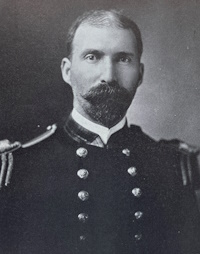
 Washington Lee Capps (31 January 1864–31 May 1935), naval officer, was born in Portsmouth and was the son of Washington Tazewell Capps and Frances Bernard Capps. At age sixteen he was appointed to the United States Naval Academy, from which he graduated third in a class of forty-six in June 1884. After spending two years at sea as a naval cadet, Capps was promoted to ensign on 1 July 1886 and sent to Scotland to study naval architecture at the University of Glasgow. Following his graduation from the university, he was appointed an assistant naval constructor on 6 June 1888 and remained in Glasgow for another year. From his return to the United States in May 1889 until January 1896 Capps served at the Department of the Navy in Washington, D.C., at a commercial shipyard in Philadelphia, at the navy yard in New York, and at the Bureau of Construction and Repair in Washington.
Appointed a naval constructor on 28 January 1895, Capps became superintendent of naval construction in San Francisco in February 1896. During the Spanish-American War he served on the staff of Commodore George Dewey and arrived in the Philippines in July 1898, more than two months after the American navy defeated the Spanish fleet in Manila Bay. Capps supervised the raising of several Spanish vessels from the bay and their repair in Hong Kong. On 5 August 1899 he was promoted to commander. Returning to Washington, D.C., Capps served on the Board of Inspection and Survey from October 1899 to March 1901 and as head of the construction department at the Brooklyn Navy Yard from March 1901 through October 1903.
On 1 November 1903 Capps was appointed chief constructor of the navy and chief of the Bureau of Construction and Repair. He was reappointed for a second four-year term in 1907. Naval construction nearly doubled while Capps was chief of the bureau. The navy enlarged and modernized the fleet and designed and built its first four dreadnoughts. Capps oversaw important developments in battleship design, including the skeleton mast and the centerline turret arrangement for heavy guns. A series of accidents on the newest battleships between 1903 and 1906 disclosed design defects, notably in the ammunition hoists inside the gun turrets. Critics of the board demanded that line officers receive more control over ship design, but Capps argued that the accidents were the result of bad decisions made by line officers already serving on the board, not of mistakes by naval architects. He disagreed with a proposal to reorganize the navy department that would have transferred powers held by staff officers to line officers. Capps resigned as chief of the bureau on 1 October 1910, at which time he received a permanent commission as chief constructor with the rank of rear admiral.
From October 1913 to February 1914 Capps represented the United States in London at the International Conference on the Safety of Life at Sea and chaired the conference's Committee on the Safety of Construction. The conference endorsed his proposal that ships be subdivided with watertight side and crosswise compartments to reduce the danger of sinking. Capps became president of the navy's Board on Hull Changes, Atlantic Coast, in September 1912, a member of the Navy Yard Commission in 1916, and president of the Naval War Claims Board in 1917.
In 1917 Capps became senior member of the Navy Compensation Board with responsibility for supervising naval shipbuilding expenditures. On 24 July of that year the president appointed him general manager of the Emergency Fleet Corporation charged with directing the merchant shipbuilding program. The following November much of Capps's authority was transferred to the president of the corporation, who was also chair of the shipping board. Citing health reasons but also perhaps because he disapproved of the changes, Capps resigned as general manager effective 3 December 1917. He received the Navy Distinguished Service Medal for his service on the Compensation Board, the General Munitions Board, and the Emergency Fleet Corporation during World War I.
Capps continued to sit on the Board on Hull Changes, the Naval War Claims Board, and the Navy Commission until his death, although he was officially transferred to the retired list on 31 January 1928. A founding member of the Society of Naval Architects and Marine Engineers, he was its secretary from 1893 to 1895 and again from 1901 to 1903 and president from 1919 to 1921. On 28 December 1911 Capps married Edna Ward, an admiral's daughter, in Roslyn, New York. They had no children. Washington Lee Capps died at his home in Washington, D.C., on 31 May 1935 and was buried in Arlington National Cemetery. In his honor the troop transport USS Admiral W. L. Capps was commissioned in September 1944.
Sources Consulted: Biographies in National Cyclopædia of American Biography, C:54–55 (portrait), Philip Alexander Bruce, Lyon Gardiner Tyler, and Richard L. Morton, History of Virginia (1924), 4:444–445, and William B. Cogar, ed., Dictionary of Admirals of the U.S. Navy (1991), 2:41; birth and death dates in Register of the Commissioned and Warrant Officers of the United States Navy and Marine Corps, January 1, 1912 (1912), 98–99, and July 1, 1935 (1935), 508, respectively; some Capps documents, including student notebook and exercise book, in Bernard Family Papers, and unidentified clippings in scrapbook in Couper Family Papers, both Virginia Museum of History and Culture, Richmond; Capps correspondence in Arthur S. Link et al., eds., The Papers of Woodrow Wilson (1966–1994), 43:260, 270, 271, 45:103, 117; works include Statements of Rear-Admiral Charles W. Rae, Chief of Bureau of Steam Engineering, and Rear-Admiral Washington Lee Capps, Chief of Bureau of Construction and Repair, … Mar. 1, 1906, 59th Cong., 1st sess., 1906, House Committee on Naval Affairs, serial 113, Report Concerning Certain Alleged Defects in Vessels of Navy, 60th Cong., 1st sess., 1908, Senate Committee on Naval Affairs Doc. 297, serial 5265, and Statement of Washington Lee Capps, Chief Constructor and Rear-Admiral …, 60th Cong., 2d sess., 1909, House Committee on Naval Affairs, serial 8; New York Times, 12 July 1910, 29 Dec. 1911, 20 Jan. 1914, 25 July 1917; obituaries in New York Times, Norfolk Ledger-Dispatch, Portsmouth Star, and Washington Post, all 1 June 1935, and Society of Naval Architects and Marine Engineers Transactions 43 (1935): 308–311.
Photograph in National Cyclopædia of American Biography (1930), C:54.