
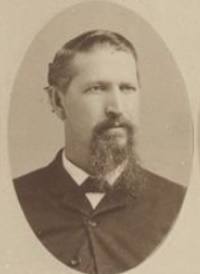
 Richard Henry Cardwell (1 August 1846–19 March 1931),Speaker of the House of Delegates and judge of the Virginia Supreme Court of Appeals, was born in Madison, Rockingham County, North Carolina, and was the son of Richard Perrin Cardwell and Elizabeth Martin Dalton Cardwell. His father died while Cardwell was still an infant, and his mother raised him and his two brothers, both of whom died fighting for the Confederacy. Cardwell attended public and private schools in North Carolina and in 1863 enlisted in the Junior Reserves of North Carolina. In May 1864 he became a private in Company F of the 1st Confederate Engineer Troops but soon required extended furloughs because of poor health. He retired from active duty and worked in the enrolling department of North Carolina until the end of the Civil War.
On 9 February 1865 Cardwell married Kate Howard, a Virginia native, in Rockingham County, North Carolina. They had four daughters and three sons, one of whom, William Duval Cardwell, also became Speaker of the House of Delegates. By 1870 Cardwell had moved to Hanover County, Virginia, where he farmed and studied law. Licensed to practice in 1874, he opened an office in Richmond while maintaining his home in Hanover County. Elected to the House of Delegates from Hanover County as a Democrat in 1881, Cardwell won reelection six times and served from 7 December 1881 until 2 March 1894. He was a member of the Committees on Courts of Justice, on Counties, Cities, and Towns, and on Immigration in his first term. In his second term he exchanged seats on the two last-named committees for a seat on the Committee on Federal Relations and Resolutions and the chair of the Committee on Propositions and Grievances. In his third term he retained the chairmanship and also served on the Committees on Officers and Offices at the Capitol, on Public Property, and on Roads and Internal Navigation.
Cardwell strongly campaigned for Democrats in the 1883 state legislative elections in which the party regained control of the General Assembly, and in 1884 he was a Democratic presidential elector. In November 1884 the General Assembly unanimously elected him a county court judge for Hanover, but he declined to serve. A widely respected public speaker and debater as well as a skilled parliamentarian, Cardwell frequently presided over his party's state conventions. In 1887 his tireless work for the Democratic Party was rewarded with his election as Speaker of the House of Delegates. He won reelection three times without opposition or with only token opposition.
From 1890 to 1892 Cardwell served on a commission charged to resolve with the state's creditors the issue of Virginia's antebellum public debt, and in 1892 he chaired a joint legislative committee formed to settle boundary disputes between Virginia and Maryland related to fishing and oyster-culling rights on the Pocomoke and Potomac Rivers. On 6 January 1894 the assembly elected him and four other Democrats to the Supreme Court of Appeals to replace the five judges that the Readjusters had elected when they controlled the legislature. Cardwell resigned as Speaker on 2 March 1894 and took his seat on the court along with the other new judges on 5 January 1895.
Membership on the court was remarkably stable and without dissension during the almost twenty-two years Cardwell sat on the bench. Three of the other four judges served for twenty of those years. The court's docket consisted largely of civil and procedural cases and a few appeals in criminal cases. Most of the court's workload concerned private, not public, law and arose from legal questions involving such matters as contracts, wills, and personal injuries. Dissents were infrequent, and Cardwell dissented in only a few cases either in brief opinions or sometimes with no published reason. His opinions for the court, like those of his fellow judges, were largely devoid of dicta or discursive commentary, relied heavily on judicial precedents, and were deferential to the state legislature. Among his more important decisions, Cardwell wrote the opinion of the court in New York, Philadelphia, and Norfolk Railroad Company v. Board of Supervisors of Northampton County (1896), holding that a county school tax on the property of a railroad company was an unconstitutional usurpation of state legislative authority. In the combined cases of Commonwealth v. Henry and Commonwealth v. Shannon (1909), Cardwell wrote the opinion of the court that upheld the constitutionality of the previous year's so-called Byrd Liquor Law. He also joined the other judges in Taylor v. Commonwealth (1903), which affirmed the validity of the Constitution of 1902 even though it had been proclaimed in effect rather than been submitted to the voters for ratification through referendum. Cardwell was president of the Supreme Court of Appeals for five months before retiring on 16 November 1916 because of serious eye trouble.
For a decade beginning in 1920 Cardwell served on the board of the Virginia Manual Labor School for Colored Boys at Hanover (later the Virginia Industrial School Board for Colored Children). His wife died on 21 January 1909, and Richard Henry Cardwell died at his home, Prospect Hill, on 19 March 1931. He was buried in Woodland Cemetery, near Ashland in Hanover County.
Sources Consulted: Biographies in R. A. Brock, Virginia and Virginians (1888), 2:773–774, National Cyclopædia of American Biography, 29:188–189, Robert C. Glass and Carter Glass Jr., Virginia Democracy (1937), 2:37–40, and Bruce F. Jamerson, ed., Speakers and Clerks of the Virginia House of Delegates, 1776–1996 (1996), 105 (portrait on 104); birth and death dates from Death Certificate, Hanover Co., Bureau of Vital Statistics, Commonwealth of Virginia Department of Health, Record Group 36, Library of Virginia; Rockingham Co., N.C., Marriage Bonds (bond dated 7 Feb. 1865); Richmond Dispatch, 28 Sept. 1892; Richmond Times-Dispatch, 25 Oct. 1916; Richmond News Leader, 6 Jan. 1932; Thomas R. Morris, The Virginia Supreme Court: An Institutional and Political Analysis (1975), 22–23, 36, Appendices B, C, and E; New York, Philadelphia, and Norfolk Railroad Company v. Board of Supervisors of Northampton County (1896), Cases Decided in the Supreme Court of Appeals of Virginia (Virginia Reports), 92:661–669; Taylor v. Commonwealth (1903), Virginia Reports, 101:829–832; Commonwealth v. Henry and Commonwealth v. Shannon (1909), Virginia Reports, 110:879–896; Virginia Law Register, new ser., 2 (1916): 619–620; obituaries and editorial tributes in Richmond News Leader, 20 Mar. 1931, and Richmond Times-Dispatch, 20 Mar. 1931; obituary and account of funeral in Ashland Herald-Progress, 26 Mar. 1931; memorial in Virginia State Bar Association Proceedings (1931), 135–139.
Photograph in House of Delegates Legislative Photograph, 1887, Extra Session, Special Collections, Library of Virginia.