
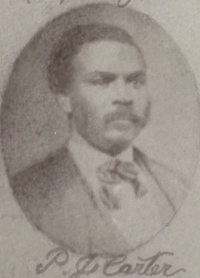
 Peter Jacob Carter (29 May 1845–19 July 1886), member of the House of Delegates, was born into slavery in the town of Eastville, in Northampton County. His parents were named Jacob and Peggie. According to family tradition, his father, whose surname was probably Carter, was the son of Pierre De Carte, a free native of West Africa, and an enslaved Virginia woman. Carter, a younger brother and sister, and their mother belonged to Calvin H. Read, a schoolteacher who may have taught Carter to read. By 1858 Read had moved to Baltimore. To repay $1,000 he had borrowed from his wife's separate estate, he deeded to her on 5 December 1860 Carter, two of his siblings, and their mother, all enumerated in the deed as residing in Northampton County.
In November 1861 Union troops occupied the Eastern Shore and held the area for the remainder of the Civil War. Carter escaped from slavery, and on 30 October 1863 in Eastville he enlisted in Company B of the 10th Regiment United States Colored Infantry. Arrested for mutiny early in February 1864 and imprisoned at Camp Hamilton, he was released on 22 May after the charges were withdrawn and then returned to duty with his regiment at Bermuda Hundred. Carter served with the quartermaster department from September through December 1865 and then on detached duty with the Bureau of Refugees, Freedmen, and Abandoned Lands from January through April 1866. He mustered out on 17 May 1866 at Galveston, Texas.
Carter settled in Franktown, in Northampton County, and from 1869 to 1871 attended the Hampton Normal and Agricultural Institute (later Hampton University). By 10 February 1873 he had married Georgianna Mapp. They had one daughter and three sons, one of whom died in childhood.
In November 1871, with votes from many of the Eastern Shore's freedpeople, Carter won election as a Republican to Northampton County's seat in the House of Delegates. His opponent unsuccessfully contested the election. Carter was appointed to the Committees of Agriculture and Mining and on Retrenchment and Economy. He won reelection three times, and his eight-year tenure was one of the longest among nineteenth-century African American members of the General Assembly. He held the same committee assignments until his last term, when he was named to the Committee on Claims and the Committee on Militia and Police. Carter introduced bills dealing with such local concerns as taxes on oysters and boundaries of election precincts, and he attempted to correct abuse of prisoners in the state penitentiary, improve care of Black deaf-mutes, and provide housing for the aged or afflicted poor in Richmond. He sought to amend antebellum laws pertaining to juries and criminal laws that discriminated between Blacks and whites. Carter's bill to incorporate the Northampton Land Association, of which several Black leaders were members, passed in March 1875.
A fine speaker and formidable presence, Carter quickly emerged as one of the leading African American members of the assembly. In 1872 he joined a delegation that met with President Ulysses S. Grant to solicit support of the civil rights bill pending in Congress. Later that year Carter attended the Republican Party national convention that renominated Grant. At the Republican State Convention that met in Lynchburg on 29 July 1873, Carter was a sergeant at arms and a vice president, and he won election to the state committee. Newspapers believed him the likely choice for a place on the state ticket, should white leaders decide to nominate an African American.
On 19 August 1875 about a hundred Black delegates from more than forty counties and cities assembled in Richmond in response to a call from African American legislators. Carter served on the Committees on Address and on Resolutions and also was sergeant at arms. He acted as temporary chair and employed his gavel frequently during intense debates over education, jobs, party organization, and other issues. He introduced a resolution calling for the replacement of the state superintendent of education, and he and another delegate nearly came to fisticuffs while arguing about the state debt. Carter was appointed to a committee on labor unions, and after the convention adjourned the committee elected him treasurer of the short-lived statewide Laboring Men's Mechanics' Union Association, with proposed headquarters in Richmond.
During Carter's eight years in the General Assembly, the most divisive political issue was payment of Virginia's antebellum debt. The Funding Act passed in March 1871 committed the state to payment of the full principal and interest, but inadequate revenue required the assembly on 15 December of that year to suspend payment temporarily. Carter voted for suspension. On 5 January 1872 he voted with the majority in support of a joint resolution to discontinue the issuance of bonds for funding the public debt. Carter joined the majority on 2 March 1872 in overriding the governor's veto and passing a bill that prohibited using coupons to pay taxes and debts, thereby repealing a key provision of the Funding Act. Many white Republicans supported full funding, but many Black Republicans, who with other whites came to be called Readjusters, opposed raising taxes for that purpose and feared that the new public school system would be endangered if money were diverted from education to debt service.
Although Carter represented an area that had not benefited from the expenditures on internal improvements that had created the state debt, he believed that Virginia should honor its full obligation. In December 1875 he voted with the assembly minority for Williams Carter Wickham, a former Confederate general and a Funder Republican, for the United States Senate. On 7 February 1878 Carter proposed raising taxes to pay off the debt. Acknowledging that the cost would be passed along to his own constituents, he declared, "In every way it is plain the working man—the Virginia negro—pays the additional tax. I belong to that toiling race. I am a poor man; but like my brethren, who will feel a higher tax keenly, I am ready to raise the rate and preserve the honor of the old Commonwealth." Two days later he was the only Republican to vote against the so-called Barbour bill that some regarded as a prelude to partial repudiation. Carter did not vote on 24 March 1879 when the assembly passed a bill to pay the debt in full but at a reduced rate of interest. As a Richmond newspaper observed, Carter was "no less a curiosity than a colored Funder and the only one of his race in Virginia who has ever voted in the Legislature for an increase of taxation to meet the indebtedness of the Commonwealth."
Carter was temporary chair of the Republican State Convention that met in Lynchburg in April 1876 and that named him a delegate to the national convention. In September of that year he attended the First Congressional District convention in Fredericksburg. Carter won reelection to the General Assembly in 1877, but before the next election Conservatives created a flotorial district consisting of Accomack and Northampton Counties in hope of defeating him. He did not seek reelection from the gerrymandered district in 1879. Instead, Carter campaigned for the seat in the Senate of Virginia representing those two counties but lost by a margin of 1,224 votes out of 2,964 cast. Even out of office, Carter remained the predominant Black leader on the Eastern Shore. He controlled the county's federal patronage and enjoyed the income from his federal job as lighthouse keeper at Cherrystone Inlet. In April 1880 he was once again elected temporary chair of the Republican State Convention, sat on its Committee on Resolutions, and in June chaired the Virginia delegation to the party's national convention.
The Readjuster leader, Senator William Mahone, formed an alliance with national Republican leaders in 1881 and received a share of the state's federal patronage. Heavily courted by Mahone, Carter left the declining Republican Party, embraced coalition with the Readjusters, and was president of a committee to reconcile mainstream and Readjuster Republicans. The Republicans failed to name a ticket for the next election, and Carter, though called a traitor and accused of taking a bribe, worked tirelessly for Readjuster candidates. In November the party captured both houses of the legislature and the governorship. As a reward, the Senate of Virginia elected Carter doorkeeper on 7 December 1881.
Carter chaired the 1882 First Congressional District Readjuster convention that nominated Robert Murphy Mayo for the House of Representatives, and he campaigned for the successful Mayo throughout the far-flung district. Stumping also for Readjusters elsewhere in Virginia, he ably debated opponents "with gloves off," as he noted in a letter to Mahone. During the 1883 campaign Carter signed a circular address to the Black voters of the state, recounting the benefits that they had received from the Readjusters. A riot in Danville days before the election helped Democrats seize control of the assembly and effectively terminated the existence of the Readjuster Party. Black leaders assembled in Norfolk in December, with Carter in the chair, to protest the deadly events in Danville and subsequently drafted a set of grievances.
Early in 1884 Carter served on the state Republican Central Committee and in April attended the Readjuster-Coalition state convention, which dropped the name Readjuster and proclaimed itself the Republican Party of Virginia. He was a member of the Committee on General Business. Carter also sat on the Committee on Business during the 1885 state Republican convention. During the ensuing campaign he reported attempts by Democrats to bribe him and to bribe and deceive other Black voters.
Carter's political importance earned him appointment to the board of the new Virginia Normal and Collegiate Institute (later Virginia State University), and at the initial meeting on 15 February 1883 the other members elected him rector. He served for about two years. When not engaged in public life, Carter farmed the 150 acres that he owned near Franktown. He also owned several other smaller parcels of land. For a time he was a merchant and also served as a justice of the peace.
On 28 November 1882 his wife died, and on 17 July 1884 Carter married Maggie F. Treherne, of Accomack County. They had a son, William M. Carter, apparently named in honor of William Mahone. After Carter's death this son changed his name to Peter J. Carter, studied medicine at Howard University, and during the 1930s was a physician at the veterans' hospital in Tuskegee, Alabama. Peter Jacob Carter became ill while traveling by steamer from Norfolk to the Eastern Shore and died on 19 July 1886, probably of appendicitis. He was buried in the family cemetery near Franktown.
Sources Consulted: Birth and death dates on gravestone in family cemetery near Franktown, Northampton County; family history information and documents, including discharge papers, copies in Dictionary of Virginia Biography Files, Library of Virginia (LVA), provided by grandson, Arthur Treherne Carter (2004); Student Record Index Card (with middle name), Hampton University Archives, Hampton, VA; 1860 sale (age fifteen on 5 Dec. 1860) in Northampton Co. Deed Book, 36:115; Compiled Service Military Records, Records of the Adjutant General's Office, Record Group 94, National Archives and Records Administration, Washington, D.C.; Marriage Register, Northampton Co. (1884), Bureau of Vital Statistics, Commonwealth of Virginia Department of Health, Record Group 36, LVA; The Debt Question: Speech of Hon. Peter J. Carter of Northampton County, in the House of Delegates, Va., February 7th, 1878 [1878], first quotation on 3; Carter letters to William Mahone (third quotation in 16 Oct. 1882) in Mahone Papers, David M. Rubenstein Rare Book and Manuscript Library, Duke University, Durham, N.C.; Luther P. Jackson, "Peter J. Carter of Northampton County, Va.," Norfolk Journal and Guide, 17 Feb. 1945; Luther Porter Jackson, Negro Office-Holders in Virginia, 1865–1895 (1945), 7, 52 (portrait); Washington New Era, 5 May 1870; Richmond Enquirer, 30, 31 July, 1 Aug. 1873; Richmond Daily Dispatch, 31 July 1873; 20 Aug. (biography), 21 Aug., 23 Aug. 1875, 17 June 1880, 14 Dec. 1883; New-York Times, 22 Aug. 1875; Lynchburg Daily Virginian, 13, 14 Apr. 1876, 11, 12 Aug. 1881; Fredericksburg News, 4 Sept. 1876; Richmond Daily Whig, 22, 23, 26 Apr. 1880; Richmond Southern Intelligencer, 26 Apr. 1880 (second quotation); Brooks Miles Barnes, "Triumph of the New South: Independent Movements in Post-Reconstruction Politics" (Ph.D. diss., University of Virginia, 1991), esp. 99–105, 125–132, 142, 166, 167, 182, 207, 208; Herbert Aptheker, ed., A Documentary History of The Negro People in the United States (1951), 1:636–637, 731–734; Northampton Co. Order Book, 47:520; Northampton Co. Will Book, 39:257–259; obituaries in Norfolk Public Ledger, 21 July 1886, Norfolk Landmark, 22 July 1886, and Accomack Court House Peninsula Enterprise, 24 July 1886 (reporting death "last Tuesday," 20 July 1886).
Photograph in Legislature of Virginia, Session 1871 and '72, Special Collections, Library of Virginia.