
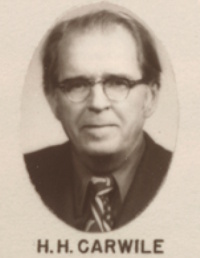
 Howard Hearnes Carwile (14 November 1911–6 June 1987), attorney and local politician, was born in Charlotte County and was the son of Willis Early Carwile and Allie Taylor Carwile, who lived on a small tobacco farm and had at least twelve children. Educated in the county's public schools, he entered the University of Virginia in 1931 but soon dropped out. Carwile spent two years at Alma White College, in Zarephath, Somerset County, New Jersey, where he washed dishes to pay his way. He completed the law course at Southeastern University, in Washington, D.C., but did not stay to receive his degree. Soon after passing the bar in Virginia late in 1938, Carwile contracted tuberculosis and spent nearly a year in the Blue Ridge Sanatorium, where he suffered a hemorrhage in one of his eyes and accused the staff of negligence and abuse. He attempted to sue the state, but the suit was dismissed under the doctrine of sovereign immunity, and he twice failed to persuade the Virginia Supreme Court of Appeals to have the suit reinstated.
Growing up poor and having to struggle for his education and livelihood, Carwile nurtured grudges against capitalists and government officials, and while in Washington he associated briefly with communists and socialists. In 1942 he was the Socialist Party candidate against the Democrat Thomas Granville Burch for the House of Representatives seat from the Fifth Congressional District running along the North Carolina border. He received less than 7 percent of the vote and two years later polled 15 percent as an unaffiliated, independent candidate for the same seat. By then Carwile had broken with the socialists and later in life was virulently derogatory about the political left.
Disqualified from military service because of his tuberculosis and poor eyesight, Carwile practiced law in Charlotte County until January 1945, when he moved to Richmond. He specialized in criminal cases and defended the poor and others whom he believed suffered injustices at the hands of state or local government officials. Carwile gained attention in Richmond shortly after his arrival when he ran as an independent candidate for governor in 1945, while also mounting a public campaign against physical abuse in the state's prison system and public health institutions. Despite receiving only 4,023 votes out of 168,783 cast in his first statewide campaign, Carwile ran for the United States Senate the following year against Harry Flood Byrd (1887–1966). Nearly every year between then and 1980 he campaigned for a seat on the city council, in the General Assembly, in Congress, or for governor.
Combative by temperament and possessing an inexhaustible and readily activated sense of righteous indignation, Carwile took his causes directly to the public in a weekly radio program that he paid for out of his own pocket for twenty-six years. He was a severe critic of Virginia's Democratic Party leadership and during the 1940s and 1950s vehemently attacked the party leaders for supporting racial segregation and for their policy of Massive Resistance to court-ordered desegregation of the public schools. In 1948 Carwile was arrested for sitting in a section reserved for African Americans at a segregated church revival, and afterward he taunted the city's white elites when he sold his house to a black family. Later he was equally disdainful of government programs intended to end or ameliorate the effects of segregation.
Carwile took on all issues that attracted his attention and pursued them with tenacious zeal. He was ejected from a legislative hearing on at least one occasion and more than once crossed verbal swords with judges and came close to being jailed for contempt of court. In style as well as by his eager opposition to the political leaders of the state, Carwile was uniquely obnoxious to Richmond's establishment, and he took pride in his conflicts with conservative politicians and judges. In 1960 he published Speaking from Byrdland, a volume of his selected radio-broadcast excoriations of Virginia politicians. Carwile's voice, famous and instantly recognizable, defied description. His speaking style was coarse and loud, colorful and rhythmical, and his voice, flexible in volume and pitch, easily adapted to the cadences of hellfire-and-brimstone preachers. His language was memorably alliterative and often personally insulting or abusive. He delighted the few who agreed with him on an issue, infuriated the others, and alternately amused and appalled nearly everybody. For decades Carwile traded colorful insults with the editors of the two daily Richmond newspapers, who never understood his motivations or his appeal. A Richmond News Leader editorial in June 1966 tried to characterize him and could do so only with comprehensive inexactitude: he was "a kind of special radical ultra-liberal lone-wolf back-handed conservative, whose public career has been built entirely upon his passionate opposition to the state."
Having repeatedly lost political campaigns, Carwile surprised nearly everybody in 1966 when he won a seat on the city council. His victory coincided with a large increase in black voting in Richmond, and he was reelected in 1968 and again in 1970, both times with more votes than any other candidate in the at-large race for nine council seats. Following his 1968 and 1970 victories, however, not one of his colleagues nominated him for mayor or even suggested that he should be considered for the office. Naturally, Carwile announced that he had expected the insult. Constant bickering with other members of the council, with local newspaper editors and reporters, and with citizens on a variety of issues kept Carwile's name in the papers and his voice in radio and television newscasts. In December 1969 the Virginia chapter of the American Civil Liberties Union presented him with its first Bill of Rights Award for his fights to protect the civil rights of African Americans, civil liberties of persons appearing in court, and freedom of speech.
In 1973 Carwile perplexed many of his former supporters by defeating the Democratic incumbent William Ferguson Reid, the first African American member of the House of Delegates in the twentieth century, for the floater seat representing Henrico County and Richmond in that body. He served on the Committees on Health, Welfare, and Institutions and on Militia and Police. Still independent of a party, he had become a rigid social and economic conservative. Carwile vigorously opposed court-ordered school busing, supported anti-abortion legislation, and fought ratification of the Equal Rights Amendment to the United States Constitution. He characteristically made few allies in the General Assembly and failed to get a single member of the House Committee on Privileges and Elections to support his bill to allow voters to elect members of local school boards. Carwile lost his 1975 reelection bid to Gerald Lee Baliles, who later served as attorney general and governor.
For several more years Carwile spoke out on public issues and announced new campaigns, but after 1980 his health deteriorated, and he receded from public view, though he continued to practice law. He had married Violet Virginia Talley, of Richmond, on 7 June 1948, and they had one son. Howard Hearnes Carwile died in a Richmond hospital on 6 June 1987 and was buried in Forest Lawn Cemetery. After Carwile's death his widow and son published a miscellaneous collection of recollections, newspaper articles, radio-broadcast transcripts, letters, and anecdotes that he had assembled during his final years.
Sources Consulted: Violet T. Carwile and Howard H. Carwile Jr., eds., Carwile, His Life and Times: An Autobiography (1988), with portraits; Richard Lee Morton, comp., Virginia Lives: The Old Dominion Who's Who (1964), 171; Anna Deihls Callahan, A History of the Callaham and Carwile Families (1976), 401; Carwile biographical file, Richmond Public Library; Howard H. Carwile Papers, including scrapbooks and audio tapes of radio broadcasts, Special Collections and Archives, James Branch Cabell Library, Virginia Commonwealth University, Richmond; feature articles in Richmond News Leader, 15 Oct. 1953, 15 (quotation), 24 June 1966, 3 June 1970, 20 Apr. 1983, Richmond Times-Dispatch, 23 Oct. 1953, 16 Dec. 1969, 2 Oct. 1977, 21 Apr. 1985, and Richmond Afro-American, 22 June 1968; obituaries in Richmond News Leader and Richmond Times-Dispatch, both 8 June 1987.
1974 House of Delegates Legislative photograph, Library of Virginia.