
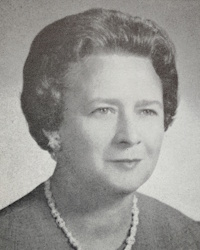
 Martha Bell Conway (24 July 1917–9 November 1997), attorney and secretary of the commonwealth, was born in Raleigh, North Carolina. When she was about six months old, her parents, Elijah James Conway and Cora Henderson Conway, moved to Richmond, where her father was manager of the city's Public Employment Bureau until his death in September 1923. The precocious Conway skipped several grades and graduated from Thomas Jefferson High School one month before her fifteenth birthday. She studied psychology at the Richmond Division of the College of William and Mary (later Virginia Commonwealth University) from 1933 until 1936, when for financial reasons she withdrew to become a secretary at a blueprint company. A business law course with the attorney David John Mays awakened in Conway the understanding that law permeated everyday life, and she enrolled in the T. C. Williams School of Law at the University of Richmond. Graduating with an LL.B. in June 1939, she passed the state bar examination in December of that year. Women lawyers were still enough of a rarity that hanging out her shingle merited a feature story in the evening newspaper. Conway later recalled, "I really didn't know I wasn't supposed to be doing all these things, so I did."
Conway practiced law privately and from 1943 until 1951 was commissioner in chancery in the Hanover County Circuit Court. In 1945 she became a registered patent attorney and the next year purchased controlling interest in the Lawyers Publishing Company, Inc. (after 1955 the Lawyers Printing Company, Inc.), which specialized in legal briefs. Conway worked from 1951 to 1955 as a real estate broker and from 1951 to 1952 as eastern district counsel for the Office of Price Stabilization.
While building her legal practice, Conway also became active in Democratic Party politics. In 1943, 1945, and 1947 she campaigned for one of Richmond's seven seats in the House of Delegates. She favored greater state support for public education, including increased pay for teachers, repeal of the poll tax as a prerequisite for voting, allowing Richmonders to determine their form of city government, forest conservation, expansion of workmen's compensation to cover occupational diseases, and passage of a boiler safety bill. Though defeated in the primary each time, Conway gained enough stature among party regulars that she was one of five women the governor named in 1947 to the Commission on Reorganization of State Government.
On 23 August 1952 Governor John Stewart Battle appointed Conway secretary of the commonwealth to replace the retiring Thelma Young Gordon. The second woman to hold the post, Conway took office on 3 September. Her responsibilities included keeping the governor's journal and the state seals, certifying extraditions, pardons, and proclamations, compiling and issuing the annual public report (popularly known as the blue book), commissioning and regulating notaries public, and registering lobbyists. Reappointed by four successive Democratic governors, Conway was for much of her eighteen-year tenure the highest-ranking and most visible woman in the state government, the only woman department head in Virginia, and in 1952 one of only six female secretaries of state in the country. She did not consider herself a feminist but in the 1970s supported passage of the Equal Rights Amendment. In a 1958 interview she stated that "I think many more women belong in public office, because the major functions of government concern health, welfare and education, and these are the fields in which women are most interested."
In 1958 the General Assembly directed Conway to compile all the interstate compacts to which Virginia was then a party. She published the work, also including the texts of several compacts no longer in effect and a discussion of compacts for which the state was eligible, under the title The Compacts of Virginia (1963). For about a decade Conway sat on the State Commission on Interstate Cooperation. In 1965 she chaired Virginia's Commission on the Status of Women and the next year issued a descriptive report and conservative recommendations. She was secretary of the National Association of Secretaries of State in 1963, treasurer in 1964, vice president in 1965, and president in 1966.
When in January 1970 Abner Linwood Holton became Virginia's first Republican governor of the twentieth century, he declined to reappoint Conway as secretary of the commonwealth. Rather than resume her law practice, on 1 April 1970, the day she left office, she became director of grants and contracts at Virginia Commonwealth University. During her eleven years as administrator, the university's annual grants and contracts increased from $6 million in 1970 to more than $25 million in 1979. In 1972 Conway was secretary-treasurer of the Southern Regional Section of the Society of Research Administrators, and in December of that year she became the first woman elected to the board of directors of the Richmond National Bank. She retired from Virginia Commonwealth University in July 1981.
Conway never married. She lived with her mother until the latter's death in 1975 and also owned a vacation house on the North Carolina coast. Her professional achievements and volunteer services led the Young Women's Christian Association of Richmond to honor her in 1980 as one of the city's outstanding women. Martha Bell Conway died in a Richmond retirement community on 9 November 1997 and was buried in Queens Creek United Methodist Church Cemetery, in Hubert, Onslow County, North Carolina. The Coastal Carolina Community College Foundation offers a memorial scholarship in her honor.
Sources Consulted: Richard Lee Morton, comp., Virginia Lives: The Old Dominion Who's Who (1964), 203–204; feature stories in Richmond News Leader, 8 Jan. 1940 (portrait), 24 Jan. 1958 (second quotation), 2 Mar. 1970, and Richmond Times-Dispatch, 31 Aug. 1980 (first quotation); Conway biographical file, Richmond Public Library; published works include Conway, "The Commonwealth's Coat-of-Arms," Virginia Journal of Education 53 (Sept. 1959): 26–27, 53, and Status of Women: Report of the Commission on the Status of Women to the Governor and the General Assembly of Virginia, published as Virginia General Assembly, House of Delegates, Journal of the House of Delegates of the Commonwealth of Virginia (1776– ), 1966 sess., House Doc. 20; Richmond Times-Dispatch, 4 Feb., 1 Aug. 1943, 7 Aug. 1945, 24 Aug. 1952, 16 Jan. 1970, 13 Dec. 1972; Richmond News Leader, 4 May 1945, 19 Mar., 3 Sept. 1952, 12 Oct. 1963, 17 Feb. 1965, 13 Feb. 1970; Peter Wallenstein, "'These New and Strange Beings': Women in the Legal Profession in Virginia, 1890–1990," Virginia Magazine of History and Biography 101 (1993): 212, 213 (portrait); obituary in Richmond Times-Dispatch, 11 Nov. 1997.
Photograph in Virginia Record 86 (July 1964): 9.