
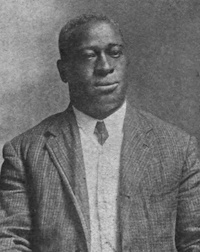
 Daniel Webster Davis (25 Mar. 1862–25 October 1913), poet and lecturer, was the son of Randall, or John, Davis and Charlotte Ann Christian Davis. He was born into slavery and in various public records gave his birthplace as Caroline County or Hanover County. Soon after the Civil War and emancipation, Davis's widowed mother moved to Richmond. He attended the city's new public schools and in 1878 graduated with honors from the Richmond Colored Normal School. He later claimed an A.M. from Guadalupe College, a Black Baptist college in Seguin, Texas, and a D.D., both probably honorary. Davis helped organize the Garrison Lyceum, a literary society, and served as its president in 1880. A member of the Acme Literary Association, he addressed this group in January 1885, after a Democrat had won the presidency, and recommended political independence to his audience.
D. Webster Davis, as he was known, began teaching at Richmond's Navy Hill School during the 1879–1880 term. Four years later he transferred to the Baker School, where he taught for the next twenty-nine years. He also participated in summer normal schools that provided continuing education for teachers. At the 1887 summer institute in Lynchburg, where he gave instruction in arithmetic and writing, Davis helped found the Virginia Teachers' Reading Circle, the first organization of African American educators in Virginia and predecessor of the Virginia State Teachers Association (later the Virginia Teachers Association). Davis married another Richmond teacher, Elizabeth Eloise Smith, on 8 September 1893. Of their six children, two sons and one daughter lived to adulthood. Ordained on 4 October 1896, he became pastor of the Second Baptist Church in Manchester (later part of Richmond). Membership grew, and the congregation erected a new building in 1906. A memorial window was later dedicated in Davis's honor.
By 1891 Davis had become editor of The Young Men's Friend, the local organ of the Young Men's Christian Association for African Americans; he also served the YMCA at various times as president and secretary. Before 1895 he edited a weekly publication, Social Drifts. His greatest ambition, however, was for his poems. Davis collected thirty-seven of them in a volume entitled Idle Moments, Containing Emancipation and Other Poems (1895). The following year Paul Laurence Dunbar's Lyrics of Lowly Life almost certainly became the first collection by a Black poet issued by a major American publishing house. Dunbar's success stirred Davis. He rearranged twenty-one of the poems from Idle Moments, shifted "Emancipation," the opening poem, deeper into the text, and added twenty-one new works, including a dialect poem that gave the collection its title, 'Weh Down Souf and Other Poems (1897). The volume, with an embossed cover depicting sunrays and orange trees, and with images by the prominent white illustrator William Ludwell Sheppard, was an obvious bid for Dunbar's audience.
The book earned condemnation from later scholars of African American literature for perpetuating contemporary racial stereotypes. James Weldon Johnson included only two of Davis's poems—both of them dialect poems, "'Weh Down Souf" and "Hog Meat"—in his celebrated anthology, The Book of American Negro Poetry (1922). Stripped of the contextualizing information in Idle Moments, Davis's 'Weh Down Souf as published does not disclose that nearly all the poems, in both dialect and standard English, were written for and performed for African Americans, not to inform white opinions about Black Virginians. Certainly Dunbar was the greater artist, but Davis never condoned slavery or white supremacy. Rather, a number of the dialect poems express the ambivalence of an educated, ambitious younger generation about the lives and thinking of their less-educated elders.
Davis appeared to endorse the accommodation philosophy of Booker Taliaferro Washington. Davis had delivered one of the new poems, "Exposition Ode," on 21 October 1895 at the Negro Building of the Cotton States and International Exposition, in Atlanta, just over a month after Washington famously opened the exposition with a speech that seemed to abjure protest. Davis's ode echoed Washington's catch phrase from his "Atlanta Compromise" speech: "let our buckets down in places where we are." But Davis's advocacy of Black voting and higher education placed him midway between Washington's accommodation strategy and the more-militant advocacy of W. E. B. DuBois.
After 1900 Davis often inserted his poetry into his lectures. The dialect poems provided a source of humor and also, as he began to speak occasionally before white audiences, a means to make that audience comfortable. Thus, his lecture "Paying the Fiddler" quoted from his earlier poem "Ole Virginny Reel," about after-hours dancing in enslaved workers' quarters, in order to lead to his conclusion that Americans would have to pay the fiddler for racial injustice. Davis was not a protestor, but he emphasized that African Americans had earned a place in America. In July 1901 he and several other Black leaders made an unsuccessful appeal before the Committee on the Elective Franchise at the Convention of 1901–1902 that the new state constitution not restrict the voting rights of African Americans.
In 1902 and again in 1904 Davis taught a special course on "Negro Ideals" at the Hampton Normal and Agricultural Institute's summer school for teachers. It also treated African American history, and he probably drew on that material in writing The Industrial History of the Negro Race of the United States (1908), inspired by and illustrating the exhibitions at the Negro Building of the 1907 Jamestown Ter-Centennial Exposition. Co-author Giles Beecher Jackson, a Richmond attorney, had been a primary promoter of the building, but it is likely that Davis drafted the book's text. Davis's Life and Public Services of Rev. Wm. Washington Browne (1910), a biography of the founder of the Grand Fountain, United Order of True Reformers, extolled the virtue of thrift and accomplishments of Blacks working together.
Davis served as the founding vice president of the Virginia Industrial, Mercantile, and Building and Loan Association in 1891 and was also the founding assistant secretary of the Negro Business League of Virginia in 1901. An active Freemason since at least the 1890s, he was elected grand chaplain of the Grand Lodge of Masons of Virginia in 1903.
Davis maintained a busy schedule as a teacher, clergyman, and popular lecturer. He traveled widely in the United States and made at least one trip to lecture in Canada. When President William Howard Taft visited Richmond in 1909, local Black Republicans met with him and selected Davis to respond to the president's address. Richmond and Staunton named elementary schools for Davis in 1915, and the laboratory high school at Virginia State College for Negroes (later Virginia State University) received his name, too. In 1937 developers of Aberdeen Gardens, a residential neighborhood for Blacks in Hampton, named Davis Road in his honor.
In poor health in 1910, Davis traveled to Hot Springs, Arkansas. After he returned to Richmond, he requested a transfer to the Navy Hill School, which was near his residence, but was unable to resume teaching. Daniel Webster Davis died at his home in Richmond of chronic nephritis on 25 October 1913. The city's public schools for Black children closed the day of his funeral. He was buried in the East End Memorial Cemetery, in Henrico County. At a later date he was reinterred in the Cemetery of the Sons and Daughters of Ham, one of the Barton Heights cemeteries.
Sources Consulted: Birth and death dates on gravestone, Barton Heights Cemeteries, Richmond; works by Davis include, "Did the American Negro Make, in the Nineteenth Century, Achievements Along the Lines of Wealth, Morality, Education, Etc., Commensurate with His Opportunities? If So, What Achievements Did He Make?" in D. W. Culp, ed., Twentieth Century Negro Literature, or A Cyclopedia of Thought on the Vital Topics Relating to the American Negro (1902), 38–41 (with portrait facing page 38 and with marriage date and father's name Randall facing page 39) and "The Sunday-school and Church as a Solution of the Negro Problem," The Development of the Sunday School, 1870–1905 (1905), 293–300; biographies in I. Garland Penn, The Afro-American Press, and Its Editors (1891), 326–330 (with birth date and Caroline Co. birthplace), W. N. Hartshorn and George W. Penniman, eds., An Era of Progress and Promise, 1863–1910: The Religious, Moral, and Educational Development of the American Negro Since His Emancipation (1910), 454 (with Hanover Co. birthplace and portrait), Lottie Davis Harrison (daughter), "Daniel Webster Davis," Negro History Bulletin 18 (1954): 55–57 (Caroline Co. birthplace), and Joan R. Sherman, "Daniel Webster Davis: A Black Virginia Poet in the Age of Accommodation," Virginia Magazine of History and Biography 81 (1973): 457–478 (portrait facing 464); Daniel Webster Davis Papers, including correspondence, typescripts of speeches, unpublished poems, and printed funeral program with birth date, Virginia Museum of History and Culture, Richmond; Marriage Register, Richmond City (with Hanover Co. birthplace, father's name Randall, and month and year only of marriage), Bureau of Vital Statistics (BVS), Commonwealth of Virginia Department of Health, Record Group 36, LVA; BVS Death Certificate, Richmond City (with Caroline Co. birthplace and father's name John); obituaries in Richmond Times-Dispatch, 28 Oct. 1913 (editorial tribute), 29 Oct. 1913, Richmond News Leader, 28 Oct. 1913 (editorial tribute); Richmond Planet, 1 Nov. 1913; Hampton Colored Virginian (copy in Peabody Newspaper Clipping File [microfiche ed.], item 25, nos. 1–9, Hampton), 1 Nov. 1913.
Photograph in Jackson and Davis, Industrial History of the Negro Race of the United States (1908).