
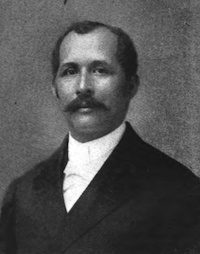
 Marion Edward Davis (19 January 1862–21 June 1946), Methodist minister, was born in Holmes County, Mississippi. His parents, Prince Davis and Ann Davis, were almost certainly enslaved at one time, although sources are silent on their status at the time of his birth. Davis grew up on a farm and attended local schools, where he showed enough aptitude to work as an instructor. After studying early in the 1880s in the normal department of Central Tennessee College (later Walden University) in Nashville, Davis returned to Mississippi, having resolved to become a minister. He taught school in his native county and was licensed to preach by the North Mississippi Annual Conference of the African Methodist Episcopal Church. About 1888 Davis matriculated at Wilberforce University in Ohio, where he received a college preparatory diploma in 1891. Payne Theological Seminary, an affiliated school, awarded him a bachelor's degree and a doctorate of divinity in 1894 and 1898, respectively. While pursuing his theological education, he served as pastor of a church in nearby Springfield.
Davis returned to Mississippi in the autumn of 1894 and was assigned to the AME church in Friars Point, Coahoma County. He remained in this post for about five years, and for part of the time he also served as pastor of the church in Clarksdale while doubling as principal of Stringer Academy, an AME school operated by the North Mississippi Annual Conference. Davis continued to polish his skills as a preacher and fund-raiser during subsequent assignments in Port Gibson (1900–1905) and Natchez (1905–1910). On October 27, 1897, he married Cora Leigh Flagg, a teacher. They had one son and one daughter.
In 1910 Davis accepted an offer to become pastor of Portsmouth's Emmanuel Church, a prestigious post in the Virginia Annual Conference, in which he quickly became a leader. Success at Emmanuel resulted in his assignment as pastor of Richmond's Third Street Bethel Church from 1916 to 1920. After two years at Saint John's Church in Norfolk, Davis became presiding elder of the Portsmouth District (1922–1927). Although maintaining his residence in Portsmouth, he served as presiding elder of the Roanoke (1927–1930), Norfolk (1930–1932), and Richmond (1932–1935) Districts before resuming the Portsmouth post in 1935. In addition, Davis was treasurer of the Virginia Annual Conference and a delegate to all but one of the denomination's quadrennial General Conference conventions between 1908 and 1944. Well-regarded nationally, he was a trustee of three AME colleges: Wilberforce University, Campbell College in Mississippi, and Kittrell College in North Carolina. In 1915 Davis won election as a vice president at the second meeting of the Hampton Ministers' Conference, an annual interdenominational event held at Hampton Normal and Agricultural Institute (later Hampton University), and he served as president for several years during the 1920s.
Davis became an early member of the executive committee of the Negro Organization Society, an umbrella group founded at Hampton in 1910 to coordinate the community-improvement efforts of African American churches and civic organizations throughout Virginia. With its motto "Better Homes, Better Schools, Better Farms, Better Health," the NOS pursued the philosophy of non-confrontational social uplift associated with Booker Taliaferro Washington. With the support of white leaders, the NOS raised funds for schools in rural Black communities, sponsored Clean-Up Days, and distributed health bulletins. In 1921 Davis was one of several speakers during an educational campaign the society organized on the Eastern Shore and in several Southside counties. During the last half of the 1920s, he chaired the health committee, which funded a state agent for the promotion of sanitation in rural areas and helped secure a facility for African American consumptives. The committee also successfully lobbied for public health nurses for the Black population funded in part by state and local governments and in part by the NOS and other charitable organizations. Elected president of the NOS in 1930, Davis led the group for the next twelve years. During his tenure, the organization took full advantage of opportunities made possible by the New Deal and funneled federal aid to client organizations and communities. In addition, Davis created a department devoted to "Better Business." During this era the NOS also began to support citizenship training and to fund voter registration programs.
Marion Edward Davis retired as president of the organization in 1942 and as presiding elder of the Portsmouth District two years later. He died at his Portsmouth home on 21 June 1946 and was buried in that city's Lincoln Memorial Cemetery.
Sources Consulted: Biographies in Arthur B. Caldwell, ed., History of the American Negro, vol. 5: Virginia Edition (1921), 286–289 (with marriage date and portrait on 287), Richard R. Wright, comp., Encyclopaedia of the African Methodist Episcopal Church (1916), 80–81 (with variant birth year of 1864), and Wright, comp., Encyclopaedia of the African Methodist Episcopal Church (1947), 86–87 (with birth date of 19 Jan. 1862); birth date of Jan. 1862 in United States Census Schedules, Coahoma Co., Miss., 1900, Records of the Bureau of the Census, Record Group 29, National Archives and Records Administration, Washington, D.C.; some Davis correspondence in Negro Organization Society papers, Hampton University, Hampton, Virginia; Negro Organization Society, Hand Book and Annual (1936), 7–8; Annual of the Negro Organization Society (1937), 7; Southern Workman 50 (Nov. 1921): 489, and 55 (Jan. 1926): 6; Norfolk Journal and Guide, 23 Nov. 1929, 22 Nov. 1930, 21 Nov. 1931, 12 Nov. 1932, 21 Nov. 1942; obituaries in Norfolk Virginian-Pilot, 22 June 1946 and Norfolk Journal and Guide, 29 June 1946.
Photograph in Caldwell, History of the American Negro, vol. 5.