
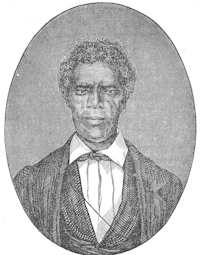
 Noah Davis (March 1804–7 April 1867), Baptist minister and author of an emancipation narrative, was born into slavery in Madison County and was the son of John Davis and Jane Davis. His father operated a mill that belonged to his owner, who lived in Fredericksburg. After the owner sold the mill in 1816, he granted Davis's parents their freedom and allowed them to live on his nearby property in Culpeper County. Davis learned farming and carpentry there before moving in December 1818 to Fredericksburg, where he was apprenticed to a shoemaker. He learned to read and write, experienced a religious conversion, and on 19 September 1831 was baptized as a member of the Fredericksburg Baptist Church, of which George Frederick Adams was then pastor. Soon thereafter Davis married another church member, Fanney, although both being then in slavery their marriage had no legal standing. During the next twenty years they had seven children who were all born into slavery.
The Fredericksburg church had about 300 Black members when Davis married. They elected him a deacon, and the white officials licensed him to preach. In 1845 Davis asked his owner whether he could purchase his freedom. The master set a price of $500 if Davis could raise the money in the North. Beginning in June, Davis addressed audiences in Boston, Philadelphia, and New York, but he returned to Fredericksburg almost four months later with only $150. He then opened a shoemaking shop and attempted to earn the balance. In 1847 white Baptists in Baltimore, including Adams and William Crane, a supporter of emigration to west Africa, offered Davis a job as a missionary to African Americans in Baltimore and provided him the balance of the money with which to purchase his freedom. Davis accepted the offer, left his family in Virginia, and in 1848 as a free man established the Second Colored Baptist Church in Baltimore. The congregation consisted of only 19 members in 1854 when Crane financed the construction of a four-story building on Saratoga Street to serve as sanctuary, school, and offices for Black community organizations. Renamed Saratoga Street African Baptist Church, it opened on February 18, 1855. It had grown to 71 members by 1857 and 167 in 1861. The Sabbath School reported 150 pupils in 1859, and the high school taught more than 100 students in 1856 and 1859.
In 1851 Davis purchased freedom for his wife and two youngest children, and during the rest of that decade he and his wife had at least two, and possibly five, more children born into freedom. Within the next few years he purchased and freed a daughter and son who were in danger of being sold out of Virginia, and in 1858 when their owner's death forced the auction of his other three enslaved children, Davis made another tour of northern cities to raise money to purchase and free his daughter. In all, he spent more than $4,000 freeing himself, his wife, and five of his children. He published his memoirs, A Narrative of the Life of Rev. Noah Davis, a Colored Man (1859) in order to raise money to purchase his two remaining enslaved sons and to help his struggling church. While preaching and fund-raising, Davis continued shoemaking at his home on Marion Street, and his wife took in laundry and did day work.
In 1863 Davis attended the American Baptist Missionary Convention in Washington, D.C. He was one of twelve Black delegates who in that year met with President Abraham Lincoln and successfully requested that African American ministers be allowed to preach to Black troops in the field and freed people within military lines. The financial condition of Davis's church was then precarious. About half of the church's $18,000 debt was retired within a year of its founding, but the school lost money and the few office tenants could not pay rent as a result of the financial panic of 1857 and difficulties during the Civil War. In 1866 the church relinquished the building and united with the city's Union Baptist Church. Noah Davis was in poor health by the time his church ceased to exist, and he died in Baltimore on 7 April 1867. His burial place is not known.
Sources Consulted: Noah Davis, A Narrative of the Life of Rev. Noah Davis, a Colored Man, Written by Himself, at the Age of Fifty-four (1859), with frontispiece portrait and month and year of birth on p. 9; United States Census Schedules, Baltimore City, Md., 1860 (listed as Davies, with wife's name and with five children age seven and under born in Maryland), Records of the Bureau of the Census, Record Group 29, National Archives and Records Administration, Washington, D.C.; George F. Adams, A Brief Sketch of the Life and Character of the Late William Crane, of Baltimore (1868), 26–29; Adams, History of Baptist Churches in Maryland Connected with the Maryland Baptist Union Association (1885), 101, 132–133; A. Briscoe Koger, Negro Baptists of Maryland (1946), 4, 8, 34–35, 42, 59, 65–66; Michael Patrick Williams, "The Black Evangelical Ministry in the Antebellum Border States: Profiles of Elders John Berry Meachum and Noah Davis," Foundations 21 (1978): 225–241; New-York Commercial Advertiser, 24 Dec. 1856; Baltimore Sun, 17 July 1858; Springfield [Mass.] Daily Republican, 11 Aug. 1860; African Repository 39 (1863): 315; obituary in Baltimore Sun, 9 Apr. 1867 (with death date).
Frontispiece portrait in Davis, A Narrative of the Life of Rev. Noah Davis, a Colored Man, Written by Himself, at the Age of Fifty-four (1859).