
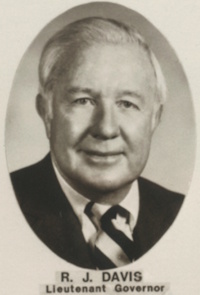
 Richard Joseph Davis (7 August 1921–4 March 1999), lieutenant governor of Virginia, was born in Portsmouth and was the son of Richard Joseph Davis, an attorney, and Mary Rose Lyons Davis. His father died of cancer in November 1928, and during his youth Davis worked several jobs to help support the family. He received a B.A. from the College of William and Mary in 1942. Davis joined the Marine Corps that August and made several combat landings in the Pacific theater during World War II. After being discharged as a captain in 1946, he entered the University of Virginia law school and graduated with an LL.B. in June 1948. He returned to Portsmouth, where he began practicing law with a childhood friend, William Belser Spong, who later became a United States senator. On 14 May 1949 Davis married Jean McLean, daughter of the wealthy Portsmouth entrepreneur George Tutton McLean. They adopted a daughter before divorcing in 1965; the marriage later was annulled by the Roman Catholic Church. During the Korean War, Davis was recalled to duty, served as a military lawyer, and was promoted to major. He later attained the rank of lieutenant colonel in the Marine Corps Reserve.
Dick Davis invested in real estate and in television and radio stations. With help from his father-in-law, in 1954 he founded Virginia Investment and Mortgage Corporation. Davis also helped organize the Tidewater Professional Baseball Corporation, which in 1963 bought the Tidewater Tides, a Portsmouth-based minor league baseball team. The Tides played in the Class A Carolina League until 1969, when Davis convinced the New York Mets to purchase and make the team its Triple-A franchise. A successor corporation, Tidewater Professional Sports, Inc., with Davis as president, continued to operate the team until 1992, during which time the Tides won several championships, including that of all Triple-A leagues in 1983.
A lifelong Democrat, he often recounted how in 1928 his father had supported the presidential candidacy of Al Smith, a Roman Catholic. The young Davis also remembered witnessing the local Ku Klux Klan burn a cross on his Catholic family's lawn. Support for his friend and colleague Spong as well as other Democratic candidates made Davis a prominent behind-the-scenes partisan beginning in the 1950s. He led other businessmen working for Portsmouth revitalization late in the 1960s. Davis won election to the city council in 1974. Chosen by his fellow councilmen as mayor, he served for two years until 1976, when, after a change in the city charter, he was popularly elected to a four-year term. During his tenure he advocated urban redevelopment, new industries, and regional cooperation.
Davis's mayoral service and business connections caught the attention of Virginia Democratic leaders, who in January 1979 tapped him to chair the state party. Internally divided between liberal and conservative wings and having lost most statewide elections to the Republicans during the previous decade, the party was at its lowest ebb in almost a hundred years. Davis proved unable to overcome the party's problems, and in 1980 Virginia Democrats lost nine of the ten congressional races and the presidential race. Davis soon resigned and in December announced his candidacy for lieutenant governor. His business background and support of the party's conservative wing during his chairmanship combined with his liberal policy stands to give him broad appeal. In May 1981 he defeated his liberal opponent at the Democratic State Convention.
Key issues during the general election campaign between Davis and the Republican Nathan Huff Miller included the twenty-year disparity in their ages and Miller's status as a conscientious objector during the Vietnam War. Buoyed by a moderate image, the Democratic ticket of Charles Spittal Robb, Davis, and Gerald Lee Baliles swept their Republican opponents in November, with Davis soundly defeating Miller by 750,743 to 602,714 votes. As lieutenant governor Davis carried out his duties as president of the Senate of Virginia and answered routine constituent requests for appointments and recommendations. He served on governor's commissions to examine federal block-grant programs and voter registration and also joined an American trade delegation to Taiwan in 1983.
In the spring of 1982 Democrats viewed Davis as a potential candidate to replace the retiring Harry Flood Byrd (1914–2013) in the United States Senate. Despite a preference for a future gubernatorial run, Davis allowed himself to be drafted into the senatorial race at the June Democratic convention. The campaign pitted the older, wealthy businessman, with a net worth of about $2.5 million, against Republican congressman Paul Seward Trible, a thirty-five-year-old, self-described "middle-class fellow." A tight and oftentimes negative contest ensued. Several newspapers criticized Davis's union support and his opposition to national right-to-work laws, as well as the Marine veteran's use of his military service as a campaign device against Trible. On 2 November 1982 he lost with 690,839 votes to Trible's 724,571.
In December 1984 Davis was the first Democrat formally to announce his candidacy for the 1985 gubernatorial election. Baliles, his opponent in a spirited contest for the party's nomination, enjoyed a delegate advantage as the June 1985 convention approached. Davis pledged to fight for the nomination, but in April he withdrew from the campaign and endorsed Baliles, who won the statewide election. In April 1986, after completing a second year-long stint as party chair, Davis accepted an appointment from Baliles to serve as director of the new Virginia Center for World Trade. In June 1988 Davis became executive director of the new Norfolk-based Virginia Department of World Trade, which combined the duties of several agencies, including the Center for World Trade, charged with expanding international trade opportunities. In September 1990 he retired from the department, which was disbanded later that year.
During his long career Davis was president of the Portsmouth Chamber of Commerce and of the Virginia Mortgage Bankers Association and also chaired the housing and community development committee of the United States Conference of Mayors. He served on the board of visitors of the College of William and Mary from 1982 to 1990 and as a trustee of Virginia Wesleyan College (later Virginia Wesleyan University).
While on a trip to Mexico City in November 1967 to attend the winter baseball meetings Davis married Martha Whitfield. They had one daughter and one son before she died of cancer on 6 September 1986. On 16 April 1988, in Virginia Beach, he married Lori Adair Collins.
Following his retirement Davis remained active in local politics, business interests, and charities, including raising funds for the Martha W. Davis Cancer Treatment Center at Maryview Medical Center in Portsmouth. Richard Joseph Davis died at his Portsmouth home on 4 March 1999 and was buried in Portsmouth Catholic Cemetery.
Sources Consulted: Biographies in General Assembly of Virginia, Manual of the Senate, 1984 sess., 96–97 (with self-reported birth date), and Louis H. Manarin, Officers of the Senate of Virginia, 1776–1996 (1997), 187–188 (portrait on 186); first and third marriages in Marriage Register, Norfolk (1949), Portsmouth (1988), Bureau of Vital Statistics, Commonwealth of Virginia Department of Health, Record Group 36, Library of Virginia (LVA); second marriage date in Norfolk Virginian Pilot and Ledger-Star, 7 Sept. 1986; feature articles in Richmond Times-Dispatch, 21 Jan. 1979, 19 Sept. 1982, Washington Post, 6 Oct. 1981, 19 Oct. 1982, Richmond News Leader, 15 Jan. 1982, and Norfolk Virginian-Pilot, 10, 17 Oct. 1990; correspondence in William Belser Spong Papers, Albert and Shirley Small Special Collections Library, University of Virginia, Charlottesville, and Angus Hamilton Macaulay Papers, Virginia Museum of History and Culture, Richmond; Lieutenant Governor Richard J. Davis Correspondence and Subject Files (including audio tapes and printed speeches), State Records Collection, Accession 32616, Record Group 129, LVA; State Board of Elections, Statement of Votes, State Records Collection, Accession 33132 (lieutenant governor), and Abstracts of Votes, Accession 33666 (United States Senate), Record Group 14, both LVA; Washington Post, 28 May 1981, 12 Dec. 1984, 28 Mar. 1985; Richmond Times-Dispatch, 4 Oct., 4 Nov. 1981, 5, 6 June, 18 July (quotation), 3 Nov. 1982; Richmond News Leader, 17 Sept., 3 Nov. 1982; obituaries and editorial tributes in Newport News Daily Press, 5 Mar. 1999, Norfolk Virginian-Pilot, 5 (incorrect birth date of 4 Aug. 1921), 6 Mar. 1999, Richmond Times-Dispatch, 5 Mar. 1999, and Washington Post, 6 Mar. 1999.
1984 Senate of Virginia legislative photograph, Library of Virginia.