
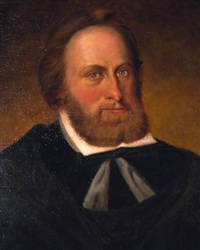
 Thomas West, third baron De La Warr (9 July 1576–7 July 1618), governor, was the son of Thomas West, second baron De La Warr, and Anne Knollys West, of Wherwell, Hampshire, England, where mostly likely he was born and christened. The family possessed impeccable social and political connections that assisted him in his career. West entered the Queen's College, University of Oxford, at age fifteen on 9 March 1592. Like many other young men he left without taking a degree, but the university awarded him and more than a dozen other dignitaries an M.A. in 1605 on the occasion of a visit by the king. West married Cecilia, or Cecily, Shirley in London on 25 November 1596. They had six daughters and one son. After a year's tour of Italy, West won election to the House of Commons from Lymington and served in the Parliament that met from October 1597 until February 1598. He soldiered in the Low Countries and campaigned in Ireland with Robert Devereaux, second earl of Essex, who knighted him in 1599. Suspected of complicity in Essex's hapless revolt against Queen Elizabeth I, West was imprisoned briefly in 1601, but the earl absolved him of any guilt. With the cloud of suspicion lifted, West became a privy councillor to the queen and to her successor, James I. When West's father died in March 1602, he succeeded to the barony and thereafter signed himself Tho: Lawarre.
In November 1606 the king appointed De La Warr to the royal council that oversaw the Virginia Company of London. De La Warr invested £500 in the company, by far the largest investment of any company officer during the following decade. During the critical first years of the Virginia colony, De La Warr monitored from London the deteriorating situation in the colony and worked toward revamping its governance. He may have assisted in drafting the Charter of 1609, which abolished the royal council and authorized the company to appoint a resident governor with the power to name his subordinate officers. Noble rank, stature at court, military experience, and his own substantial personal investment in the company combined to make De La Warr the obvious choice as Virginia's governor, and on 28 February 1610 the company commissioned him governor and captain-general for life.
De La Warr departed from London a few weeks later in command of a substantial expedition of colonists, supplies, and ships. The swiftness of his departure and the number of resources suggest that his appointment had been agreed to long before the date of his commission and the first references to it in the company's surviving records. De La Warr's fleet arrived in Virginia early in June 1610. As it entered the James River, it encountered Sir Thomas Gates and the survivors of the starving time of November 1609–May 1610. They had abandoned Jamestown and were setting sail for Newfoundland to catch a ride to England aboard the fishing fleet. De La Warr's timely arrival with reinforcements and provisions prevented Virginia from becoming another failed venture like the colony on Roanoke Island in the 1580s.
De La Warr reorganized the colony along the military lines that the company had envisioned. To that end, he implemented harsh civil regulations akin to what the English had imposed on their troops in the Netherlands and Ireland. Sir Thomas Dale subsequently added military regulations, and the combined orders were published in London under the title For The Colony in Virginea Britannia. Lawes Divine, Morall and Martiall, &c. (1612). The military regime stabilized Virginia, though it gave rise to choruses of complaints from the settlers and did little to ensure the colony's profitability. De La Warr attacked the Powhatan with a fierceness and brutality that matched his fighting in Ireland, but the bloodshed had brought no resolution to the First Anglo-Powhatan War by the time he left Virginia. De La Warr remained in Virginia for a mere ten months before chronic ill health, including dysentery and scurvy, drove him to flee to England in the spring of 1611 in search of relief. His abrupt return to London caused such consternation in the company that later in the year he defended himself by publishing The Relation of the Right Honourable the Lord De La-Warre, Lord Governour and Captaine Generall of the Colonie, Planted in Virginea.
Three of De La Warr's brothers also took active parts in the colonization of Virginia. Francis West sailed to Virginia with Christopher Newport in 1608. He served on the Council of State from 1609 until his death and as governor from November 1627 through February 1629. Nathaniel West and John West (1590–1659) may have gone to Virginia together in 1618. The latter established himself as a prominent military officer, a member of the Council, and acting governor from 1635 to 1637.
One of the early settlements on the James River, West and Shirley Hundred, probably acquired its name from the family names of the governor and his wife. Samuel Argall named a cape and a bay for De La Warr during voyages along the mid-Atlantic coast in 1610 and 1612. The river that empties into that bay and one of the principal Indian tribes that dwelled in its vicinity also acquired his name in English-language discourse, as did the American state, all spelled as one word, Delaware.
Meager documentation clouds De La Warr's movements during the first years after he returned from Virginia, but he continued to help direct the affairs of the colony and appeared eager to resume command there. He appointed the deputy governors who filled in for him after 1611: George Percy, Sir Thomas Dale, Sir Thomas Gates, George Yeardley, and Samuel Argall. De La Warr may have had a hand in revising the company charter of 1612, and he may also have recruited additional investors. In 1616 he and his wife helped introduce Pocahontas and John Rolfe to the royal court when the pair visited England. What part De La Warr acted in the company debate about Virginia's future that led to the Charter of 1618 is no more certain than is his relationship with the chief architect of that document, Sir Edwin Sandys, who became the company treasurer.
Early in 1618 Thomas West, third baron De La Warr, boarded the Neptune to return to Virginia and resume his work as governor, but he died en route on 7 July 1618. John Pory reported in the autumn that De La Warr had "dyed in Canada," suggesting that the governor died near the coast north of the charter boundaries of Virginia, probably off Nova Scotia or perhaps Newfoundland. One of De La Warr's servants later testified that the governor's body was carried to Virginia and buried there.
Sources Consulted: Biographies in Alexander Brown, "Sir Thomas West, Third Lord De La Warr," Magazine of American History with Notes and Queries 9 (1883): 18–30, and Brown, ed., The Genesis of the United States . . . (1897), 2:1048–1049 (with variant birth date of 9 July 1577); birth year derived from Joseph Foster, Alumni Oxonienses: The Members of the University of Oxford, 1500–1714 . . . (1891–1892), 4:103 (age fifteen on 9 Mar. 1592); marriage date from parish register of Saint Dunstan's in the West, London, in Evelyn Philip Shirley, Stemmata Shirleiana; or the Annals of the Shirley Family . . . , 2d ed., rev. (1873), 258; copies of commission and instructions in Papers Relating to the Foundation of Virginia, Add MS 21993, fols. 183–189, British Library, London, England; copies of commission and instructions in Ashmolean MSS 1147, fols. 191–206, Bodleian Library, University of Oxford, England; numerous references in Susan Myra Kingsbury, ed., Records of the Virginia Company of London (1933), including instructions on 3:24–29; De La Warr et al. to company, 7 July 1610, Relation of a Voyage to Virginia, Harleian MSS 7009, fols. 58–61, British Library, London, England; De La Warr to earl of Salisbury, n.d., received September 1610, Public Record Office, Colonial Office Papers 1/1, fol. 85a, National Archives, Kew, England (available on Virginia Colonial Records Project (VCRP) microfilm, Library of Virginia); De La Warr to earl of Salisbury, 22 June 1611, Public Record Office, State Paper Office 14/64 no. 53, National Archives, Kew, England (available on VCRP microfilm, LVA); John Pory to Sir Dudley Carleton, 25 Oct. 1618, Public Record Office, State Paper Office 14/103/46 (quotation), National Archives, Kew, England (available on VCRP microfilm, LVA); J. Frederick Fausz, "An 'Abundance of Blood Shed on Both Sides': England's First Indian War, 1609–1614," Virginia Magazine of History and Biography 98 (1990): 3–56; Mark Nicholls, ed., "George Percy's 'Trewe Relacyon': A Primary Source for the Jamestown Settlement," Virginia Magazine of History and Biography 113 (2005): 251–257; death date of 7 July 1618, in Susan Myra Kingsbury, ed., Records of the Virginia Company of London (1933), 3:419–420; variant death date of 7 June 1618 in Cole's Escheats, Thomas Cole Collections, vol. 5, Harley 760, p. 421, British Library, London, England; burial place in Peter Wilson Coldham, ed., "The Voyage of the Neptune to Virginia, 1618–1619, and the Disposition of Its Cargo," Virginia Magazine of History and Biography 87 (1979): 32.
1877 copy of a seventeenth century portrait, State Art Collection, Library of Virginia.