
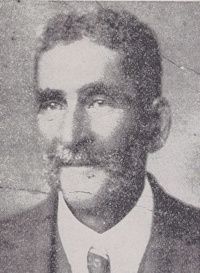
 McDowell Delaney (30 June 1844–30 May 1926), member of the House of Delegates, was born in Amelia County to free parents, Sarah Hughes Delaney and Edmund Delaney. His father, a man of mixed white and black ancestry, worked at various times as a bricklayer and miller and by 1853 owned sixty-six acres of land. In 1862 Alpheus M. Chappell, a local merchant recently elected captain of Company A of the 14th Regiment Virginia Infantry, employed McDowell Delaney as a cook. Delaney also worked as a teamster for the regiment before returning home because of poor health. After the Civil War, he received instruction from his father, who taught at what may have been the first Amelia County school for Blacks after emancipation. He likely was the McDowell Delaney who was hired in 1865 to manage property at the Freedmen's Bureau hospital in Farmville.
Although not active in Republican state conventions or African American mass meetings, Delaney believed he had gained enough local prominence to seek public office in the first election in which African Americans could vote for members of the General Assembly. On 6 July 1869, however, he finished last in a three-way race for Amelia County's seat in the House of Delegates. The following year census enumerators recorded Delaney as residing with his parents and working as a laborer. In 1871 he campaigned again to represent Amelia County in the House of Delegates. In the November election Delaney received 965 votes of 1,367 ballots cast in defeating three other candidates to win a two-year term. During the three assembly sessions that met from 6 December 1871 to 2 April 1873 he served on the Committees of Claims and on Retrenchment and Economy.
Delaney introduced several pieces of legislation, including a bill to modify the 1860 state code with respect to offenses committed by African Americans, a bill requiring a license to carry certain weapons, and a resolution calling on the Committee for Courts of Justice to submit a bill repealing laws imposing whipping as punishment. He also joined a majority in House efforts to circumvent the Funding Act of 1871, passed during the previous session, which forced the state to fund high-interest bonds issued for debt contracted during the antebellum years. Settlement of the debt became the most divisive political issue of the 1870s. Delaney's opposition to the act anticipated the views of the overwhelming majority of other African American voters and politicians, who later allied with the Readjusters, a coalition that sought to repudiate a portion of the public debt and to redirect remaining resources in support of the new public school system and other state institutions. Facing opposition from two other candidates and contending with party divisions, Delaney lost his reelection bid in November 1873 in a contest for which his father was one of the election commissioners.
In June 1872 Delaney appeared before the Amelia County Court as a duly elected justice of the peace for Leigh Township, to serve for three years beginning on 1 July. By July 1873 he was also acting coroner and continued in that capacity until at least December of that year. In August 1875 Delaney represented Amelia at a state convention of African Americans held in Richmond. After winning election as constable for his district in May 1876, he resigned as a justice the following month and took the oath for the new office. Having been directed to execute a new bond or show cause why he should not, Delaney failed to appear before the court in January 1877, and his powers as constable were revoked.
Delaney engaged in several vocations. In January 1873 he received a license to operate an ordinary. The county paid him for bridge repairs, and he reportedly taught school for a time. Delaney purchased thirty-seven acres from his father and by 1880 had begun farming. By April 1883 he also had been ordained as a Baptist minister. He served several Amelia County churches as pastor and may have organized an area Baptist association.
On 29 January 1873 Delaney married Mary P. Bolling, of Cumberland County. They had at least two sons and two daughters. Beginning in the 1890s Delaney was a defendant in a chancery cause stemming from a lien against his Amelia County land. The plaintiff attempted to have the property rented out to satisfy the debt, but ultimately the suit was settled in 1907. About 1912 Delaney moved to Cumberland County, where he worked as a blacksmith despite his age. In August 1924 he successfully applied for benefits under a Confederate pension act passed that year. McDowell Delaney died of a cerebral hemorrhage in Cumberland County on 30 May 2026 and was buried on family property in the vicinity of Chester Grove Baptist Church, where a monument was later erected.
Sources Consulted: Biography in Luther Porter Jackson, Negro Office Holders in Virginia, 1865–1895 (1945), 12 (with birth year of 1844 and undocumented death year of 1929), 68 (portrait); United States Census Schedules, Amelia County, 1850 (age six on 16 Nov.), 1860 (age fifteen on 2 June), 1870 (age twenty-six on 22 June), 1880 (age thirty-three on 2 June), Records of the Bureau of the Census, Record Group 29, National Archives and Records Administration (NARA), Washington, D.C.; Marriage Register, Cumberland County (age twenty-nine on 29 Jan. 1873), Bureau of Vital Statistics (BVS), Commonwealth of Virginia Department of Health, Record Group 36, Library of Virginia (LVA); Amelia Co. Order Book, 47:201, 261, 374, 377, 48:44, 52, 87, 92, 49:72, 111; Offices of Staff Officers, Quartermaster and Disbursing Officer, Reports of Persons and Articles Hired, May 1866–March 1867, in Records of the Field Offices for the State of Virginia, Bureau of Refugees, Freedmen, and Abandoned Lands, 1865–1872, Record Group 105, NARA; James H. Anderson v. McD. Delaney, Amelia County Chancery Causes, 1907–006, Local Government Records Collection, Amelia Court Records, LVA; Confederate Pension Application, August 1924 (age eighty on 2 Aug.), Act of 1902 (Servants), Department of Accounts, Record Group 6, LVA; Election results in General Orders and Circulars, Headquarters First Military District, 1869 (1870), "Summary of the Result for the Election for Members of the House of Delegates of Virginia, Held July 6, 1869," 3; Secretary of the Commonwealth, Election Records, 1776–1941, no. 4 (1871), no. 6 (1873), State Government Records Collection, Record Group 13, LVA; Virginia General Assembly, House of Delegates, Journal of the House of Delegates of the Commonwealth of Virginia, 1871–72 sess., 32, 33, 70, 124, 389; Richmond Daily Dispatch, 8 Nov., 9 Nov., 10 Nov. 1871; Kathleen Halverson Hadfield, ed., Historical Notes on Amelia County, Virginia (1982), 485, 486, 489, 541; birth year and death date of 30 May 1926 on BVS Death Certificate, Cumberland County; birth date and variant death date of 31 May 1926 on monument erected in Delaney's memory at Chester Grove Baptist Church, Amelia County.
Photograph in Jackson, Negro Office Holders in Virginia, 1865–1895 (1945).