
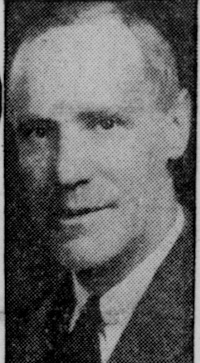
 Armistead Mason Dobie (15 April 1881–7 August 1962), law professor, United States District Court judge, and Fourth Circuit Court of Appeals judge, was born in Norfolk and was the son of Margaret Kearns Cooke Dobie and Richard Augustus Dobie, a Confederate veteran, merchant, and superintendent of Norfolk schools from 1896 to 1922. Dobie entered the University of Virginia in 1898. As an undergraduate he became a member of Phi Beta Kappa and editor of the student literary publication, the University of Virginia Magazine. He received a B.A. in 1901, an M.A. in 1902, and an LL.B. in 1904. Dobie practiced law for three years in Saint Louis, Missouri, and then in 1907 returned to the University of Virginia as a member of the law faculty. He was promoted to full professor in 1909.
When the United States entered World War I in the spring of 1917, Dobie, then age thirty-six, began officer training school. Commissioned a captain in the reserves in August 1917, he served for several months as an aide to the commanding general of Camp Lee, Virginia. Dobie served two stints in France, from September 1917 to February 1918 and again from May 1918 to May 1919 as the chief of the Intelligence Publication Section at the headquarters of the Allied Expeditionary Force and as assistant chief of staff at the 80th Division's headquarters in Chaumont. He received the Officier d'Académie with Palms and was discharged as a major on 6 June 1919.
Returning to Charlottesville, Dobie displayed a talent for administration as executive director of the university's Centennial Endowment Fund from 1920 to 1921. He then took a one-year leave of absence and earned a doctorate of juridical science (S.J.D.) under Felix Frankfurter at Harvard University. When Dobie rejoined the University of Virginia's law faculty in 1922, he introduced the case method of instruction that he had observed at Harvard, an innovation that faculty colleagues and students resisted but that many other laws schools had already embraced. A prodigious scholar, he published widely in criminal law, legal history, and federal jurisdiction and procedure. Dobie's best-known work, Handbook of Federal Jurisdiction and Procedure (1928), was a widely employed text and often reprinted. It was a ready reference for the committee, on which he sat from 1935 to 1938, that in the latter year completed the new Federal Rules of Civil Procedure. Dobie also served as an adviser to the Conflict of Laws Section of the American Law Institute and in 1935 was a special assistant to the attorney general of the United States.
Appointed dean of the law school in 1932, Dobie continued to write and to teach. After his 1939 appointment to the federal bench, he continued to lecture, including a return to Charlottesville to give the 1951 William H. White Lectures, which detailed the careers of Virginia's federal district judges before the Civil War. Although possessed of a rather shrill voice, Dobie was a preternaturally talented speaker, even something of a showman. His so-called Dobie lecture, an Easter-week gathering for which students dressed up and brought dates, was legendary, and he often spoke at football pep rallies. Wit, wordplay, and trademark colloquialisms distinguished every Dobie talk. For most of his life Dobie drew energy from other people and enjoyed sharing his many passions with friends. He was an epicure, an oenophile, a fan of literature and classical music, an avid follower of baseball and the stock market, and a keen player of bridge and bettor on horses.
In May 1939 President Franklin Delano Roosevelt, with whom Dobie had played poker during a presidential visit to Charlottesville, appointed Dobie federal judge of the Western District of Virginia after failing to secure confirmation of an appointee whom the two senators from Virginia had refused to support. Roosevelt judiciously allowed Senators Harry Flood Byrd (1887–1966) and Carter Glass to claim that they had advised Dobie's selection. The following December, Roosevelt appointed Dobie to a vacant seat on the Fourth Circuit Court of Appeals, where for sixteen years he served with John J. Parker and Morris A. Soper. Dobie heard more than 1,400 cases and wrote 458 opinions. He dissented only six times; in three of those instances the Supreme Court of the United States reversed the appeals court rulings, and on a fourth occasion the Third Circuit Court of Appeals overturned the ruling. Dobie made only modest attempts to sublimate his rollicking personality on the bench. Counsel might as well expect from him a quip as a query.
The most notable legal development during Dobie's judicial tenure was the undermining of the separate-but-equal doctrine of the 1896 Plessy v. Ferguson decision that sanctioned state-enforced racial segregation. When African American plaintiffs under the leadership of Percy Casino Corbin sued the Pulaski County school board, contending that inferior facilities and the longer distances they had to travel to school made their educational opportunities unequal to those of the county's white students, Dobie and his colleagues agreed. In concluding his opinion in Corbin et al. v. County School Board of Pulaski County, Virginia, et al. (1949), Dobie wrote, "Whenever the forbidden racial discrimination rears its head, a solemn duty to strike it down is clearly imposed upon the courts." He believed that the separate-but-equal doctrine required real equality, and his opinion required improvements of schools for the county's African American students, not desegregation of the school system. Dobie followed precedent and believed that the states should be allowed to require racial segregation.
In 1952 Dobie presided over the three-judge district court that heard the initial phase of Davis v. County School Board of Prince Edward County, which directly challenged racial segregation. Joined by more demure but equally tradition-bound federal district judges Albert Vickers Bryan and Charles Sterling Hutcheson, Dobie conducted the Richmond proceeding in his usual freewheeling way. Few were surprised that Bryan's opinion for the court unanimously affirmed the legality of racially separate schools. When that ruling was appealed to the Supreme Court of the United States, the case was combined with others as part of Brown v. Board of Education, in which the Court in 1954 overruled Bryan's opinion and declared that separate was inherently unequal and that mandatory racial segregation in public education was therefore a violation of the Fourteenth Amendment to the Constitution.
A long, difficult, and publicly unacknowledged battle with depression led Dobie to retire from the bench on 1 February 1956. Although he had hoped to continue working some after he retired, he never returned to court, and he could no longer maintain his reputation as a host and raconteur. Dobie remained a bachelor until age seventy-seven, when he married his longtime friend Rita Elizabeth McKenney in Charlottesville on 18 July 1958. Armistead Mason Dobie died in a Charlottesville hospital on 7 August 1962 and was buried in the University of Virginia Cemetery. In 1970 the University of Virginia established an endowed professorship in law in his name.
Sources Consulted: Variant birth date of 14 April 1881 in Birth Register, Norfolk City, Bureau of Vital Statistics, Commonwealth of Virginia Department of Health, Record Group 36, Library of Virginia (LVA); self-reported birth date of 15 Apr. 1881 in Military Service Records, World War I History Commission Records, Accession 37219, State Government Records Collection, Record Group 66, LVA; self-reported birth date of 15 Apr. 1881, in passport application, 18 July 1923, General Records of the Department of State, Record Group 59, National Archives and Records Administration (NARA), Washington, D.C.; self-reported birth date of 15 Apr. 1881 in World War II Selective Service System Draft Registration Cards (1942), Record Group 147, NARA; Armistead Mason Dobie Papers, Arthur J. Morris Law Library, University of Virginia (UVA), Charlottesville; some Dobie letters in John Paul Papers, Arthur J. Morris Law Library, UVA; Corbin et al. v. County School Board of Pulaski County, Virginia, et al. (1949), Federal Reporter, 2d ser., 177:924–928, quotation on 928; biography in W. Hamilton Bryson, ed., Legal Education in Virginia, 1779–1979: A Biographical Approach (1982), 196–202, with bibliography of publications and portrait facing 197, and Washington and Lee Law Review 55 (1998): 490–493; Richard Kluger, Simple Justice: The History of Brown v. Board of Education and Black America's Struggle for Equality (1977 ed.), 485–506; John Ritchie, The First Hundred Years: A Short History of the School of Law of the University of Virginia for the Period 1826–1926 (1978), 71–75; feature article in Saturday Evening Post, 28 Dec. 1940, condensed in University of Virginia Alumni News 29 (1941): 71–72; Charlottesville Daily Progress, 23 July 1958; Richmond News Leader, 16 May 1939, 17 May 1939, 19 Dec. 1939, 1 Feb. 1956; Richmond Times-Dispatch, 17 May, 17 Dec. 1939, 20 Jan. 1956; obituaries and memorials in Charlottesville Daily Progress, 8 Aug., 10 Aug. 1962, New York Times, 8 Aug. 1962, Richmond News Leader, 8 Aug. 1962, 9 Aug. 1962, Richmond Times-Dispatch, 8 Aug., 9 Aug. 1962, Washington Post, 8 Aug. 1962, Federal Reporter, 2d ser., 311:5–29, Virginia Law Review 49 (1963): 1079–1081, Virginia State Bar Association Proceedings (1963), 160–167.
Photograph in Charlottesville Daily Progress, June 27, 1936.