
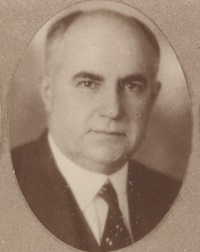
 Grover Ashton Dovell (8 June 1885–28 October 1949), Speaker of the House of Delegates, was born in Madison County and was the son of Early Beauregard Dovell, a farmer and businessman, and Lucy Mary Bond Dovell. He graduated from the College of William and Mary with an A.B. in 1908. A devoted alumnus, he later received the college's Alumni Medallion and in 1939 an honorary doctorate of laws. Dovell attended law school for two years at the University of Virginia and then moved to Tacoma, Washington, where he practiced law with one of his brothers. On 28 February 1911 he married Martha Lane in Williamsburg, where they returned to live five years later. They had no children.
Ashton Dovell, as he was known, quickly became a leader of the Williamsburg community. In 1916 he was named city attorney, a position he retained for the rest of his life. He also maintained a private law practice, which was briefly interrupted in 1918 by military service in Kentucky during the closing weeks of World War I. From 1919 to 1922 Dovell served as commonwealth's attorney for James City County and Williamsburg. In later years he offered legal advice for the historic preservation and restoration project that transformed the city into a popular tourist attraction. Dovell was a charter member and first president of Williamsburg's Rotary Club. For a number of years he sat on the vestry of Bruton Parish Episcopal Church. He also chaired the Virginia Yorktown Sesquicentennial Commission, which organized the commemoration of the British surrender at Yorktown.
In 1923 Dovell won election to represent Williamsburg and the counties of Charles City, James City, New Kent, and York in the House of Delegates. A dedicated legislator and fine orator, he rose through a succession of powerful House posts over the course of nine consecutive terms. In 1928 he became chair of the Privileges and Elections Committee and thus the House floor leader (or majority leader, in the parlance of Virginia Democrats of the era). That year he also gained a seat on the influential Rules Committee. The following term Dovell added chairmanship of the powerful Appropriations Committee to his responsibilities. He retained all three assignments during two subsequent sessions. Having embraced the reform agenda that defined the gubernatorial administration of Harry Flood Byrd (1887–1966), he remained for the most part devoted to the Byrd organization's philosophy of parsimonious, efficient government, but occasionally he sounded more-independent notes.
Dovell's influence within the General Assembly, underscored by his 1935 selection to the governor's seven-member legislative advisory council, made him a logical candidate for Speaker in 1936. He was unanimously elected and remained in that office until retiring from the House after the 1940 term. Early in his first year as Speaker, and in response to a Black woman's application to attend graduate school at the University of Virginia, Dovell and Allie Edward Stokes Stephens introduced and saw through passage a bill to pay out-of-state tuition and educational costs for Virginians who had been denied admission to one of the state's public institutions of higher education and who could not obtain equivalent educational opportunities in another. The law allowed Virginia's all-white public colleges and universities to avoid desegregation lawsuits and enabled the state to avoid making expensive improvements to undergraduate and graduate programs at its Black colleges.
As Speaker, Dovell jealously guarded the assembly's authority over lawmaking, which he worried was frequently being ceded to the executive branch and to special commissions. He enjoyed a reputation for fairness and a sarcastic wit. When the assembly's rejection of matching funds for a federal unemployment insurance plan prompted calls for a special session, which would have required the approval of four-fifths of the legislature, he remarked on the futility of such an effort: "I don't think there has been that much change in sentiment. The Virginia Manufacturers' Association is still in existence."
Dovell's willingness to tweak such a powerful lobby illustrated his growing independence of the Byrd organization. Although remaining committed to low taxes, he urged legislators to incorporate social-welfare programs, such as unemployment and old-age insurance, into the range of services the state government offered. As Byrd and his adherents grew more alienated from liberal New Deal policies, Dovell became more outspoken in his approval of the administration of President Franklin Delano Roosevelt. Declaring his candidacy for governor in October 1940, he pledged support for the federal government, state governmental reorganization, increased education spending, and elimination of the poll tax as a prerequisite for voting. Although Dovell had initially been considered an organization candidate, his platform aligned him with the Democratic faction that opposed Byrd's control of the party. He attracted favorable media attention, but with the Byrd organization united behind Colgate Whitehead Darden Jr., he recognized futility and withdrew in May.
After his abortive candidacy, Dovell continued to distance himself from the conservative establishment. A radio address in October 1944 in support of Roosevelt's reelection campaign blasted the priorities of Virginia's leadership and its lack of support for the president. Dovell continued to attack the poll tax, but he was not able to translate these sentiments into higher political office. Running against the machine in a 1945 special election to fill the vacant Third District seat in the House of Representatives, he finished second in a three-way race and lost to Julian Vaughan Gary. Although Dovell continued to support the Democrats' small liberal faction, he did not seek office again. Beginning in 1945 he served a one-year term as president of the Virginia State Bar Association. During the summer and autumn of 1949 his health declined. Grover Ashton Dovell, memorialized as a political independent, died in a Richmond hospital on 28 October 1949 and was buried in Cedar Grove Cemetery, in Williamsburg.
Sources Consulted: Biographies in Robert C. Glass and Carter Glass Jr., Virginia Democracy (1937), 3:118, 121–122 (portrait on 119), and Bruce F. Jamerson, ed., Speakers and Clerks of the Virginia House of Delegates, 1776–1996 (1996), 132–133; Marriage Register, Williamsburg, Bureau of Vital Statistics, Commonwealth of Virginia Department of Health, Record Group 36, Library of Virginia (LVA); Dovell's military service record in Virginia War History Commission, Individual Service Records (Questionnaires), 1919–1924, Accession 37219, LVA; correspondence in Lewis Preston Collins Papers, Martin Ashton Hutchinson Papers, and John Powell Papers, all Albert and Shirley Small Special Collections Library, University of Virginia (UVA), Charlottesville, and Louise Este Fisher Bruce Papers, Virginia Museum of History and Culture, Richmond; sound recording of speech, 28 July 1949, in Horace Hall Edwards Gubernatorial Campaign Recordings (1949), Accession 43950, LVA; published writings include Dovell, Major Problems for Consideration (1938), and "Democracy Rests on Public Education," Virginia Journal of Education 34 (1941): 348–349; feature stories in Richmond News Leader, 12 Oct. 1940, and Richmond Times-Dispatch, 22 Dec. 1940; Richmond Times-Dispatch, 9 Nov. 1936 (quotation); Report of the Virginia Yorktown Sesquicentennial Commission (1932), esp. 8–12; platform Ashton Dovell, Candidate for Governor of Virginia. Subject to Democratic Primary, August 5, 1941 (1941), copy at UVA; obituaries and editorial tributes in Richmond News Leader, 28 Oct. 1949, 29 Oct. 1949, Williamsburg Virginia Gazette, 28 Oct./4 Nov. 1949, and New York Times, Richmond Times-Dispatch, and Washington Post, all 29 Oct. 1949; memorial in Virginia State Bar Association Proceedings (1950), 134–135.
Photograph in 1934 House of Delegates Legislative Photograph, Special Collections, Library of Virginia.