
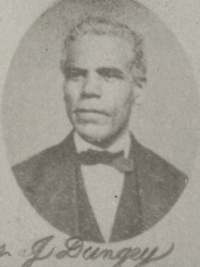
 Jesse Dungey (ca. 1820–August 1884), member of the House of Delegates, was born in King William County and was the son of Joseph Dungey and Elizabeth, or Betsy, Collins Dungey, members of a free family of mixed African, Pamunkey, and white ancestry. Contemporaries spelled his first and last names in a variety of phonetic ways. Autograph signatures rendered in 1871 and 1880 demonstrate that he preferred the spelling Dungey. He may have been related to Shed Dungee, who represented Buckingham and Cumberland Counties in the House of Delegates from 1879 to 1882. Some reference works confuse Dungey with John William Dunjee, allegedly a son of John Tyler (1790–1862) who was born into slavery, escaped to Canada in 1860, and after the Civil War became a Baptist minister in Virginia, West Virginia, and Oklahoma.
Dungey was a boot- and shoemaker and also practiced cupping and leeching, skills that increased his income and enabled him to buy land. His name appeared in the scant surviving records of King William County for the first time in the 1841 personal property tax returns. In 1847 Dungey purchased a 25-acre farm. By 1851 he owned 90 acres of land in the county and at the time of his death 248 acres. He was successful enough that in addition to paying taxes on his real estate and livestock, he was assessed for his above-average-quality wagons, furniture, clocks, watches, and sewing machines. Dungey and his wife, Mary Jane Dungey (whose maiden name is not recorded), married young and had at least five daughters and ten sons. About half of Dungey's children died before he did. Three of his sons graduated from Hampton Normal and Agricultural Institute (later Hampton University) after the Civil War, and they and some of his other children had successful careers in education, law, and medicine. One son became a published poet. What Dungey did during the Civil War is undocumented. After the war he submitted a claim for $290 to the federal government, for which he received $150 as payment for goods provided to Union authorities.
In October 1867 the local agent for the Bureau of Refugees, Freedmen, and Abandoned Lands praised Dungey as a noteworthy community leader who had donated land and provided lumber for constructing a school and also had raised $100 toward the cost of erecting a new church. The agent reported that Dungey planned to teach in the school, and "when he gets his school & church in order he will start a Temperance Movement." In April 1868 Dungey and his wife officially conveyed the land, for the price of one dollar, to be used for the school and church in West Point, in King William County. In September of that year he was mentioned in a Freedmen's Bureau report as being a teacher at the completed school.
On 7 November 1871 Dungey defeated the Conservative Party candidate, with 634 to 530 votes, to win King William County's seat in the House of Delegates. A Republican, Dungey was appointed to the lowest-ranking seat on the Committee of Agriculture and Mining and to a low-ranking seat on the Committee on Officers and Offices at the Capitol. His legislative career, like those of many other inexperienced African American legislators of the time, was relatively undistinguished. Dungey attended and voted regularly but apparently did not make any motions, introduce any bills, offer any resolutions, or participate in debates. On the third day of the assembly he was on the losing side of an 81-to-31 vote on a motion that Richmond ministers, without regard to race, alternately open House sessions with prayer.
On 15 December 1871 Dungey voted with the majority to suspend payment on Virginia's public debt and on 5 January 1872 with the majority in favor of a joint resolution to discontinue issuing bonds for funding the public debt. The Funding Act of 1871, passed at the previous assembly session, had pledged to pay off the entire principal and interest of the prewar state debt. Tax revenue had proved inadequate, however, and many Virginians exacerbated the state's financial difficulty by paying their taxes with coupons clipped from the bonds rather than with money. The two votes Dungey cast were part of the first important attempts to refinance the state debt, and on 2 March 1872 he joined the majority in voting to override the governor's veto of a bill prohibiting the use of coupons to pay taxes and debts.
Dungey apparently did not seek reelection in 1873. He later ministered at several churches in King William County and in 1880 served as a census enumerator. Jesse Dungey died, probably at his King William County farm, on an unrecorded date in August 1884, possibly of Graves' disease. The place of his burial is not known.
Sources Consulted: Biography in Luther Porter Jackson, Negro Office Holders in Virginia, 1865–1895 (1945), 12–13 (with names of parents, estimated birth in 1812, surname spelled Dungee, and middle initial W.); United States Census Schedules, King William County, 1850 (age thirty-one on 17 Nov.), 1860 (age thirty-eight on 18 June), 1870 (age fifty-one on 16 Aug.), and 1880 (age sixty on 30 June; also several autograph signatures as census enumerator), Records of the Bureau of the Census, Record Group 29, National Archives and Records Administration, Washington, D.C.; application (no. 3402) with birthplace, age "51 abt." on 4 Aug. 1871, and autograph signature, Freedman's Savings and Trust Company Records, Record Group 101, National Archives and Records Administration (NARA), College Park, Maryland; Land Tax Returns and Personal Property Tax Returns, King William County, Auditor of Public Accounts, Record Group 48, Library of Virginia (LVA); Third General Report of the Commissioners of Claims, Submitted December 8, 1873, 43d Congress, 1st sess., House of Representatives Misc. Doc. 23, serial 1617, p. 32; quotation in G. P. Goodyear to Paul R. Hambick, 31 Oct. 1867, Records of the Assistant Commissioner for the State of Virginia, 1865–1869, Bureau of Refugees, Freedmen, and Abandoned Lands, Record Group 105, M1048, NARA, Washington, D.C.; G. P. Goodyear to Paul R. Hambick, 8 Sept. 1867 and 28 Feb. 1868, copy of King William County deed conveying land for church and school (28 Apr. 1868), and Sub-Assistant Commissioner's Monthly Report on Education of Freedmen and Refugees, September 1868, all in Records of the Field Offices for the State of Virginia, 1865–1872, Bureau of Refugees, Freedmen, and Abandoned Lands, Record Group 105, M1913, NARA; Secretary of the Commonwealth, Election Records, 1776–1941, no. 4, Record Group 13, State Government Records Collection, LVA; Richmond Daily Dispatch, 9 Nov., 14 Nov., 1871; Virginia General Assembly, House of Delegates, Journal of the House of Delegates of the Commonwealth of Virginia, 1872 sess., esp. 33, 34, 69–70, 123–124, 386–390; Estate and family information in King William County Chancery Causes, Robert T. Dungey, etc. v. Mrs. Mary Dungey etc., 1888-002, Local Government Records Collection, LVA; Estate records in King William Co. Deed Book, 6:384–387, LVA; Death Register, King William County (age sixty-four), Bureau of Vital Statistics, Commonwealth of Virginia Department of Health, Record Group 36, LVA.
Photograph in Legislature of Virginia, Session 1871 and '72, Special Collections, Library of Virginia.