
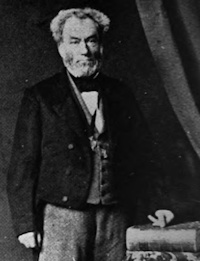
 Robley Dunglison (4 January 1798–1 April 1869), medical educator and author, was born at Keswick, England, and was the son of Elizabeth Jackson Dunglison and her first husband William Dunglison, a woolen manufacturer. He was named for his great uncle Joseph Robley, a planter in the West Indies who promised to take responsibility for Dunglison. Following Robley's death while Dunglison was still young, Dunglison was educated in England, first at Brisco Hill, near Wigton in Cumberland (later Cumbria) about 1803, and afterwards at Green Row Academy on Solway Firth.
Dunglison commenced his medical education in a local surgery, and at age seventeen began an apprenticeship with Keswick surgeon John Edmondson. He continued his medical studies in London with Dr. Charles Thomas Haden, and subsequently attended lectures at the University of Edinburgh and the Royal Infirmary there, as well as at the École de Medécine and private courses in Paris. Dunglison received diplomas in 1818 from the Royal College of Surgeons and the Society of Apothecaries in London, where he established his medical practice. He soon tired of general practice and graduated by examination from the University of Erlangen (later the University of Erlangen-Nuremberg) with a dissertation on neuralgia. Dunglison decided in 1823 to specialize in obstetrics, and obtained a position at the Eastern Dispensary in Whitechapel. He took on a student and announced a lecture course on midwifery, but in the autumn of 1824 Dunglison met Francis Walker Gilmer, who had been sent to England to recruit faculty for the nascent University of Virginia. Dunglison accepted a position as professor of medicine at the university in part because it enabled him to marry Harriette Leadam, which he did on 5 October 1824. Of their seven children, two daughters and four sons survived childhood.
Dunglison and his wife left London on 27 October 1824, but weather delays off the English coast delayed their voyage. They arrived in Charlottesville in February 1825 and took up residence in Pavilion X at the University of Virginia. Thomas Jefferson soon began consulting Dunglison on health matters, and Dunglison became a frequent visitor to Monticello, attending Jefferson at the latter's illness and death in 1826. Aside from his treatment of Jefferson, Dunglison's contract with the University of Virginia prohibited him from conducting private practice in addition to teaching. Because of this, he is sometimes described as the first professional full-time professor of medicine in the United States. He assembled a collection of materials for anatomical demonstration courses and requested a separate anatomical theater, which Jefferson designed in 1825. Dunglison also taught courses in physiology, obstetrics, medical practice, and medical jurisprudence during his nine years at the university. In 1826 and again from 1828 to 1830 Dunglison served as chairman of the faculty, then the highest-ranking administrative position at the university.
He left the University of Virginia in 1833 for a professorship of Materia Medica, Therapeutics, Hygiene, and Medical Jurisprudence at the University of Maryland. After three years in Baltimore, Dunglison accepted a professorship of the Institutes of Medicine and Medical Jurisprudence at Jefferson Medical College (later Thomas Jefferson University), and moved his family to Philadelphia in September 1836. Two years later, he became a naturalized United States citizen. Dunglison remained at Jefferson Medical College until his retirement in 1868, serving as dean from 1854 onward.
Despite frequent attacks of gout, Dunglison was active in numerous Philadelphia charities and organizations. In 1838 he helped campaign for the establishment of an asylum for the city's impoverished mentally ill residents, which received legislative approval three years later. He was also an officer of the Pennsylvania Institution for the Instruction of the Blind (later Overbrook School for the Blind) beginning in 1844. He sat as president of the Musical Fund Society of Philadelphia and was a member of the Franklin Institute of the State of Pennsylvania for the Promotion of Mechanic Arts (later the Franklin Institute). Dunglison also worked as an attending physician at the Philadelphia Hospital. Elected to membership in the American Philosophical Society in 1832, he served as a secretary 1840 to 1852, and as a vice president from 1853 to 1856, and again in 1858.
Dunglison's actual medical practice was limited; his influence was greater in teaching and publishing. He conducted little original research, but wrote, translated, and published extensively on a variety of medical topics, including his landmark work Human Physiology (1832) and the frequently reprinted New Dictionary of Medical Science and Literature (1833), both of which he produced while at the University of Virginia. He supervised the preparation of a dictionary in a system of raised type for the blind and edited several journals, including the monthly American Medical Library and Intelligencer from 1837 to 1842. Dunglison also assisted in revising the 1842 edition of The Pharmacopoeia of the United States of America. His works sold widely and went through numerous editions in his lifetime. Robley Dunglison died on 1 April 1869 at his home in Philadelphia and was buried next to his wife, who had died on 5 March 1853, in the city's Laurel Hill Cemetery.
Sources Consulted: Biography in Samuel X. Radbill, ed., "The Autobiographical Ana of Robley Dunglison, M.D.," Transactions of the American Philosophical Society, new ser., 53 (1963): 1–212, with frontispiece portrait, list of honors and positions on 194–196, and bibliography of Dunglison's works on 196–199; birth and death dates on gravestone, Laurel Hill Cemetery, Philadelphia, PA; Robley Dunglison Papers, 1830–1869, Historical Medical Library, College of Physicians of Philadelphia, Philadelphia; Robley Dunglison Collection, Scott Memorial Library, Thomas Jefferson University, Philadelphia; Dunglison correspondence in various collections, Claude Moore Health Sciences Library and Albert and Shirley Small Special Collections Library, University of Virginia, Charlottesville; John M. Dorsey, ed., The Jefferson-Dunglison Letters (1960); Autobiography of Samuel D. Gross, M.D. … with Sketches of His Contemporaries, ed. Samuel W. Gross and A. Haller Gross (1887), 2:329–335; Mary Jeanne A. Jones and Chalmers L. Gemmill, "The Notebook of Robley Dunglison, Student of Clinical Medicine in Edinburgh, 1815–1816," Journal of the History of Medicine and Allied Sciences 22 (1967): 261–273; Percy G. Hamlin, "Aesculapius in Charlottesville: Robley Dunglison, M.D.," Virginia Cavalcade 22 (summer 1972): 14–21; obituaries and memorials in Philadelphia Inquirer, 2, 6 Apr. 1869, Richmond Daily Enquirer and Examiner, 5 Apr. 1869, American Literary Gazette and Publishers' Circular 12 (15 Apr. 1869): 287–288, Lippincott's Magazine of Literature, Science and Education 3 (1869): 676–678, Medical and Surgical Reporter 20 (17 Apr. 1869): 310 and (24 Apr. 1869): 322–323, and Franklin Peale, Memorial of the Late Robley Dunglison, M.D., One of the Vice-Presidents of the Pennsylvania Institution for the Instruction of the Blind (1869).
Photograph in Transactions of the American Philosophical Society, new ser., 53 (1963): 156.