
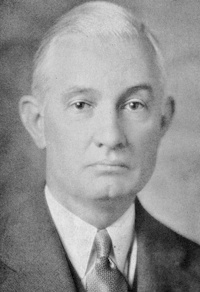
 Charles Vernon Eddy (13 September 1877–17 October 1963), librarian, was born in Winchester and was the son of Florence Alberta "Bertie" Snapp Eddy and James Clarkson Eddy, a millwright who died of tuberculosis in 1888. He and his brother established a printing business in 1892 while students at the Shenandoah Valley Academy, from which Eddy graduated in 1896. He married Katharine Graham Kurtz on 22 March 1905. They had three sons, one of whom died in infancy. The Eddy Press, as the business was later named, expanded to become one of the state's largest printing operations and included an office in New York, but financial difficulties led to a declaration of bankruptcy in 1904 and the company was later sold. He remained with the Eddy Press until about 1907, when he moved with his family to Philadelphia and became an assistant manager of a printing house there.
C. Vernon Eddy, as he was generally known, returned to Winchester in January 1913 to take charge of the Handley Library. The result of an 1895 bequest from John Handley, a Pennsylvania judge, the library was established as a free public institution in the city. After many legal and financial complications the building was completed in 1909, but it was not until 13 June 1912, that the Handley Fund's board of trustees named Eddy as librarian at an annual salary of $1,200. He spent time studying with John Thomson, head librarian of the Free Library of Philadelphia. As a result of his training, Eddy made the decision to implement open stacks at the Handley Library rather than follow the original plans for closed stacks. His first task as librarian was to order furniture, shelving, and books for the Handley Library, which was formally dedicated on the evening of 21 August 1913. Staff members began issuing library cards and checking out books the next day.
During the library's first four months of operation Eddy reported that the collection held 2,345 books, that 820 cards had been issued, and that there had been 15,445 visits. On the library's twentieth anniversary, in August 1933, he announced that it held about 23,000 books and boasted that there had been more than 1.2 million visits to the library and more than 1 million volumes borrowed during that time. Throughout his forty-six-year tenure as librarian Eddy kept the library open with a small staff and limited funds. For many years the library's only revenue came from interest derived from the trust. The city of Winchester began providing some funding in 1929, but did not take over administration of the library until after Eddy's retirement in 1959. As librarian he added two additional glass book-stack levels to accommodate more volumes and ensured that activities, programs, and new books were well publicized. During both world wars he headed up drives to collect books for soldiers. He also served as secretary to the Handley Fund's board of trustees from 1920 to 1960 and as treasurer from 1931 to 1960.
Eddy encouraged the donation of family manuscripts and collections to the library and in 1925 the widow of Holmes Conrad, president of the board of trustees, donated more than 1,500 books and pamphlets from his private collection. The historical reference collection continued to grow, and during the 1970s the Handley established an archives. Eddy may be best known for his work with the maps and papers of Jedediah Hotchkiss, who during the Civil War served as cartographer and topographer for Thomas J. "Stonewall" Jackson and Robert Edward Lee. Eddy learned in 1928 that Hotchkiss's papers were located in Staunton and in 1938 began cataloging the maps. Eddy spent the next decade working to ensure that researchers would have access to these invaluable maps and papers. He made many trips and engaged in extensive correspondence with anxious heirs and prospective buyers until the Library of Congress purchased the collection in 1948. Eddy was lauded for his work in making the Hotchkiss maps available to a wider audience, and in gratitude for all of his endeavors the cartographer's granddaughter gave three Hotchkiss maps to the Handley Library.
Eddy advocated increasing the number of libraries in Virginia and he stressed the importance of ensuring that they were child- and youth-friendly to encourage their interest in reading. He supported the work of the segregated branch of the Handley Library for African Americans during its operations from 1921 until it closed in 1955, two years after the Handley was opened to all city residents regardless of race. He served two one-year terms as president of the Virginia Library Association in 1923–1924 and 1938–1939, and he was Virginia's representative on the American Library Association's governing council in 1934–1936 and 1939–1940.
A Freemason since 1899, Eddy held many offices in his local Masonic lodge and was elected Grand Master of the Grand Lodge of Virginia in 1937. He was elected secretary of the local Red Cross chapter in 1917 and held that post for more than thirty years. In 1921 he was a founding director of the Winchester Rotary Club, and in 1930 was the founding secretary of the local historical society.
Charles Vernon Eddy suffered poor health and largely withdrew from public affairs before he died of heart disease in a Winchester nursing home on 17 October 1963. He was buried next to his wife, who had died on 5 March 1953, in the city's Mount Hebron Cemetery.
Sources Consulted: Birth Register, Winchester, 1877, Bureau of Vital Statistics, Commonwealth of Virginia Department of Health, Record Group 36, Library of Virginia (LVA); Winchester Marriage License, 1905; self-reported personal information in C. C. Williamson and Alice L. Jewett, eds., Who's Who in Library Service, 1933 (first edition), 152, and 1943 (second edition), 152; Charles Vernon Eddy reports, interviews, and correspondence, as well newspaper clippings, are at the Stewart Bell Jr. Archives, Handley Regional Library, Winchester; Eddy correspondence in Virginia Library Association Records, 1905–1999, Accession 32434, Organization Records Collection, LVA; William Couper, History of the Shenandoah Valley (1952), 3:21–22; Peter W. Roper, "The 'Discovery' of the Hotchkiss Maps and Papers," Winchester-Frederick County Historical Society Journal 4 (1989): v (Eddy biography, with portrait facing v), 22–27; Eloise C. Strader, "The Eddy Press," Winchester-Frederick County Historical Society Journal 11 (1998–1999), ix–xi (portrait on x); Garland R. Quarles, John Handley and the Handley Bequests to Winchester, Virginia. Second edition, 1998; Handley Regional Library: The First One Hundred Years (2012); Winchester Evening Star, 10 Oct. 1904, 22 Mar., 4 Nov. 1905, 22 Aug., 23 Aug., 27 Aug. 1913; Richmond Times-Dispatch, 28 Nov. 1923, 30 Oct. 1938; Harrisonburg Daily News-Record, 11 Feb. 1928; obituary in Winchester Evening Star, 17 Oct. 1963 (portrait); memorial in Proceedings of the Most Worshipful Grand Lodge of Ancient Free and Accepted Masons of the Commonwealth of Virginia: Emergent and Annual Communications (1964).
Frontispiece photograph in Proceedings of the Most Worshipful Grand Lodge of Ancient, Free and Accepted Masons of the Commonwealth of Virginia (1937).