
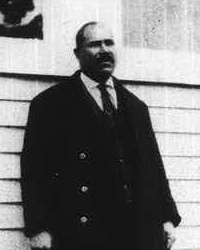
 Stephen Johnson Ellis (1 August 1867–1 February 1937), civic leader, was born in Buckingham County to formerly enslaved parents, John "Jack" Ellis and Ann Ellis, whose maiden name might have been Tyler or Wright, and was the first of their children to be born free. His older brother Wilson Ellis had been impressed into service for the Confederate army as a hospital servant in Richmond and was later awarded a pension. Stephen Ellis and his siblings were educated in the segregated public schools that early in the 1870s had been established across Buckingham County. These schools were little more than one-room log cabin buildings with earthen floors and limited to seven grades taught by a single teacher. Despite these educational challenges, Ellis eventually attended Virginia Seminary (later Virginia University) in Lynchburg in the mid-1890s and entered the ministry. He was likely influenced by Caesar Perkins, who helped found Buckingham County's first Black school and who later preached in the same area churches.
Ellis married Kate "Kittie" Jones on 19 July 1905. She died on 29 September 1909, leaving him with a son and a daughter. Less than a year later, he married Kate's sister Dora Jones on 2 August 1910 and had at least two more daughters. He ministered at a number of churches, including Jerusalem, Fork Union, Liberty Chapel, and Zion Baptist, supported Baptist foreign missions, and served as moderator of the North River Baptist Association. To supplement his earnings as a minister, he worked as a farm laborer, coal miner, undertaker, and insurance agent.
Ellis became an unrelenting force on the issue of Black education, using his pulpit to rally the community to tackle the inequality in the county's education system, especially the lack of a high school for African American students. In 1919, he formed the County-Wide League for School Improvement to petition the Buckingham County School Board to build a high school for Black students with a grant from the Julius Rosenwald Fund, which had been established to help Black communities around the country expand educational opportunities for their children. The school board rejected Ellis's request on the grounds that a high school was not necessary because African American children needed only basic training for such occupations as farming and cooking and cleaning. After numerous meetings, the board told Ellis that Black parents would have to raise the necessary funds on their own before a grant request would be submitted.
To secure a Rosenwald grant for the construction of a four-room high school, Ellis and the County-Wide League first had to raise $3,000 from a population earning less than a couple of dollars per day. Working with the County-Wide league and the Black community, Ellis went door to door, conducted special church offerings, organized livestock and vegetable sales, and contributed his own funds. In 1923, Ellis went back to the school board with funding in hand to request the proposed Rosenwald grant be submitted, only to be told that Buckingham County was simply not interested in a Black high school. Undeterred, Ellis continued his appeals to the school board until it agreed to appropriate $4,000 for building the school, with the provision that the Black community raise an equal amount along with a request from the Rosenwald Fund for $1,500. On 31 October 1924 the Buckingham Training School officially opened as the first and only high school for African Americans in the county.
Although the new four-room school seemed opulent to students accustomed to one-room schoolhouses, the county provided little in the way of teaching materials or other basic school equipment. There was no public-school bus service, library, cafeteria, electricity, or indoor plumbing. Recognizing that little or no county funding would be provided to operate the school, Ellis continued to lead the Black community in raising funds to overcome these obstacles. Black parents, already paying taxes to support the county's white schools, also shouldered the needs of their school through housing teachers and students, establishing makeshift buses, and selling hams and cakes. Over the next thirty years, the continuous support of the African American community enabled more than 1,500 Black students to graduate from high school.
In 1923, Ellis helped organize the Colored Rural Life Conference of Central Virginia, which he also served as president. Members sought to bring rural residents together to study and discuss how to improve education, public health, farm life, and race relations in their communities. Later in the decade he was also vice grand shepherd of the Improved Order of Shepherds and Daughters of Bethlehem, a fraternal benefits association.
Stephen Johnson Ellis died of pneumonia at his home on 1 February 1937. He was buried next to his first wife in the First Liberty Baptist Church Cemetery in Dillwyn, in Buckingham County. Ellis was fondly remembered as "a martyr to the causes he loved, for the good of his county and his people, whom he … unselfishly served." In 1954, the Buckingham Training School was reconfigured as an elementary school and named the Stephen J. Ellis Elementary School in his honor. After the school moved to a new building in 1964, the property fell into disrepair and the county demolished the Training School building during the 1970s. In 2007 the campus was reimagined as Ellis Acres Memorial Park, a community space offering recreational activities and educational programs, and the 1932 vocational shop building that had also been constructed with Rosenwald Funds was preserved. The Buckingham Training School site was placed on the Virginia Landmarks Register in 2014 and the National Register of Historic Places the following year.
Sources Consulted: Birth date in Birth Register, Buckingham Co., Bureau of Vital Statistics (BVS), Commonwealth of Virginia Department of Health, Record Group 36, Library of Virginia (LVA); variant birth year of 1865 on gravestone; BVS Marriage Register, Buckingham Co., 1905, 1910; United States Census Schedules, Buckingham Co., 1870, 1880, 1900 (with Feb. 1868 birth date), 1910–1930, Records of the Bureau of the Census, Record Group 29, National Archives and Records Administration, Washington, D.C.; Roanoke Times, 12 May 1923; Thomas L. Dabney, "Rural Education Buckingham County, Virginia" Southern Workman 55 (1926): 79–82 (portrait on 80) and "Colored Rural Life Conference of Central Virginia," Southern Workman 55 (1926): 224–227; Farmville Herald and Farmer-Leader, 16 Apr. 1954 (portrait); Charles W. White, The Hidden and Forgotten: Buckingham County (1985); Phyllis Slade Martin, Separate and Unequal: Buckingham Training School and the History of Segregation and Desegregation in Buckingham County, Virginia (2010); BVS Death Certificate, Buckingham Co., with incorrect birth date of 22 Feb. 1880; obituaries in Richmond Times-Dispatch, 4 Feb. 1937, Farmville Herald and Farmer-Leader, 5 Feb. 1937 (quotation), and Norfolk Journal and Guide, 13 Feb. 1937.
Photograph in Southern Workman 55 (Feb. 1926): 80.