
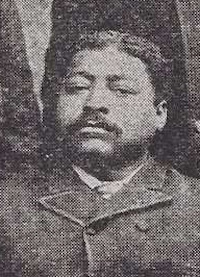
 William W. Evans (d. 16 November 1892), journalist and member of the House of Delegates, was born into slavery in Dinwiddie County early in the 1860s and was the son of Josephine C. Evans and Joseph P. Evans. His father bought his own freedom about 1859 and later settled in Fredericksburg with his family before moving in 1871 to Petersburg, which he represented in the House of Delegates and in the Senate of Virginia. It is not known when or under what circumstances William W. Evans became free. He probably attended a school operated by Giles Buckner Cooke. In 1880 Evans was living in his parents' house and was employed as a letter carrier. He may also have worked for a time as a barber.
Evans began an occasional correspondence with William Mahone in 1882. The former Confederate general was the leader of the Readjusters, a coalition of Blacks and whites who advocated paying only part of the state's massive prewar public debt and channeling remaining resources to desperately needed services. On 3 May 1882 Petersburg Readjusters and Black Republicans nominated Evans for city gauger. The lone Black Republican on the ticket, he soundly defeated two other candidates in the 25 May election and retained the office until 1888. He was an inconspicuous delegate at the Readjuster State Convention that met in Richmond on 23 April 1884 during which the Readjusters formally merged with the Republican Party.
Evans served as secretary of the Virginia Normal and Collegiate Institute (later Virginia State University) for one year beginning in September 1885. He qualified as a notary public in 1886. That year he helped found the Colored Agricultural and Industrial Association of Virginia and in November was named to its board of directors at its inaugural fair. By August 1887 Evans had become editor of the Virginia Lancet, a Republican newspaper that he used to advocate improvements in the political and material lives of African Americans. Later that month the Petersburg Daily Index-Appeal published Evans's call for restraint in the wake of two public confrontations between Blacks and whites. A Lancet editorial criticizing the perceived disparity in punishments the Petersburg mayor had meted out in the two racially charged cases led the mayor to accuse Evans of malicious libel. An otherwise sympathetic grand jury indicted Evans, and he later paid a $5 fine.
That autumn Evans campaigned in a field of four candidates for a seat in the House of Delegates. He called for new legislation redefining libel and for abolition of the grand jury. Evans placed second in the November polling and won election as one of two delegates representing Petersburg in the assembly session that met from 8 December 1887 to 5 March 1888. He was appointed to the lowest-ranking seats on the Committees on Militia and Police and on Officers and Offices at the Capitol. On 20 December he joined the minority in voting for Mahone for United States senator. Evans did not often participate in the assembly's daily business and introduced only one bill, about libel, which was not enacted.
Evans obtained a law license in March 1888 and established a practice in Petersburg. As a member of the city's delegation to the Republican State Convention in May, he sat on the Committee on General Business and was named an alternate delegate-at-large to the national convention in Chicago. Although Evans had pledged to follow Mahone's lead, by September he had temporarily broken with Mahone and was supporting the congressional campaign of John Mercer Langston, a nationally prominent Black leader and president of Virginia Normal and Collegiate Institute. Evans chaired the credentials committee during a meeting at which Petersburg Republicans selected delegates to the district convention. A floor fight ensued when Mahone's followers voted to reject Evans's report accrediting Langston supporters in three of the city's wards. Both camps sent delegates to the district convention, which nominated Mahone's candidate. Outraged, Langston joined anti-Mahone forces and independently continued his quest for a seat in the House of Representatives. Loyal to the regular Republican organization, Evans campaigned against Langston and the Democratic candidate. The bitter race resulted in a contested election. Testifying before a congressional committee in 1890, Evans denounced Langston's conduct and asserted that Langston had incited his supporters to harass regular Republican Party canvassers, including Evans, and had stirred up ugly tensions between whites and Blacks. Evans's opposition to Langston cost him 170 regular Lancet subscribers, a financial blow delivered by Blacks determined to make Evans "Smell Hell."
In December 1889 Evans served as secretary at a meeting of prominent African Americans who gathered in Richmond to discuss disfranchisement of Black voters in previous elections. Among other proposals, the convention unanimously approved a resolution calling for a national election law, which Evans and several other Black politicians presented to a congressional committee a month later. Although desiring to protect the rights of Black voters, Evans had expressed reservations in January 1889 about the possible appointment of an African American to the president-elect's cabinet. Conceding that such an appointment would be a source of pride, he feared it would needlessly disrupt the Republican Party because of the depths of racial bigotry, North and South, and would damage African Americans' long-range interests for a gain more symbolic than substantive.
On 21 June 1890 Evans was found not guilty in a libel suit stemming from a Lancet editorial of 6 July 1889 that had accused a local candidate of being unfit for office. Sometime later he relinquished control of his weekly newspaper and moved to Portsmouth, where he worked as a clerk in the navy yard until declining health forced him to return to Petersburg. William W. Evans died of kidney disease at his home in Petersburg on 16 November 1892. His burial place is unknown.
Sources Consulted: Biography in Luther Porter Jackson, Negro Office Holders in Virginia, 1865–1895 (1945), 15 (with frontispiece portrait); United States Census Schedules, Spotsylvania County, 1870 (age nine on 5 June), Dinwiddie County, 1880 (age twenty on 2 June), Records of the Bureau of the Census, Record Group 29, National Archives and Records Administration, Washington, D.C.; correspondence in William Mahone Papers, David M. Rubenstein Rare Book & Manuscript Library, Duke University, Durham, North Carolina (quotation in Evans to Mahone, 22 Nov. 1888); Secretary of the Commonwealth, Election Records, no. 24, Record Group 13 Library of Virginia (LVA); Virginia General Assembly, House of Delegates, Journal of the House of Delegates of the State of Virginia, 1887–1888 sess., 74, 75; John M. Langston vs. E. C. Venable, 51st Congress, 1st session, 1890, House of Representatives Report 2462, serial 2814, 38–41; Petersburg Minute Book, 1884–1886, 416–417, 1887–1889, 270, 1889–1891, 344–345, LVA; Petersburg Daily Index-Appeal, 4, 26 May 1882, 31 Aug., 15, 22, 26 Oct., 2, 9 Nov., 21 Dec. 1887, 21, 23 June 1890; Richmond Dispatch, 15 Sept. 1887, 18 Dec. 1889; Washington National Leader, 2 Feb. 1889; Baltimore Sun, 27 Jan. 1890; William D. Henderson, Gilded Age City: Politics, Life, and Labor in Petersburg, Virginia, 1874–1889 (1980), 112, 141, 172, 215, 226–227; Death Register (age thirty), Petersburg, Bureau of Vital Statistics, Commonwealth of Virginia Department of Health, Record Group 36, LVA; death and funeral notices in Petersburg Daily Index-Appeal, 18, 19 Nov. 1892
Photograph in Jackson, Negro Office Holders in Virginia, 1865–1895 (1945).