
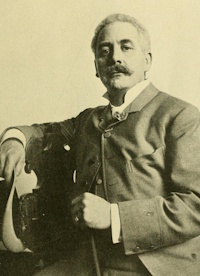
 Moses Jacob Ezekiel (28 October 1844–27 March 1917), sculptor, was born in Richmond and was the son of Catharine De Castro Ezekiel and Jacob Ezekiel, a dry goods merchant who had settled in the city a decade earlier. His family was of Spanish-Jewish origin. As a result of his parents' financial problems, he grew up primarily in the household of his maternal grandmother and a stepgrandfather. Ezekiel attended local academies, but by the age of twelve he had begun working as a bookkeeper in his stepgrandfather's store. Interested in drawing and painting from a young age, he attempted his first sculpture, a clay bust of his father, when he was about thirteen. As a young man he may have had a liaison with Isabella Johnson, a free African American who worked in the Ezekiel home and whose daughter was born in 1859. Ezekiel entered the Virginia Military Institute in 1862, the first cadet of Jewish descent. During the Civil War he fought alongside his fellow cadets at the Battle of New Market on 15 May 1864, and the following year he served with the corps of cadets in the defenses around Richmond. In 1866 he graduated from VMI last in his class of ten.
Ezekiel returned to Richmond to work in his father's dry goods store. With some thoughts of becoming a physician, in 1867 he began attending anatomy classes at the Medical College of Virginia. That year his father moved some of the family to Cincinnati, Ohio, and Ezekiel soon joined them. There he began a serious study of sculpture. Ezekiel's small clay figure Industry (1868), portraying a girl knitting socks while studying her lessons from a book in her lap, won notice in the Cincinnati press when displayed in the window of an art store.
In 1869 Ezekiel sailed for Berlin, Prussia, where the sculptor Rudolf Siemering offered him a place in his studio. After gaining admission to the prestigious royal academy, Ezekiel studied life-modeling under Albert Wolff. In 1873 Ezekiel entered his bas-relief Israel in the prestigious Michel Beer Prix de Rome competition at the academy. He was the first non-German to win the award, which provided a stipend for a year's study in Rome. Later that year the Independent Order of B'nai B'rith commissioned Ezekiel to sculpt a piece for display in Philadelphia during the United States centennial celebration in 1876. Religious Liberty depicts a woman representing Liberty flanked on one side by an American eagle crushing Intolerance and on the other by Faith, a youth holding an eternal flame. After arriving in Rome in 1874, Ezekiel carved the work from a solid block of Carrara marble.
In 1879 Ezekiel established his studio in Rome at the ancient Baths of Diocletian. It quickly became a meeting place for other artists, political figures, and members of the Italian royal family. Ezekiel's close friends included the composer Franz Liszt and Gustav Cardinal von Hohenlohe, both of whom sat for portrait busts. Ulysses Simpson Grant, the financier John Pierpont Morgan, and the Virginia writer and diplomat Thomas Nelson Page numbered among Ezekiel's many American visitors, for some of whom he created portrait busts or funerary effigies.
Ezekiel's sculptures follow the classical lines of his early German training—a romantic, elaborate, and ornate style dependent on heavy lines and bold mass. He modeled his works in clay, usually from living models, formed them into plaster, and then carved the sculptures from blocks of marble or sent them to a foundry for casting in bronze. Most of his more than two hundred surviving pieces were portraits of individuals. Some of Ezekiel's works employed religious themes, including a bronze head of David (1893) and the recumbent marble Christ in the Tomb (1896). In 1899 he completed a bronze bust of Rabbi Isaac Mayer Wise, an advocate of Reform Judaism in the United States. Always proud of his heritage, Ezekiel considered himself an artist who was also Jewish, but he did not want to be labeled a Jewish sculptor.
Ezekiel secured enduring fame as a sculptor through his heroic lifelike portraits. In 1877 he accepted a commission from William Wilson Corcoran for eleven marble statues of famous artists through the ages, including Phidias, Michelangelo, Leonardo da Vinci, and Thomas Crawford, for display in the exterior niches of the Corcoran Gallery of Art, in Washington, D.C. The museum moved to a new location in 1897, and Ezekiel's sculptures were later installed at the Norfolk Botanical Garden. In 1899 Ezekiel completed for the city of Louisville, Kentucky, a large-scale bronze of Thomas Jefferson standing atop the Liberty Bell and reading the Declaration of Independence, a statue he replicated for the University of Virginia and unveiled eleven years later. His other public commissions include bronzes of Thomas J. "Stonewall" Jackson (1909) for the Charleston, West Virginia, chapter of the United Daughters of the Confederacy (a copy of which was installed at VMI in 1912); John Warwick Daniel (1913), a United States congressman and senator from Lynchburg; and Edgar Allan Poe (1915) for the Poe Memorial Association, in Baltimore.
Ezekiel retained his love of Virginia and the Confederate cause all his life and expressed disappointment when his designs for monuments in Richmond honoring Robert Edward Lee and Confederate soldiers and sailors were rejected. In 1903 VMI installed Virginia Mourning Her Dead as a memorial to the cadets who had fought at New Market. Ezekiel had molded the figure while a student in Berlin, and he completed and cast it in bronze in 1900. His statue of a soldier, entitled Southern, was unveiled in 1910 at the cemetery for Confederate prisoners of war at Johnson's Island, Ohio. Ezekiel returned to the United States on several occasions for unveilings and to visit family and friends in Virginia. His last such visit occurred in 1914, when he attended the dedication of his monumental bronze memorial to the Confederate soldiers buried at Arlington National Cemetery.
Throughout his career Ezekiel received numerous honors, including the Cross of Merit for Art and Science from the grand duke of Saxe-Meiningen in 1887 and the Golden Cross of the House of Hohenzollern from the German emperor in 1893. King Victor Emanuel III declared Ezekiel a Cavaliere Ufficiale della Corana d'Italia (Officer of the Crown of Italy) in 1906. The sculptor was known as Sir Moses Ezekiel as early as 1892. The origin of the title is unclear, and sources cite variously a knighthood bestowed by the king of Italy and by the German emperor. Ezekiel may have adopted the title himself after receiving one of his prestigious awards.
In 1909 the Italian government reclaimed the Baths of Diocletian, and Ezekiel moved to a new studio in the Tower of Belisarius. During World War I he served on a committee that distributed American Red Cross funds to Italians in need, and he also helped coordinate shipments of supplies to soldiers at the front. Overworked during the cold, damp winter of 1916–1917, Moses Jacob Ezekiel developed pneumonia and died at his studio on 27 March 1917. He left incomplete his final work, a statue of VMI's first superintendent, Francis Henney Smith. Ezekiel was interred temporarily in the city cemetery near the San Lorenzo neighborhood in Rome. In accordance with his wishes, on 31 March 1921 he was buried among his Confederate comrades in Arlington National Cemetery at the base of his towering monument.
The permanent collections of many institutions, including the VMI Museum, the Cincinnati Art Museum, and the Skirball Cultural Center at Hebrew Union College, Los Angeles, feature examples of Ezekiel's work. In 1985 the National Museum of American Jewish History, in Philadelphia, organized a major traveling exhibition.
Sources Consulted: Biographies in Henry K. Bush-Brown, "Sir Moses Ezekiel: American Sculptor," Art and Archaeology 11 (1921): 227–234, Joseph Gutmann and Stanley F. Chyet, eds., Moses Jacob Ezekiel: Memoirs from the Baths of Diocletian (1975), and Stan Cohen and Keith Gibson, Moses Ezekiel: Civil War Soldier, Renowned Sculptor (2007); will with birth date in Richmond City Chancery Court Will Book, 17:260–266; Ezekiel correspondence, photographs, and other materials in numerous collections, including American Jewish Archives, Cincinnati, OH, Archives of American Art, Smithsonian Institution, Washington, D.C., Beth Ahabah Museum and Archives, Richmond, Charles J. Anderson Letters (Accession 29586) and Governor James L. Kemper Letter Book (Accession 35358) and Executive Papers (Accession 43755), Library of Virginia, The Valentine, Richmond, Virginia Museum of History and Culture, Richmond, and Preston Library, Virginia Military Institute, Lexington; Katharine H. Wrenshall, "An American Sculptor in Rome," World's Work 19 (1909–1910): 12255–12264; Regina Soria, "Moses Ezekiel's Studio in Rome," Archives of American Art Journal 4 (Apr. 1964): 6–9; Alice M. Greenwald and Roberta K. Tarbell, Ezekiel's Vision: Moses Jacob Ezekiel and the Classical Tradition (1985); obituaries in New York Times, 28 Mar. 1917, Richmond News Leader, 28 Mar. 1917, and Richmond Times-Dispatch, 28 Mar. 1917; memorials in American Jewish Year Book (1917), 227–232, Confederate Veteran 25 (1917): 235–236, and University of Virginia Alumni Bulletin, 3d ser., 10 (1917): 327–338.
Photograph in Hilary A. Herbert, History of the Arlington Confederate Monument (1914).