
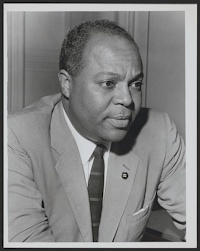
 James Leonard Farmer (12 January 1920–9 July 1999), civil rights leader, was born in Marshall, Texas, and was the son of James Leonard Farmer, a Methodist minister and professor at Wiley College there, and Pearl Marion Houston Farmer, who had taught school before their marriage. His father's career required the family to move frequently, and he grew up in Holly Springs, Mississippi, Austin, Texas, and Atlanta, Georgia, before returning to Marshall and entering Wiley College at age fourteen. Under the mentorship of Melvin Tolson, a professor of English, he excelled in the college's debate team. Farmer graduated in 1938 with a bachelor of science in chemistry and earned a bachelor of divinity at Howard University School of Theology in 1941. There he studied under legendary mystic Howard Thurman, who introduced him to the life and work of Gandhi.
After graduating, Farmer moved to Chicago to serve as race relations secretary for the pacifist group Fellowship of Reconciliation. Though committed to pacifism (he sought conscientious objector status during World War II, but was deferred as a clergyman), Farmer's primary passion was racial justice. Deeply scarred by his first encounter with Jim Crow when as a child he learned that he could not purchase a soft drink at a drugstore counter, he resolved to fight the system that barred African Americans from equal opportunities. In 1942 Farmer and a group of like-minded pacifists formed the Committee of Racial Equality (later Congress of Racial Equality and known as CORE), an interracial action group committed to demonstrating that racial problems could be solved without violence. Borrowing a strategy used with success by the United Auto Workers, Farmer and his CORE colleagues immediately launched what he later believed was the first organized civil rights sit-in in American history at Chicago's Jack Spratt Coffee House, which refused to serve African Americans.
On 19 April 1946 Farmer married Dolores Winifred Inez Christie, but they divorced in November 1947 after she had a miscarriage and he an affair. In May 1949 he married actress Lula A. Peterson, a white woman who was a member of CORE. Their children included twins, a son and daughter, who died after a premature birth, and two daughters. For two years beginning in 1945 Farmer worked for the Upholsterers International Union, helping organize mill workers in Virginia and North Carolina. He was a field secretary for the League for Industrial Democracy from 1950 to 1955, organizer from 1955 to 1959 for the American Federation of State, County, and Municipal Employees, and program director of the National Association for the Advancement of Colored People from 1959 to 1961.
In 1961, as the civil rights movement grew, CORE leaders hired Farmer as national director. His first priority in office was to increase the visibility and fund-raising potential of the predominantly northern organization by launching a direct action campaign in the South. On 4 May 1961 an interracial team of thirteen CORE volunteers under Farmer's leadership left Washington, D.C., for a bus trip through the South to highlight the flouting of two Supreme Court decisions banning segregation in interstate transportation, Morgan v. Virginia(1946) and Boynton v. Virginia(1960). The Freedom Riders, as participants called themselves, put their bodies on the line in a calculated attempt to force federal enforcement of the court decisions. A bus carrying the riders was burned outside Anniston, Alabama, and participants were viciously beaten while in both Birmingham and Montgomery. Farmer, who had returned to Washington for his father's funeral prior to the violence in Birmingham, considered calling off the rides, but a determined group of experienced young activists from Nashville persuaded him to continue. Rejoining the group in Montgomery, Farmer was arrested with the others in Jackson, Mississippi, and jailed for forty days. Unbowed, he left the state penitentiary determined to continue the fight for racial equality and justice.
Farmer was jailed many more times. Because he refused to post bail in Plaquemine, Louisiana, where he was arrested during a series of demonstrations against police brutality in August 1963, he was the only leader of a major civil rights organization who missed the March on Washington that month. After facing multiple threats on his life, friends smuggled Farmer out of the parish in the back of a hearse. On behalf of the American Negro Leadership Conference on Africa, Farmer toured sub-Saharan Africa in 1965, cultivating ties between Black Africans and Black Americans. That same year, he guided CORE through a transition from primary focus on direct action protest to increased emphasis on community organizing and the pursuit of political power.
The oratorical skills Farmer honed beginning in college served him for the rest of his life. By early in the 1960s, he had a reputation as one of the best speakers in the civil rights movement, eclipsed only by Martin Luther King Jr. Unafraid to argue in front of an audience, Farmer participated in several formal debates with the Black Muslim leader Malcolm X, forging a mutually respectful relationship with him in the process. After the assassination of Malcolm X in 1965, Farmer was one of the few civil rights leaders to attend the funeral.
In 1965 Farmer published a book, Freedom—When? He stepped down from the national directorship of CORE in 1966 in the midst of an organizational debate about Black nationalism and accepted teaching positions at Lincoln University and New York University. Neither a Democrat nor a Republican, he ran for Congress in 1968 on the Liberal-Republican ticket, losing to New York City assemblywoman Shirley Chisholm, who became the first African American woman to serve in Congress.
An early advocate of the principle of affirmative action, Farmer influenced President Lyndon Baines Johnson's thinking on the topic in the mid-1960s and in 1969 accepted a post as an assistant secretary in the Department of Health, Education, and Welfare in the administration of Richard Milhous Nixon. An outspoken proponent of the idea that African Americans should not be in the pocket of either of the major parties, Farmer was the best-known African American in the administration, but he did not serve for long and resigned in December 1970 in frustration with bureaucratic delays, opposition to the war in Vietnam, and disappointment with Nixon's record on civil rights.
Farmer's wife died on 15 May 1977. From 1977 to 1982 Farmer was executive director of the Coalition of American Public Employees. About 1980 he moved to Virginia and resided in Massaponax, in Spotsylvania County. In 1983 and 1984 he taught at Antioch University's Philadelphia branch and in 1985 published Lay Bare the Heart: An Autobiography of the Civil Rights Movement. From 1985 to 1998 he was Distinguished Professor of History at Mary Washington College (later the University of Mary Washington). In his later years, Farmer battled complications from diabetes, eventually losing his eyesight and both of his legs to the disease. President William Jefferson Clinton awarded Farmer, one of only three surviving members of the movement's so-called Big Six coalition, the Presidential Medal of Freedom on 15 January 1998 in recognition of his visionary leadership in the fight for racial justice. He received numerous honorary degrees and other accolades, as well. Following a heart attack James Leonard Farmer died on 9 July 1999 at a Fredericksburg hospital. His body was cremated. In April 2001 a bust of Farmer was dedicated on the campus of Mary Washington College, which also named its multicultural center in his honor.
Sources Consulted: Autobiography with variant first marriage date in James Farmer, Lay Bare the Heart: An Autobiography of the Civil Rights Movement (1985); James Farmer Oral History Interviews, October 1969 and 20 July 1971, transcriptions, Lyndon B. Johnson Presidential Library, Austin, TX; James Leonard, Jr., and Lula Peterson Farmer Papers, Center for American History, University of Texas at Austin; James L. Farmer Collection and James L. Farmer Image Collection, both University of Mary Washington, Fredericksburg; District of Columbia Marriage Register (1946), Clerk of the Superior Court, Washington, D.C., Records Office; James L. Farmer FBI File, Federal Bureau of Investigation Vault, at http://vault.fbi.gov (accessed 20 Nov. 2012); James Farmer, "We Cannot Afford to Fail," New York Times, 29 Sept. 1963; CORE: A Study in the Civil Rights Movement 1942–1968 (1973); Mary Washington Bullet, 15 Sept. 1994; Washington Post, 5 May 1961, 16 May 1961, 5 July 1961; Chicago Defender, 11 Feb. 1961, 15 Feb. 1969, 8 Dec. 1970; New York Times, 4 July 1965, 26 July 1968; Richmond Times-Dispatch, 16 Jan. 1998; obituaries in Fredericksburg Free Lance-Star, 10 July 1999, New York Times, 10 July 1999, and Richmond Times-Dispatch, 10 July 1999.
Photograph courtesy Library of Congress, Prints and Photographs Division, New York World-Telegram and the Sun Newspaper Photograph Collection