
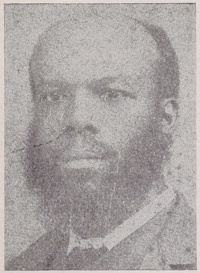
 James Apostles Fields (August 1844–23 November 1903), member of the House of Delegates, was born into slavery in Hanover County and was the son of Washington Fields and Martha Ann Fields, whose maiden name is recorded as Berkley and Thornton. His parents lived on separate plantations. He may have learned to read while enslaved. While tending horses for attorneys conducting business at the Hanover courthouse, Fields observed courtroom proceedings that later inspired his interest in the law. During the Civil War, he fled after suffering a particularly brutal beating and eventually joined the rest of his family, who had escaped in 1863 to the lines of the United States Army in the Hampton area. Fields attended a nearby American Missionary Association school for African Americans and worked at Fort Monroe for the army's Quartermaster Department in 1864 and as a watchman for the Bureau of Refugees, Freedmen, and Abandoned Lands in 1865–1866. In 1869 he was among a group of students that constituted the first class of the Hampton Normal and Agricultural Institute (later Hampton University). He taught in Williamsburg the following year and in 1871 graduated from Hampton.
Between 1873 and 1886 Fields lived in Elizabeth City County. He became active in Republican Party politics and on 17 January 1880 won election as doorkeeper of the House of Delegates to fill a vacancy for the 1879–1880 session. In 1882 Fields received a law degree from Howard University, in Washington, D.C., and soon began practicing law in the Hampton area. Two years later he was licensed to practice in adjacent Warwick County. On 9 May 1885 in Hampton, Fields married Carrie E. Washington, who, according to family tradition, had been born Caroline E. Armistead and later took her stepfather's surname. The couple had four sons.
Fields served as a captain in the Libby Guards, a Hampton militia unit, and as a justice of the peace, either in Elizabeth City County or in Warwick County. Scarce documentation makes it difficult to verify many public offices he may have held. By 1887 Fields had moved to Newport News, in Warwick County. From 15 June 1887 until at least 14 January 1891 he served as commonwealth's attorney, and in October 1890 he took the oath of notary public.
Fields easily won election in 1889 to the House of Delegates representing the counties of Elizabeth City, James City, Warwick, and York and the city of Williamsburg in the assembly that met from 4 December 1889 to 6 March 1890. Two weeks into the session he attended a gathering in Richmond of more than one hundred influential Black Virginians who decried instances of fraud in the recent election and called on Congress to remedy the situation. Fields played a prominent role in the proceedings and sat on the Committee on Address. In the House he held the lowest-ranking seats on the Committees on Claims and on Schools and Colleges. Fields introduced bills pertaining to pay and mileage for jurors and appropriate compensation for judges of elections. He also proposed to amend petit and grand larceny laws, to empower Warwick County supervisors to regulate the valuation of property in the county, and to authorize construction of wharves on the Poquoson River. He did not seek reelection in 1891.
For about fourteen years Fields instructed students, many of whom later became educators, at makeshift schools at Williamsburg's First Baptist Church and at Hampton's Third Baptist Church. He taught Sunday school at the Hampton church for many years, had become school superintendent by 1890, and also served as treasurer of the Hampton Young Men's Christian Association. He farmed and maintained a law practice, through which he also coached aspiring young African Americans who wished to enter that profession. His niece, Inez Catherine Fields (later Scott), became one of the earliest African American women to practice law in Virginia.
In 1900 the twenty-five lots on which Fields paid taxes in Newport News and Elizabeth City County were valued at $12,242, and estimates of the estate he left at his death ranged from $25,000 to $50,000. James Apostles Fields died of Bright's Disease at his home on 23 November 1903 and was buried in Pleasant Shade Cemetery, in Hampton. After his death, his late-Victorian Italianate residence in Newport News was used for several years as a hospital, likely the first such facility for African Americans in the city. In 2002 the James A. Fields House was added to the National Register of Historic Places.
Sources Consulted: Biography in Luther Porter Jackson, Negro Office-Holders in Virginia, 1865–1895 (1945), 11 (portrait), 16–17; birth date of August 1844 in United States Census Schedules, Warwick County, 1900, Records of the Bureau of the Census, Record Group 29, National Archives and Records Administration (NARA), Washington, D.C.; self-reported information in Twenty-Two Years' Work of the Hampton Normal and Agricultural Institute (1893), 25 (with birth year of 1844); family information in Alice M. Bacon, "From Slavery to Freedom," Southern Workman 21 (1892): 46–47, 62; family information in Kevin M. Clermont, ed., The Indomitable George Washington Fields: From Slave to Attorney (2013), esp. 63–66, 91–94; numerous references in Records of the Field Offices for the State of Virginia, Bureau of Refugees, Freedmen, and Abandoned Lands, 1865–1872, Record Group 105, M1913, NARA; Marriage Register, Elizabeth City County, Bureau of Vital Statistics, Commonwealth of Virginia Department of Health, Record Group 36, Library of Virginia (LVA); Warwick County Order Book (1881–1886), 232, and (1887–1891), 55, 85, 564, 610; Virginia General Assembly, House of Delegates, Journal of the House of Delegates of the Commonwealth of Virginia, 1879–80 sess., 150–151, 1889–90 sess., 41, 47, 77, 111, 231, 246; Secretary of the Commonwealth, Election Records, 1776–1941, no. 31, State Government Records Collection, Record Group 13, LVA; Republican Ticket, 5 Nov. 1889, Broadside Collection, LVA; Richmond Dispatch, 9 Nov. 1889, 18 Dec. 1889; J. Clay Smith Jr., Emancipation: The Making of the Black Lawyer, 1844–1944 (1993), 226; John V. Quarstein and Parke S. Rouse Jr., Newport News: A Centennial History (1996), 51, 77; Robert Francis Engs, Freedom's First Generation: Black Hampton, Virginia, 1861–1890 (2004), 106, 126, 139, 144, 149; National Register of Historic Places Registration Form, James A. Fields House, Newport News (18 Apr. 2002), Virginia Department of Historic Resources, Richmond, VA; transcription of Newport News death certificate provided by Gregory Cherry (2013); burial Register of Greenlawn Cemetery, Newport News Public Library (provided by Drusilla Pair, 2013); death notice in Richmond Times-Dispatch, 24 Nov. 1903, and memorial in Southern Workman 33 (Jan. 1904), 10–11.
Photograph in Jackson, Negro Office-Holders in Virginia, 1865–1895 (1945).