
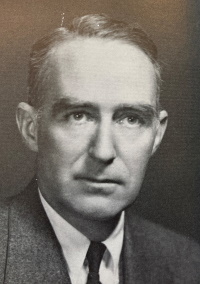
 John Norville Gibson Finley (30 December 1898–27 November 1971), founding director of George Mason College, later George Mason University, was born in Baltimore, Maryland, and was the son of William Norville Finley, a civil engineer, and Lucy Clara Hank Finley. Educated in the Baltimore public schools, he left high school during the ninth grade to help support his family by working as an office boy and in the accounting department of the Baltimore and Ohio Railroad. An Episcopalian, Finley attended the Berkeley Divinity School, in New Haven, Connecticut, early in the 1920s and then transferred to Lafayette College, in Easton, Pennsylvania, for two years. He graduated from the Johns Hopkins University in 1926 with a degree in history and English. Over the next decade he worked as a reference librarian at the Enoch Pratt Free Library in Baltimore and as a history teacher at high schools in Winchester and Charlottesville.
Jack Finley, as he was known to family and friends, married Cecile Bolton Hewson, a divorced child of civil engineer Channing Moore Bolton, on 10 July 1935 in Charlottesville. Having had a distinguished academic career, she graduated from Bryn Mawr College and earned an M.A. and a Ph.D. in psychology from the University of Virginia. In 1937 she received a fellowship to study abnormal psychology at Cambridge University. After teaching at Sweet Briar College, in Amherst County, she became the first full-time female professor in the College of Arts and Sciences at the University of Virginia, where she chaired the Psychology Department from 1941 to 1946. She later taught at Hollins College (later Hollins University), in Roanoke, and served as the chief psychologist for the Montgomery County, Maryland, school board from 1951 to 1961. They had no children.
Finley studied modern European history at the University of Virginia graduate school from 1935 to 1937 but did not finish his dissertation. He won a Carnegie Foundation grant to study diplomatic history at Cambridge University in 1937 and 1938. When he returned to Charlottesville in 1938, Finley worked for four years in Adult Education in the University of Virginia’s Extension Division and was the home study history instructor. While at Johns Hopkins, he had participated in an educational experiment in Pennsylvania to provide night classes for working men who had no high school experience. Finley had already decided to be a teacher, but adult education became his special calling. He was associate director of the Extension Division in 1942 and 1943 and secretary of the Bureau of Workers Education, which assessed the impact of World War II on working men.
Finley entered the navy in 1943 and served for two years in the Bureau of Naval Personnel Administration Section, which established naval training units on college campuses. Returning to the University of Virginia in 1944 as dean of counseling, he administered emergency housing for both students and faculty for four years with special attention to war veterans. Finley also organized conferences at which Virginia college counselors studied the needs of returning veterans.
In 1948 Finley was promoted to a professor in the university’s Extension Division, where discussions were underway to establish an extension center in Northern Virginia to meet the needs of veterans. Citizens of Arlington County had already formed an exploratory committee for that purpose and met with Finley and the division’s director George B. Zehmer in March 1949. By the summer Colgate Whitehead Darden, president of the University of Virginia and former governor, had not only agreed but had appointed Finley to administer the new Northern Virginia University Center of the University of Virginia. With community support from local lawyer C. Harrison Mann, Finley opened the center on 1 October 1949 in a frame building on the grounds of Washington-Lee (later Washington-Liberty) High School in Arlington. He planned a curriculum to meet a variety of local needs, which included courses for academic credit, for improvement of job skills, and for cultural enrichment. Classes began on 1 February 1950 and by April 1952 more than 3,400 students had completed 193 formal and informal course offerings. By 1953 he reported an enrollment of 700 students from forty-six states and nine foreign countries. By the autumn of 1957, the number of students registering for classes had increased to 2,400.
For a decade Finley guided the center and was the only visible agent of the university in Northern Virginia. He and his wife moved to Arlington, and he tirelessly promoted the center throughout the Washington area. The selection of Finley as director was inspired. According to an admirer, Finley was "a gentle and serene spirit whose scholarly presence added immeasurably to the quality of life" in the region. He understood that the success of the school depended on a broad base of civic, political, and economic support from the community. He was a humble man who understood diplomacy, who gained the trust of all manner of persons, and who demonstrated a saintly degree of patience. The success of the center would have been the monument to his life's work had he not simultaneously and quietly labored to create a separate branch college of the University of Virginia that evolved into George Mason University.
In 1953 Finley experimented by scheduling morning classes to assess public interest in a full-fledged community college. It was a great success, and in January 1954 the center's advisory council, consisting of representatives from several jurisdictions, met with Zehmer and Finley and agreed to work for the creation of a school that would provide at least two years of college classes under the sponsorship of the University of Virginia. In 1956, Mann, then a member of the House of Delegates, introduced and the General Assembly passed a resolution authorizing the University of Virginia to develop a branch college in Northern Virginia. In 1957 Darden named Finley director of the Northern Virginia University College of the University of Virginia.
With only a small staff to assist him, for three years Finley was joint director of both institutions and he continued to promote and expand the center while administering the endless details of the new college such as finding a location, building a library, outfitting science labs, and hiring faculty. Finley discovered an abandoned elementary school at Bailey's Crossroads, which Arlington County offered and the board of visitors in Charlottesville agreed to lease. The college opened in September 1957 with 17 registered students, but by September 1963 enrollment had risen to more than 170. On 12 December 1959 the university's board of visitors accepted the recommendation of local citizens and named the school George Mason College.
Finley relinquished the directorship of the center in 1960 to focus on the college. His greatest challenge was finding a permanent location. He engaged in a series of negotiations for several proposed sites before the mayor of Fairfax convinced the town council to purchase 150 acres of land and to donate the tract to the college. From 1960 until he retired in 1963, Finley guided the construction of the original campus buildings, which were among the first college buildings in Virginia with air conditioning at his recommendation. In 1962 he received an honorary doctor of laws degree from Drexel Institute of Technology (later Drexel University), in Philadelphia, in recognition of his contributions to adult and higher education in Virginia. The main administration building was named after Finley in 1972, although different departments have since occupied it. The annual Finley Lecture Series began in 1994, and the J. N. G. Finley Post-Doctoral Fellowship in United States History is a one-year appointment requiring teaching and research on American rights.
After Finley retired with the rank of professor emeritus in 1963, he became a visiting professor of English at the United States Coast Guard Academy, New London, Connecticut. The Finleys then retired a second time to Charlottesville. John Norville Gibson Finley died at the University of Virginia's hospital on 27 November 1971 and was buried in the Church of Our Saviour Cemetery in Charlottesville.
Sources Consulted: Birth and death dates in Death Certificate, Charlottesville, Bureau of Vital Statistics (BVS), Commonwealth of Virginia Department of Health; BVS Marriage Register, Albemarle Co.; Charlottesville Daily Progress, 11 July 1935; numerous documents and reports, including Joseph H. Harrison and Lee H. Potter oral history interview, 17 Sept. 1989, typescript memorial, "The Director of George Mason College of the University of Virginia J. N. G. Finley (1957–1963)," and William Hugh McFarlane "A Tribute to J.N.G. (Jack) Finley," 19 Oct. 1988 (quotation), all in William Hugh McFarlane George Mason University Collection, Special Collections Research Center, George Mason University (GMU), Fairfax; C. Harrison Mann Papers, GMU; Cecile Bolton Finley Papers, 1921–1987, Albert and Shirley Small Special Collections Library, University of Virginia (UVA), Charlottesville; Arlington Northern Virginia Sun, 30 June 1962 (portrait); Fairfax Globe, 25 Sept. 1975; Michael Ronald Sorrell, "Extending Public Higher Education into Northern Virginia: The Formative Years of George Mason University, 1949–1972" (Ph.D. diss., UVA, 2002); obituaries in Charlottesville Daily Progress, Washington Post, and Washington Star all 29 Nov. 1971, and Richmond Times-Dispatch, 30 Nov. 1971.
Photograph in National Cyclopaedia of American Biography (1891–1984), 57:732.