
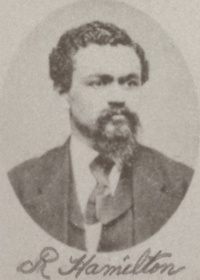
 Ross Hamilton (ca. January 1843–2 May 1901), member of the House of Delegates, was born into slavery in Mecklenburg County. The identities of his parents are not recorded, nor is it known whether he learned to read and write before being freed as a consequence of the Civil War. Because his handwriting was not always clear, he sometimes engaged a family member or associate to write letters for him. A carpenter by trade and also a sometime storekeeper, Hamilton was married to or had lived for six or more years with a woman named Pattie (whose surname may have been Shelton), by 1870, at which time they had three daughters, one of whom later died in 1885 while attending college. Before his wife's death of consumption on 18 November 1883 they had another daughter and two sons, both of whom died at less than three months old.
Public records preserve less information about Hamilton's personal and family life than about his long career in post–Civil War Republican Party politics. His name apparently first appeared in a public record in October 1867 when he was one of many African American men who voted for the first time in the election for delegates to a convention called to write a new state constitution as required by Congress as part of the Reconstruction Acts. Early in 1868 he received $3.00 for two days' work repairing the Boydton office of the Bureau of Refugees, Freedmen, and Abandoned Lands. In June 1869, Hamilton may have been indicted with John Watson and two other men in Charlotte County for inciting a riot shortly after the killing of Joseph R. Holmes, a former member of the Convention of 1867–1868. The charges were dropped in August on the order of John McAllister Schofield, the commanding general of the First Military District. Watson was also a former member of the convention and won election to the House of Delegates a few weeks later but died in December. At a special election on 26 May 1870 Hamilton, identified as a Republican, received a majority of all the votes cast and easily defeated two other men to serve the balance of Watson's two-year term. He took his seat for the first time on 2 June 1870.
A majority of the residents of Mecklenburg County were African American, and Hamilton carefully cultivated friendships and made alliances throughout the county. He was a good speaker and very able political leader. Hamilton enjoyed drinking in bars and talking politics with his friends on Saturday nights and rising early on Sunday mornings to attend church with their families. Several African American Republicans in the county and some white politicians elsewhere came to regard Hamilton as almost unbeatable on election day. He received the largest number of votes in each of seven consecutive elections for the House of Delegates from 1870 through 1881.
Hamilton had the longest legislative career of any African American in nineteenth-century Virginia. Always a member of the minority party in the House, during his first three terms he received appointments to low-ranking seats on the minor Committees on Executive Expenditures and on Manufactures and Mechanic Arts. In 1877 the Speaker appointed Hamilton to the important Committee on Privileges and Elections but as the least-senior member. Hamilton received a low-ranking seat on the Committees on Claims, on Retrenchment and Economy, and on Immigration in 1879. Two years later he received higher-ranking seats on the Committees on Immigration and on Labor and the Poor.
Hamilton was one of the best-known African American legislators in Virginia, although he was less influential as a legislator than as a party leader. In 1882, he persuaded the House of Delegates to allow use of its chamber in the Capitol for "a lecture on the question of temperance in intoxicating drinks"; but in that same year, he unsuccessfully proposed bills to prevent people who did not live in Virginia from attending the tax-payer-supported public schools in Mecklenburg County, on the North Carolina border, and another to authorize election of local school trustees, whom the state Board of Education had been appointing. Hamilton regularly attended county, district, and state Republican Party conventions, was a member of the Committees on Resolutions and on Finance at the state convention in August 1875, and was a delegate to Republican national conventions in 1872 and 1876. His long service to the Republican Party earned him a watchman's job, a minor patronage reward, at the Department of the Treasury in Washington, D.C., about 1879. Thereafter, he apparently resided part of the time in Washington and part of the time in Boydton.
On 4 April 1871, before his first term in the House of Delegates expired, Hamilton paid $70 to purchase ten acres of land adjacent to the Boydton Institute, a school for African Americans that occupied the prewar building that Randolph-Macon College had constructed before it moved to Ashland. During the ensuing three decades, he bought and sold several small parcels of land in the vicinity, including a town lot in Boydton that he jointly acquired for $500 in 1875 with James Richard "Dick" Jones, who was elected to represent Mecklenburg in the state senate the following year to fill an unexpired term. Hamilton occasionally borrowed money using his property as collateral, and he also acted as a trustee for several other people to help ease them through financial difficulties or to shield their property from creditors.
Unlike most of his contemporary African American political leaders, Hamilton did not initially favor proposals to refinance the antebellum public debt to lower the rate of interest or amount of principal to be paid in order to divert tax revenue from debt service to support the public schools. He did not take part in founding the biracial Readjuster Party that included both Democrats and Republicans who favored refinancing the debt or the March 1881 convention in which nearly three hundred African American Republicans voted to affiliate with the Readjusters; instead, in August 1881, he attended the state convention of what at the time was called the Straightout Republican Party. Perhaps as a consequence of that difference of opinion with other Republicans and African American politicians in the county, opposition to Hamilton began to coalesce.
The Republican Party in Mecklenburg County included factions that were hostile to each other, and ambitious men competed for leadership positions. By the 1880s, Hamilton's old friend and business partner Dick Jones led the opposition to him. After 1883 when Hamilton lost the party nomination for an eighth term in the House of Delegates to Amos Andre Dodson, a supporter of the Readjusters, Hamilton became a fervent supporter of and close ally of William Mahone, who had been the leader of the Readjusters but became a Republican as a member of the United States Senate.
Hamilton married M. B. Knox, known as Belle, on 18 May 1885 in the District of Columbia, about the time that the Democratic administration in Washington dismissed him from his treasury job. They had a daughter and a son before they married and another daughter in 1887. Hamilton continued to be active in Republican politics in Mecklenburg County even while he resided part of the time in Washington and was instrumental at the 1887 county convention in preventing Dick Jones from winning nomination to a second term in the House of Delegates by throwing his support to another African American, Britton Baskervill Jr., who later won the election. In November 1889, Hamilton won election again to the House of Delegates to represent Mecklenburg County by defeating a white man 2,248 to 2,194. That was the last nineteenth-century general election in which any African American won election to the General Assembly. As in many other election campaigns during the final decades of the century, violence was an integral part of white Democrats' efforts to suppress African American voting.
The Speaker of the House appointed Hamilton to the lowest-ranking seats on the Committee of Asylums and Prisons and again to the comparatively inconsequential Committee on Retrenchment and Economy. On 3 January 1890, less than a month after the session began, the House declared Hamilton's election improper and seated his opponent, who had challenged the result on the grounds that officers of election at several voting precincts had violated the rights of some voters to a secret ballot. The officers had insisted that African Americans hand their ballots to the election officers who then folded them and marked them with a large cross-mark before depositing them in the ballot box. A few weeks later, Hamilton was one of several men from Virginia who presented a protest to a congressional committee about mistreatment of African American voters in the state.
Hamilton permanently moved to Washington early in the 1890s and worked in the government printing office and later was a laborer at the Department of the Interior. He continued his political activism, speaking at an 1892 meeting of the Virginia Republicans at the party's national headquarters in Washington and campaigning for the Republican congressional candidate in the Fourth District in 1894 and 1898, although he did not hesitate occasionally to denounce white Republicans for not respecting African American party members. Ross Hamilton died at his residence in Washington, D.C., on 2 May 1901 and was buried on the grounds of Boydton Institute in Boydton. His real estate holdings, some of which included buildings that had fallen into decay in his absence, were valued at $790 at the time of his death and were all sold at auction to pay his
Sources Consulted: Biography in Luther Porter Jackson, Negro Office-Holders in Virginia, 1865–1895 (1945), vi (portrait), 19; United States Census Schedules, Mecklenburg Co., 1870 (age thirty-one), 1880 (age thirty-nine; wife identified as Martha), District of Columbia, 1900 (born Jan. 1843), Records of the Bureau of the Census, Record Group 29, National Archives and Records Administration, Washington, D.C.; Poll Book, 3d District, Mecklenburg County, Military Rule Election Records, Secretary of the Commonwealth, 1867, 1869, Record Group 13, Library of Virginia (LVA); identified as "Poss White alias Hamilton" in Charlotte Co. Order Book 37:141, as "Posse White alias Hamilton" in Richmond Daily Dispatch, 23 June 1869, and as "Ross Hamilton" in Alexandria Gazette, 24 June 1869; second marriage in Marriage License, District of Columbia Record Book 20, 228, Washington, D.C. Records Office; family data, two letters, and estate records in Bettie Hamilton Smith et al. v. Administrator of Ross Hamilton, Mecklenburg Co. Chancery Causes, 1906-009, LVA; property transactions documented in Mecklenburg County Deed Books 38–64, esp. 38:256–257, 40: 221–223, 434–435, 48:149, 151, 281, 51:173–175, 259–260, 53:62–63, 63:285–286, and 64:83–84, 561–564; property ownership documented in Ross Hamilton, Trustee of Mary Beard Farrar v. Administrator of James Beard et al., Mecklenburg Co. Chancery Cause 1876-025, and in Ross Hamilton v. Administrator of Lewis Thompson, Mecklenburg Co. Chancery Cause., 1887-013, LVA; Secretary of the Commonwealth, Election Records, 1776–1941, nos. 3 (1870), 4 (1871), 6 (1873), 10 (1875), 13 (1877), 17 (1881), 31 (1889), State Government Records Collection, Record Group 13, LVA; Virginia General Assembly, House of Delegates, Journals of the House of Delegates of the State of Virginia, 1869–1870 sess., 502, 1871–1872 sess., 33, 1874 sess., 41, 1875–1876 sess., 50, 1876 sess., 29, 1877–1878 sess., 34, 1879–1880 sess., 30, 1881–1882 sess., 30, 31, 168, 310 (quotation), 1882 extra sess., 110, 1889–1890 sess., 41, 42, 115–119 (election challenge); correspondence in William Mahone Papers, David M. Rubenstein Rare Book & Manuscript Library, Duke University, Durham, N.C.; Washington Post, 5 Oct. 1892; Richmond Dispatch, 18 July 1894; 8 Nov. 1898; Norfolk Virginian, 24 Oct. 1895; Washington, D.C., Evening Star, 14 Oct. 1898; Harold S. Forsythe, "'But My Friends Are Poor': Ross Hamilton and Freedpeople's Politics in Mecklenburg County, Virginia, 1869–1901," Virginia Magazine of History and Biography 105 (1997): 409–438 (family portrait on 410); death at age fifty-eight on 2 May 1901, in District of Columbia Death Certificate, Washington, D.C. Health Department; obituaries in Washington, D.C., Evening Star, 3 May 1901, Alexandria Gazette, 4 May 1901 (with erroneous report "died yesterday"), and Richmond Times, 5 May 1901 (with erroneous death date of May 3, 1901).
Photograph in Legislature of Virginia, Session 1871 and '72, Special Collections, Library of Virginia.