
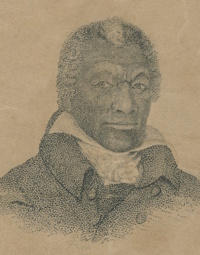
 James Lafayette (ca. 1748–9 August 1830), espionage agent during the American Revolution, was born into slavery, probably on the property of his owner, William Armistead, in New Kent County a few miles east of Richmond. No references to James during his lifetime identified him as James Armistead or as James Armistead Lafayette, but some later writers incorrectly assumed that he had been named James Armistead.
When the British army invaded Virginia during the spring of 1781, Continental army officers needed reliable information about the enemy's strength and strategy. By this time Armistead was serving as state commissary of military supplies and was in Richmond with his body servant James. Like many other African Americans, James found it easy to pass through the lines in the guise of a servant, laborer, or teamster. He began spying, with the consent of Armistead, for the marquis de Lafayette, then in command of the Continental army in Virginia. James was a double agent who pretended to spy on the American army on behalf of the British but repeated to Lafayette the conversations he overheard waiting tables at the headquarters of General Charles Cornwallis in Yorktown. James also carried messages from Lafayette to other agents behind the enemy's lines, "of the most secret & important kind," he later recalled in the formal third-person petition he presented to the General Assembly, "the possession of which if discovered on him would have most certainly endangered" his life. James also smuggled papers out of Cornwallis's headquarters to confirm that the British general and his army intended to remain in Yorktown. Lafayette mentioned his spy, almost certainly James, in reports to General George Washington, calling him a "Correspondant of Mine Servant to Lord Cornwallis," "My Honest friend," and "A Very Sensible fellow." A few days after Cornwallis surrendered on 19 October 1781, the British commander paid a courtesy visit to Lafayette and recognized James. "Ah you rogue," a person who was present later recalled him saying, "then you have been playing me a trick all this time."
With the war concluded, James resumed his duties as Armistead's enslaved laborer, but Lafayette did not forget him. On 21 November 1784, when James was attending Armistead, then a member of the House of Delegates in Richmond, he encountered Lafayette, who wrote the following statement for him: "This is to Certify that the Bearer By the Name of James Has done Essential Services to Me While I Had the Honour to Command in this State. His Intelligence from the Ennemy's Camp were Industriously Collected and Most faithfully deliver'd. He perfectly Acquitted Himself With Some Important Commissions I Gave Him and Appears to me Entitled to Every Reward his Situation Can Admit of."
Two weeks later James submitted a petition to the General Assembly to be emancipated for his service during the war, but despite Lafayette's affidavit, the assembly adjourned before the committee to which it had been referred reported. The petition and the original of Lafayette's certificate are lost. James filed a second petition on 30 November 1786, and the House of Delegates passed an act freeing him from slavery on 25 December 1786, and the Senate followed suit on 1 January 1787. James then took Lafayette as his surname. He resided in New Kent County, where about 1816 he bought two tracts of land that totaled forty acres.
James Lafayette may have married and had children, but the loss of the county's records leaves much of his life undocumented. He was probably literate and could sign his name, which he rendered as James Fayette. By 1785, the French artist Jean-Baptiste Le Paon had painted a portrait of the marquis at Yorktown and included a fanciful representation of a Black servant, probably intended to be James, in an incongruous French livery. An engraving of the portrait was distributed in the United States and in Europe. In December 1818, James Lafayette petitioned the General Assembly a third time to request a pension based on his military service and his advanced "age of Three score years & ten." The assembly granted him $60 in immediate relief and a pension of $40 annually, which he collected for the remainder of his life.
James Lafayette evidently became a familiar figure in Richmond, to which he traveled twice a year to collect his pension. A report in a Richmond newspaper early in the autumn of 1824 referred to him as "a very venerable and respectable free black man" and stated that he hoped to travel to Yorktown in October to greet his old commander, who was beginning a tour of the United States, but feared he was too poor to equip himself properly for the trip. When Lafayette visited Richmond late in October, though, James Lafayette was there, and during a procession to Capitol Square, the marquis recognized him in the crowd, called to him by name, and embraced him. Four years later when James E. Heath, the auditor of public accounts, published Edge-Hill, or, The Family of the Fitzroyals, A Novel, a two-volume fictional account of the Revolution, he made James Lafayette a subsidiary hero and on the last page quoted verbatim Lafayette's statement about his services. The artist John Blennerhasset Martin painted a portrait of James Lafayette about that time and printed copies of it with the marquis's testimony about his Revolutionary War service.
James Lafayette died in Baltimore on 9 August 1830. The place of his burial is not known.
Sources Consulted: Stanley J. Idzerda et al., eds., Lafayette in the Age of the American Revolution: Selected Letters and Papers, 1776–1790 (1977–1983), second quotation on 4:290, 357; engraving of James Lafayette with text of the marquis de Lafayette's 1784 statement reproduced beneath, ca. 1824 (fourth quotation), Virginia Museum of History and Culture, Richmond; Jared Sparks Collection of American Manuscripts, MS Sparks 32 (third quotation on 1:250), Houghton Library, Harvard University, Cambridge, MA; Lafayette's lost 1784 petition recorded in Virginia General Assembly, House of Delegates, Journal of the House of Delegates of the Commonwealth of Virginia, 1784–1785 sess., 54; Legislative Petitions, New Kent Co., 30 Nov. 1786 (first quotation) and 28 Dec. 1818 (fifth quotation, "age of Three score years & ten"), Accession 36121, Library of Virginia (LVA); Lafayette's emancipation in William Waller Hening, ed., The Statutes at Large: Being a Collection of All the Laws of Virginia, from the First Session of the Legislature, in the Year 1619 . . . (1809–1823), 12:380–381; Lafayette's pension in Acts Passed at a General Assembly of the Commonwealth of Virginia . . . , 1818–1819 sess., 188; Land Tax Returns, New Kent County, 1816, Auditor of Public Accounts, Record Group 48, Library of Virginia; date and place of death in Revolutionary War Pension Records, APA Inventory Entry No. 230, and date of death in Revolutionary War Pension Rolls, 1786–1851, vol. 2, APA Inventory Entry No. 232, both in Auditor of Public Accounts, Record Group 48, LVA; lost issue of Richmond Compiler excerpted in Salem (Mass.) Gazette, 8 Oct. 1824 (sixth quotation); Richmond Enquirer, 29 Oct. 1824; James E. Heath, Edge-Hill, or, The Family of the Fitzroyals, A Novel (1828), 2:224; Luther P. Jackson, "James Lafayette, Spy in the American Revolution," Norfolk Journal and Guide, National Ed., 20 Nov. 1943; John Salmon, "'A Mission of the most secret and important kind': James Lafayette and American Espionage in 1781," Virginia Cavalcade 31 (1981): 78–85 (portraits).
Image: Engraved portrait of James Lafayette after the painting by John B. Martin, ca. 1824, Visual Studies Collection, Library of Virginia.