
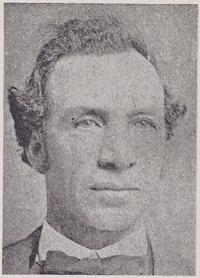
 James F. Lipscomb (4 December 1830–10 August 1893), member of the House of Delegates, was born free in Cumberland County and was the son of Martha Lipscomb, a free seamstress who owned her own land; the name of his father is not recorded. A dozen or more households of free African Americans named Lipscomb lived in Cumberland and Powhatan Counties, and both males and females in each county owned land. He was probably related closely to John Robinson, known early in life as John Lipscomb, who represented Cumberland County in the Convention of 1867–1868 and served four years in the Senate of Virginia.
In 1850 Lipscomb and three other free African American laborers, one of them his younger brother, William, resided in Cumberland County with white farmers Hezekiah Ford and Elizabeth Ford. Late in the decade Lipscomb left the county and by the summer of 1860 was living in Richmond with the household of Robert Edmond, a prosperous, white merchant, for whom he was the carriage driver. His wife Judith Lipscomb resided with him there; her maiden name and the date of their marriage are not known.
It is likely that Lipscomb remained in Richmond during the Civil War, but he moved back to Cumberland County soon afterward. In May 1870 he bought forty-five acres of land in the county for $400, and he purchased two other tracts in September 1871 and April 1873. Together with four additional purchases during the next two decades, he acquired more than 500 acres. In 1892, he paid taxes on about 390 acres of land worth more than $2,500. He was probably one of the most prosperous African Americans in the county. In 1870 the census enumerator listed two teenage boys and two teenage girls living with him and his wife, but it is not certain whether all the children were theirs or whether they had children born earlier or later than any of those four.
On 6 July 1869, in the second election in which African Americans voted in Virginia, Lipscomb won election to a two-year term in the House of Delegates representing Cumberland County. Voters that same day ratified a new state constitution, and the votes tallied by race in the referendum closely matched his margin of victory over a white candidate of the Conservative Party, 1,133 to 615. That indicates that all or nearly all of the Black voters in the county but few or none of the white men voted for Lipscomb. He easily won reelection in 1871, 1873, and 1875, served for eight consecutive years, and was a member of the relatively inconsequential Committee on Executive Expenditures. Newspaper reports of election returns from the county uniformly identified him as a radical, indicating his affiliation early in his career with the radical wing of the state's Republican Party.
During Lipscomb's first term the assembly created the first statewide system of public schools. He voted to ratify the Fourteenth and Fifteenth Amendments to the United States Constitution as Congress required before it admitted senators and representatives from the former Confederate states, which ended Congressional Reconstruction in the state. He voted in March 1871 for the Funding Act that the assembly passed to pay the antebellum public debt, a law that led to more than a decade of political turmoil.
Lipscomb regularly attended local, district, and state conventions of the Republican Party, but in 1872 the county's Republican Party convention objected to his pending appointment as an assistant assessor of federal taxes in the county. The convention declared that the incumbent assessor had done a good job and should not be replaced. In August 1875, Lipscomb was among the approximately one hundred delegates who attended a convention in Richmond that had been called by African American legislators. Delegates discussed the numerous problems faced by African Americans across the state, including a lack of jobs and poor schools, and organized a short-lived Laboring Men's Mechanics' Union Association to promote their economic and political interests.
In 1877, when Lipscomb ran for a fifth term in the House of Delegates, he lost to a white candidate by a narrow margin, which concluded his career in electoral politics. Three years later Lipscomb was recorded in the census as farmer who was then living with a daughter, his wife having evidently died on an unrecorded date after 1870. In addition to his farm Lipscomb operated a general store out of his residence, which was one of the largest of any African American in that part of the county. He operated the store until his death, at which time his descendants took it over and ran it for several generations. Early in the twentieth century they moved it into a nearby building, and it remained a center of community life until it closed in 1971. The state government recognized the importance of Lipscomb and his store in 1994 when it erected a historic marker at the site of the general store. James F. Lipscomb died, probably at his residence in Cumberland County, on 10 August 1893 and was likely buried on his property there.
Sources Consulted: Biography in Luther Porter Jackson, Negro Office Holders in Virginia, 1865–1895 (1945), 25–26, 31 (portrait on 31), reprinted in Cumberland County Virginia and Its People (1987), 87; birth date on Virginia Department of Historic Resources highway marker, probably from family sources, printed in Scott David Arnold, comp., A Guidebook to Virginia's Historical Markers, 3d ed. (2007), 258; mother identified on his 25 Feb. 1851 registration and on the 1837 and 1838 lists of free Negroes, Cumberland County Free Negro and Slave Records, 1753–1865, Local Government Records Collection, Barcodes 1156165 and 1156166, Library of Virginia (LVA); property holding in Cumberland County Deed Books 30:114, 332, 393–394; 32:203–204; 34:30–31; 37:84–85, 85–86, Library of Virginia; Land Tax Returns, Cumberland County, 1892 (Colored), Auditor of Public Accounts, Record Group 48, LVA; first election results in General Orders and Circulars, Headquarters First Military District, 1869 (1870), "Summary of the result of the election for members of the House of Delegates of Virginia, held on the 6th day of July, 1869," 10; Secretary of the Commonwealth, Election Records, 1776–1941, nos. 3 (1871), 2 (1873), 29 (1875), 413 (1877), State Government Records Collection, Record Group 13, LVA; Richmond Daily Dispatch, 28 Sept. 1871, 20 Aug. 1875, 21 Aug. 1875; Richmond Daily State Journal, 6 Apr. 1872, 1 June 1872, 19 June 1872, 12 July 1872, 26 July 1873;Washington, D.C., New National Era, 20 Aug. 1874; history of store in Rob Chapman, "Family, Friends Remember Life of James F. Lipscomb," Farmville Herald, 7 Sept. 1994, also reprinted in Cumberland County Virginia Historical Bulletin 10 (1995): 38; Register of Deaths, Cumberland Co. 1893, Bureau of Vital Statistics, Commonwealth of Virginia Department of Health, Record Group 36, LVA.
Photograph in Jackson, Negro Office Holders in Virginia, 1865–1895 (1945).