
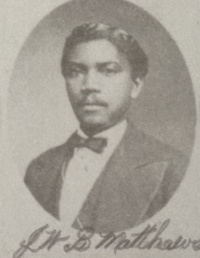
 John Walter Boyd Matthews (1840–11 July 1879), member of the House of Delegates, was born free in Petersburg and was the son of James Z. Matthews and his first wife, Rebecca Nicholas Gilliam Matthews. She had inherited several lots in the city and several enslaved men, women, and children, whose number increased to about thirty-five at her death when he was eight or nine years old. She named her only son for Walter Boyd Gilliam, the white planter who bequeathed land and enslaved workers to her and her mother and was her father. Of biracial ancestry, Matthews's parents were literate, and he learned to read and write.
It is unclear what John W. B. Matthews, as he was generally known, and members of his family did during the Civil War, but he probably remained in Petersburg, where he became a barber. Working in one of the few skilled professions open to African Americans during this period, he paid taxes on personal property worth about $60 in the years immediately after the war but did not then own any real estate. Petersburg had the state's largest population of free African Americans before the Civil War, and afterward it had one of the most politically active populations. The precise circumstances under which Matthews became involved in Republican Party politics are not clear, but as early as May 1870, he had a job in the customs house there, which he may have obtained through political alliances. On 25 October 1871, when Petersburg Republicans met to nominate candidates for the city's two seats in the House of Delegates, Matthews and Joseph P. Evans, both of whom the local newspaper identified as Radicals, won nomination. In November both men outpolled their Conservative white opponents by about 550 votes of approximately 3,500 votes cast.
As a member of the minority party in the House of Delegates, Matthews held the lowest-ranking seat on the relatively inconsequential Committee of Claims, but he was more active on the floor, introducing bills, making motions, and speaking, than were most of the other African American members that session. He unsuccessfully proposed to abolish chain gangs for prisoners, to raise taxes on alcoholic beverages, to inquire what legislation was needed to enforce the provisions of the Constitution of 1869 that guaranteed equal rights to all citizens, and to revise the tax laws. In the second year of his term, Matthews introduced a bill to allow local referenda to determine whether counties or townships should enforce the optional state fence law, and he proposed an inquiry into how many artificial limbs the state purchased for wounded Confederate veterans. He also cast one important vote during the first legislative skirmishings about payment of the pre–Civil War public debt under provisions of the so-called Funding Act of 1871. That law allowed payment of taxes with the interest-bearing coupons on the bonds issued then to refinance the debt, but that reduced the revenue the state received for supporting the new public school system. Matthews voted with the minority in March 1872 when the House of Delegates overrode the governor's veto of a bill to prevent payment of taxes with coupons.
In August 1872 Matthews was named a vice president at the organizational meeting of the Petersburg Grant and Wilson Club, which looked to advance Republican principles and work for the election of Ulysses S. Grant as president. Matthews did not run for renomination in the autumn of 1873, perhaps because on 28 May 1873, at Gillfield Baptist Church in Petersburg, he married Frances E. V. R. Gilliam and planned to start a family. They had at least one son and two daughters, one of whom died in childhood. At the time of his marriage, Matthews held the post of deputy collector at the City Point customs house, where he worked until his death. He purchased lots of land in Petersburg in June 1874 (his mother's old house on Sycamore Street), in July 1877, and in May 1878, and early in 1879 he took out a mortgage to pay back the $165 he had borrowed from the Petersburg Savings and Insurance Company to buy the third property.
Matthews remained active in Republican Party politics and in August 1875 he attended a state convention in Richmond that had been called to address the political and economic discrimination faced by African Americans in Virginia. He was a member of the standing committee on address. The convention adopted resolutions in favor of readjusting the state's public debt and forming a statewide Laboring Men's Mechanics' Union Association to unite African Americans to protect their rights as citizens to purchase land and to receive fair wages. John Walter Boyd Matthews died of a stroke at his home in Petersburg on 11 July 1879. The place of his burial is not known.
Sources Consulted: Brief biography with 1840 year of birth and incorrect post-Civil War relocation to Massachusetts in Luther Porter Jackson, Negro Office-Holders in Virginia, 1865–1895 (1945), 26, 28; brief biography with age thirty-five in Richmond Daily Dispatch, 20 Aug. 1875 (reprinted in Petersburg Index and Appeal, 21 Aug. 1875); Petersburg Hustings Court Register of Free Negroes and Mulattoes (1839–1850), no. 3284 (with full name and age "about six" on 2 Dec. 1845); family history and records and full name in Matthews v. Matthews Executor et al., Petersburg Chancery Cause 1854-038, Local Government Records Collection, Library of Virginia (LVA); family background in Luther Porter Jackson, Free Negro Labor and Property Holding in Virginia, 1830–1860 (1942), 223–225; marriage in Petersburg Hustings Court Marriage Register (1854–1890) and reported in Richmond Daily State Journal, 30 May 1873 (with wife's first name erroneously written as Tanner); Petersburg Hustings Court Deed Books, 36:80, 38:572, 39:489–490, 628–629; family and death date documented in Thomas Scott and T. L. Bond v. Administrator of John W. Matthews et al. Petersburg Chancery Cause 1881-023, LVA; Secretary of the Commonwealth, Election Records, 1776–1941, no. 4, Record Group 13, State Government Records Collection, LVA; Virginia General Assembly, House of Delegates, Journal of the House of Delegates of the State of Virginia, 1871–1872 sess., 32, 49, 90, 195, 389–390, 410–411, 1872–1873 sess., 35, 111; Petersburg Index, 17 May 1870; Petersburg Daily Progress, 26 Oct. 1871; Richmond Daily Dispatch, 8 Nov., 9 Nov. 1871, 6 Jan., 7 Mar., 3 Apr., 19 Apr. 1872, 11 Jan., 17 Jan., 20 Feb., 7 Mar., 8 Oct. 1873; Richmond Daily State Journal, 16 Dec. 1871, 17 Jan., 18 Jan., 26 Jan., 6 July, 2 Aug., 2 Sept. 1872, 3 Feb., 14 Feb., 25 Feb., 18 Mar., 21 Mar. 1873; Alexandria Gazette, 27 Feb. 1873; death date in Petersburg Index-Appeal, July 12 July 1879.
Photograph in Legislature of Virginia, Session 1871 and '72, Special Collections, Library of Virginia.