
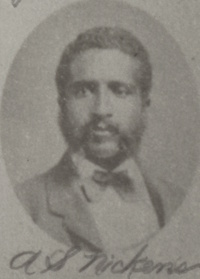
 Armistead S. Nickens (July 1836–25 or 26 April 1906), member of the House of Delegates, was born in Lancaster County and was the son of Armistead Nickens and Polly Weaver Nickens, both members of African American families that had been free for several generations. Family tradition is that his middle name and his father's middle name were Stokalas. Little is known about his early life, but descendants claim that his father, who almost certainly died when Nickens was young, taught him to read. He was recorded as being literate in the 1850 census. He may have been the Armistead Nickens described about 1858 in neighboring Northumberland County's Register of Free Negroes as five feet ten inches tall with a dark complexion and a scar on his right wrist.
In 1860 Nickens was working as a sawyer in Northumberland, and in that year or the following year married his employer's sister, Sophronia Wood. They had at least one son and one daughter before she died, probably late in 1869 or early in 1870. What Nickens did during the Civil War is not known. He moved back to Lancaster County about 1866 and worked as a farmer. The following year the local agent of the Bureau of Refugees, Freedmen, and Abandoned Lands, better known as the Freedmen's Bureau, identified him and his father-in-law, Holland Wood, as respectable local men who had been loyal during the war. The war and its aftermath likely contributed to Nickens's financial difficulties in October 1870, when he reported to the Lancaster County clerk $99.00 in personal property (including livestock and furniture) to be exempt from sale for debt. His situation improved and in 1873 he paid $700 for 135 acres of land along the road from the county seat to Kilmarnock. On 19 November 1871 he married Violet Watkins, a widow with two sons and two daughters. They had three daughters and two sons.
Nickens attended the Republican State Convention in September 1871 and on the following 7 November won election by a vote of 443 to 362 to represent Lancaster County, which had a Black majority, for a two-year term in the House of Delegates. He was the first African American to hold elected office in the county and one of very few until late in the twentieth century. Nickens served on the Committee on Militia and Police and usually voted with his party's radical minority faction. In 1873 he won the Republican nomination for a second term over a white candidate by reportedly stating that an African American could best look after Black people's interests. In the November general election he defeated a white Conservative opponent by twenty-nine votes. When Nickens returned to the assembly he was again a member of the Committee on Militia and Police and also sat on the Committee on Agriculture and Mining. Local tradition indicates that he advocated building a bridge across the Rappahannock River to connect the town of Tappahannock and Richmond County. It is not known whether Nickens chose not to run for a third term in 1875 or failed to win nomination against a white radical Republican that year.
Nickens apparently did not run for public office again, but he retained his interest in politics. In March 1881 he attended a convention of African American Republicans in Petersburg that laid the groundwork for a coalition with the new Readjuster Party that pledged to provide financial support for the state's struggling new public school system and refinance the public debt left over from before the war. Perhaps in return for supporting the Readjusters during the general election that year, Nickens received an appointment the following year as a special collector of delinquent taxes in Lancaster County. During the 1882 congressional campaign Nickens received a check to pay back taxes for several men who were later identified as political supporters of the Readjuster candidate and needed to have their tax delinquency removed before they could vote. In a subsequent investigation, Nickens swore that he did not know the money was for the benefit of men who backed the Republican-Readjuster coalition only.
Nickens later received credit for constructing a school for the county's African American children in 1876. He was one of five trustees of Saint John's Colored Baptist Church in 1890 and reportedly hauled logs and laid bricks during construction of Calvary Baptist Church. Nickens was ordained a deacon in that church on 11 June 1892. For much of his life, he appears to have been financially independent, but during the winter of 1885–1886 he acknowledged being $25 in arrears on his state taxes, and in 1898 he mortgaged his 135-acre farm to enable him to pay his debts. Despite the difficulties, in 1902 the county court named him a commissioner to help settle an estate. His own property then consisted of 153 acres of real estate worth about $1,000 and personal property that after his death was valued at a little more than $300. Armistead S. Nickens died at his home on either 25 or 26 April 1906 and was buried in the family plot in Lancaster County.
Sources Consulted: Biography in Luther Porter Jackson, Negro Office-Holders in Virginia, 1865–1895 (1945), 29, 60 (portrait); month and year of birth in United States Census Schedules, Lancaster County, 1900, Records of the Bureau of the Census, Record Group 29, National Archives and Records Administration (NARA), Washington, D.C.; Register of Free Negroes, Northumberland County, 1849–1851 [1849–1858], Library of Virginia (LVA); E. W. Busby to O. Brown, 1 Apr. 1867, in Reports on Prominent Whites and Freedmen, March–May 1867 in Records of the Assistant Commissioner for the State of Virginia (1865–1869), Bureau of Refugees, Freedmen, and Abandoned Lands, Record Group 105, M1048, NARA; 1 Mar. 1872, application (no. 4329) in Registers of Signatures of Depositors, Freedman's Savings and Trust Company (1865–1874), Records of the Office of the Comptroller of the Currency, Record Group 101, NARA; second marriage in Lancaster County Marriage License, Lancaster County Deed Books 43, 47, 48, 49, LVA; Secretary of the Commonwealth, Election Records, no. 2 (1871) and no. 3 (1873), State Government Records Collection, Record Group 13, LVA; 1883 testimony in House of Representatives, 48th Congress, 1st Session, Misc. Document No. 18, Testimony and Papers in the Contested-Election Case of George T. Garrison vs. Robert M. Mayo, from the First Congressional District of Virginia (January 10, 1884), 274–275; Fredericksburg Herald, 28 Aug. 1873; feature article with possible middle name (misspelled as Stocklas) in Norfolk Journal and Guide, 8 Apr. 1972; J. Allen Ball, "The Honorable Armistead S. Nickens, Statesman, Virginia Gentleman, Father: A Memoir," Pleasant Living 2 (Winter 1990): 16–17, 22, 25; Carolyn H. Jett, Lancaster County, Virginia: Where the River Meets the Bay (2003): 158, 226, 398; death notice with death date of 26 Apr. 1906, in Irvington Virginia Citizen, 4 May 1906; memorial with death date of 25 Apr. 1906, in Irvington Virginia Citizen, 15 June 1906; memorial by Calvary Baptist Church with no death date in Irvington Virginia Citizen, 8 June 1906; estate inventory and accounts in Lancaster County Estate Book 44:111, 116–117.
Photograph in Legislature of Virginia, Session 1871 and '72, Special Collections, Library of Virginia.