
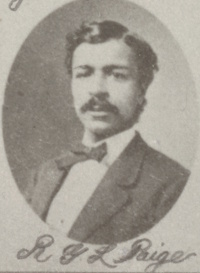
 Richard Gault Leslie Paige (31 May 1846–21 or 22 September 1904), was born into slavery in the city of Norfolk. He was probably the son of Thomas F. Paige and Frances L. Paige. Contemporaries occasionally spelled his surname as Page, and tradition in the mixed-race family linked them with the prominent white Page family. About 1857 Dick Paige, as he was familiarly known, fled to freedom aboard a schooner bound for Philadelphia, where he adopted a second middle name of Leslie in gratitude to an abolitionist there who assisted him. Paige then joined an aunt and brother who had previously escaped from slavery in Norfolk and settled in Boston. During his ten years in Boston he received an education and may have picked up some knowledge of law from abolitionist George Stillman Hillard, who sponsored him and his aunt, or from attorney George Lewis Ruffin, a Richmond native, one of the first African Americans to graduate from Harvard, and the first African American judge in Massachusetts. Paige married Ruffin's sister, Lillie A. Ruffin, in Chelsea, Massachusetts, on 26 November 1868. They lived in Chelsea, where he worked as a journeyman in a metalworking shop and accumulated real and personal property worth more than $4,000. They had five sons and three daughters, and another child whose gender is not known.
R. G. L. Paige, as he was known after he returned to Virginia in 1870, settled in the town of Berkley, in Norfolk County, which the city of Norfolk annexed in 1906. He and two of his brothers purchased land in Norfolk County in 1868, and during the 1870s and 1880s he bought and sold several lots in Berkley and some tracts of land in the county, some on his own and some in partnership with others. In December 1880 he and two other men purchased the local African American burial ground (later Mount Olive Cemetery), sometimes known as the Paige Cemetery.
In 1871 Paige easily won election to the House of Delegates for a two-year term representing Norfolk County. Reelected by a comfortable margin in 1873, he served on the Committee on Propositions and Grievances and during his second term on the Committee on Retrenchment and Economy as well. Paige quickly assumed a leadership role among the assembly's Republicans. He chaired a meeting of African American legislators on 17 January 1872 that appointed a six-member committee, of whom he was one, to travel to Washington, D.C., and petition Congress to pass a pending civil rights bill. Paige was one of the secretaries of the Republican State Convention in April of that year, and was a delegate to the Republican National Convention that met in Philadelphia and nominated Ulysses S. Grant for president. In July 1873 Paige was elected president of the party's state convention. His talent and party work earned him a patronage appointment on 1 June 1874 as an assistant clerk at the customs house in Norfolk, where he worked for several years and rose to clerk and inspector.
Paige won election to the House of Delegates again in 1879, receiving a majority of the votes in a three-man race. He and most other African American Republicans of the time supported proposals of the Readjuster Party, founded in February of that year, which promised to refinance the antebellum public debt at a lower rate of interest and repudiate part of the principal in order to divert revenue from payment of interest to support the public schools. His elder brother, Thomas F. Paige, a successful entrepreneur and owner of a hotel in Norfolk, also supported the Readjusters. In 1879 Republicans and Readjusters jointly won majorities in both houses of the General Assembly, which gave added influence to African American members. As a consequence Paige served on the influential Committee on Privileges and Elections and also on the Committees on Labor and Poor and on Counties, Cities, and Towns. He voted for the Readjusters' refinancing bill, known as the Riddleberger Bill, in 1880, but the governor vetoed it.
On 21 January 1880 Paige introduced a resolution requesting the governor to offer rewards for the capture and punishment of people who had recently lynched African Americans in Amherst and Fauquier Counties. He made a passionate speech that was printed by several newspapers, including the New York Herald, but the House killed the resolution by consigning it to a committee. Later in the session Paige presented a petition from a group of Richmond women asking the assembly to abolish the whipping post, a brutal legacy of slavery, for punishing African Americans. Paige continued to make the news. Early in February he and another African American man bought tickets to view an exhibition at a Richmond theater, but the proprietor turned them away stating that the gallery for African Americans was closed. They threatened to sue but evidently did not. At the same time some African American Republicans were maneuvering to make a coalition with the Readjusters, and in an interview with a local newspaper Paige explained that African Americans should decide for themselves how to protect their own interests and make alliances with white men, such as the white leaders of the Readjuster Party, when it was expedient to do so. Paige was one of the vice presidents of the March 1881 Petersburg convention of African American Republicans who made a formal alliance with the Readjusters.
As a candidate of the coalition, Paige won reelection to the House of Delegates by a wide margin in 1881 when the voters also elected a Readjuster governor. Paige served on the Committee on Schools and Colleges and was chair of the Committee on Claims. In January 1882 he voted for a revised version of the refinancing bill that the Readjuster governor signed. Paige also voted for the law that abolished public whippings. He introduced bills in 1882 to establish a board of health for Norfolk County and to incorporate two local companies, none of which passed; but one bill in which he was personally interested did pass, to charter the Virginia Building and Savings Association. He was a founding member of its board of directors.
Paige had been reading law in the meantime and on 6 July 1880 qualified to practice, perhaps the first African American lawyer in Norfolk and among the earliest in the state. On 7 March 1882 the governor appointed Paige one of the curators responsible for overseeing the use of money from the federal land-grant educational fund paid annually to the Hampton Normal and Agricultural Institute (later Hampton University). He served as secretary of the curators through 1885. By early in 1883 Paige had become assistant postmaster of Norfolk and he did not run for reelection to the General Assembly that year. He remained active in Republican Party politics, however. Before the 1884 congressional election he advised African Americans to vote for a white Republican candidate, James Dennis Brady, rather than an African American who would be able to achieve less in Congress for Black Virginians. At the 1888 Republican State Convention Paige was named an alternate delegate to that year's national convention. His reputation was such that in 1891 when African Americans throughout the country were lobbying to have an exhibition at the 1893 World's Columbian Exposition in Chicago, a large number of men from Virginia and North Carolina nominated Paige for the task of promoting such an exhibition. Among the nationally prominent Republicans who endorsed Paige's nomination were United States Representative Henry Cabot Lodge and future president William McKinley, but nothing came of it.
Paige's longtime friend George Freeman Bragg later described him as a man "superior in character and ability" and militant in asserting his rights. Bragg also related how during the postmaster's frequent absences from Norfolk, white men worked under Paige's supervision "without a murmur. It could hardly have been otherwise, for first and last, Dick was a 'gentleman.'" In 1892, a few months after his sole surviving brother died, Paige wrote a short will leaving all his property to his wife and naming her executrix of his estate. At the time of his death he owned at least ten properties and five buildings in Berkley and Norfolk County with a total taxable value of more than $6,500. Richard Gault Leslie Paige died of peritonitis at his home in Berkley on either 21 September 1904, as his widow had inscribed on his monument, or on 22 September 1904, as was reported by the Norfolk Landmark and Norfolk Virginian-Pilot. He was buried in nearby Mount Olive Cemetery. Lillie Paige erected a twelve-foot-tall engraved obelisk over his grave and lived until 27 April 1913. According to her physician a contributing factor to her death was "grief over loss of Husband."
Sources Consulted: Biography in Luther Porter Jackson, Negro Office-Holders in Virginia, 1865–1895 (1945), 27 (portrait), 32–33; birth date and death date of 21 Sept. 1904 on gravestone, Mount Olive Cemetery, Norfolk; William Still, The Underground Railroad: A Record of Facts, Authentic Narratives, Letters, Etc… (1872), esp. 565; incomplete biography in Richmond Daily Dispatch, 20 Aug. 1875; incomplete biography in Norfolk Journal and Guide, 20 Feb. 1932 (first and second quotations); marriage in Boston Post, 8 Dec. 1868; admission to the bar in City of Chesapeake (Norfolk County) Minute Book, 40:243; Secretary of the Commonwealth, Election Records, 1776–1941, nos. 4 (1871), 2 (1873), 14 (1879), 17 (1881), State Government Records Collection, Record Group 13, Library of Virginia (LVA); Washington, D.C. New National Era and Citizen, 7 Aug. 1873; Richmond State, 21 Jan. 1880; interview in Richmond Southern Intelligencer, 23 Feb. 1880; letter to editor, 26 July 1884, in Petersburg Lancet, 9 Aug. 1884; Norfolk Co. Circuit Court Will Book, 9:333–334; third quotation in Lillie A. Paige's death certificate, Norfolk City, Bureau of Vital Statistics, Commonwealth of Virginia Department of Health, Record Group 36, LVA; obituaries in Norfolk Landmark, 23 Sept. 1904 (with death date of 22 Sept. 1904) and Norfolk Virginian-Pilot, 24 Sept. 1904 (with death date of 22 Sept. 1904).
Photograph in Legislature of Virginia, Session 1871 and '72, Special Collections, Library of Virginia.