
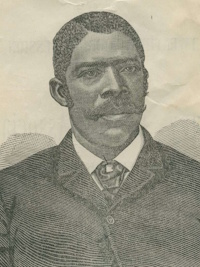
 Guy Powell (d. by 19 November 1900), member of the Senate of Virginia and of the House of Delegates, was born enslaved between 1849 and 1851, likely in the month of March, in Brunswick County and was the son of Milton Powell and Pythena Powell. Little is known about his early life, but on 27 January 1869 he was working as a laborer when he married Mary Ann Ryland, a widow. They do not appear to have had any children. Powell attended Richmond Institute (later Richmond Theological Seminary, one of the institutions that still later became Virginia Union University) and before he left in 1880 he had already begun his career as a minister. For much of the decade he was the pastor of two Baptist churches in Brunswick County, including Poplar Mount in Powelton, and two in neighboring Greensville County, and reported baptizing about 2,000 people. Between 1886 and 1894 he was elected moderator at the annual conventions of the Bethany Baptist Association, of South-Side Virginia, and in 1894–1895 he served a term as third vice president of the Virginia Baptist State Convention, for which he gave the opening sermon at its 1895 meeting. In 1887 he became pastor of Cool Spring Baptist Church, in the Southampton County town of Franklin, while continuing to serve his other churches for the next few years.
In addition to his work in the ministry, Powell became active in local and state politics. In 1872 he was a Republican supervisor of elections for a township in Brunswick County. In November 1875 he won election to a four-year term in the Senate of Virginia to represent the counties of Brunswick, Lunenburg, and Nottoway. He won all three counties and defeated his Democratic opponent by a vote of 2,205 to 1,690. Powell was assigned to the Committee on Immigration as its lowest-ranking member. He did not speak often, but did make a motion to repeal the fence law in Brunswick County. Fence laws had been a major issue of controversy since the Civil War as landowners sought to prevent grazers and others from using uncultivated land. Several senators and delegates who represented Brunswick County introduced similar measures well into the 1880s. Somewhat impatient, perhaps, Powell made several unsuccessful motions to adjourn during the extra session in March 1879 because he believed the legislature had concluded its most important work.
In December 1876 Powell and several other African American delegates got into a public dispute with James T. Fry, the proprietor of the Eagle Hotel, in Richmond. Powell and his colleagues left the hotel, the most substantial in the city available to African Americans, for what they deemed poor accommodations for the price, choosing instead to stay in private residences for the remainder of the legislative session. Fry took exception to this and published a notice in the local Richmond paper, boasting that his hotel offered comparable accommodations to those available for whites at the same price. He also called on the city to refuse to allow private residences to provide lodging because they did not have expensive hotel licenses. Powell and his colleagues, believing that their character had been questioned, responded with a newspaper notice of their own in which they described poor conditions at the hotel, including no gas or water amenities, having to sleep six to a room, and being forced to eat in a separate temporary structure with no heat. They also pointedly accused Fry, whom they argued could not read or write, of being duped into subscribing his name to the notice.
Powell did not run for reelection to the Senate in 1879. In January of that year he and his father, or possibly a brother of the same name, purchased a 217-acre tract of land in Brunswick County for $651. In the 1880 census he identified himself as a preacher and farmer. Powell bought the other half of the property for $325 in November 1881, and he and his wife later sold several small parcels of the property. In December 1891 they signed over another 132 acres to pay an outstanding debt, which was retired via a sale to James Powell (likely a relative) who raised money for the purchase by leasing the land for timber harvesting.
On 14 March 1881 Powell attended a large convention of African American Republicans in Petersburg. They voted to affiliate with the Readjuster Party, which advocated refinancing the public debt in order to make more money available for the public schools. That November, he received 1,460 votes against no organized opposition to win election to a two-year term in the House of Delegates from Brunswick County. The coalition of Republicans and Readjusters won large majorities in both houses of the General Assembly, and a Readjuster was elected governor. Powell was assigned to the Committee on Propositions and Grievances and to the Committee on Immigration and probably supported most or all of the large reform agenda the assembly passed early in 1882, including a radical refinancing of the debt and increased appropriations for the schools. The assembly also enacted a law to permit a referendum in two Brunswick County magisterial districts on repealing the county fence law, a referendum that passed. In January 1882 Powell introduced an amendment to repeal a prohibition on the use of seines and fish traps in freshwater rivers and streams, but it failed. The following month he presented a bill to curb the spread of smallpox and another to protect illegitimate children, but the details of his bills are not recorded, and neither passed. Powell did not run for reelection in 1883 when Democrats won majorities in both houses of the General Assembly.
By 4 February 1889 Powell had moved to Southampton County and on that date purchased for $75 a parcel of land in the town of Franklin. On 23 February he sold the property for $70, and three days later, on 26 February 1889, purchased for $75 a ¾-acre lot just outside the town. When the 1900 census was taken in Franklin on 3 July 1900 Powell was still listed as a minister, and by that date he may have also served as a justice of the peace. He was almost certainly in declining health when he wrote his will on 9 November 1900. Guy Powell died before 19 November 1900, when his will was proved by the Southampton County Court. He was buried probably in Franklin.
Sources Consulted: Brief biography in Luther Porter Jackson, Negro Office-Holders in Virginia, 1865–1895 (1945), 35 (with birth year of 1851); United States Census Schedules, Brunswick Co., 1870 (age 20 on 5 Sept.), 1880 (age 30 on 5 June), and Southampton Co., 1900 (March 1849 birth date), Records of the Bureau of the Census, Record Group 29, National Archives and Records Administration, Washington, D.C.; Brunswick County Marriage Licenses, 2:139 (age 18 on 27 Jan. 1869); Brunswick County Deed Book, 41:102–104, 42:108, 45:564–565, 46:141–142, 352–353, 379–381, 51:173–175, 52:44–45, 54:356–357; Southampton County Deed Book, 40: 466–467, 468–469; Secretary of the Commonwealth, Election Records, 1776–1941, no. 10 (1875), no. 17 (1881), State Government Records Collection, Record Group 13, Library of Virginia; Richmond Whig, 25 Oct. 1872; Richmond Daily Dispatch, 13 Dec. 1876, 15 Dec. 1876; Richmond Daily Whig, 18 Mar. 1881; Bethany Baptist Association Minutes, 1882–1900 (with frontispiece portrait in 1900 Minutes); Charles H. Corey, A History of the Richmond Theological Seminary (1895), 152–153; Southampton County Order Book (1896–1904), 372 (will proved on 19 Nov. 1900); Southampton County Will Book, 22:22–23.
Engraving in Minutes of the Twentieth Annual Session of the Bethany Baptist Association of Southside Virginia (1900).