
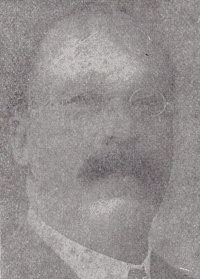
 Robert M. Smith (d. 13 February 1923), member of the House of Delegates, was born free during the mid-1840s in New Kent County and was the son of Robert Smith and Susan Smith. His middle name may have been Marcus or Marx. At about age seventeen he was apprenticed to a wheelwright or carriage maker in nearby Charles City County to learn the blacksmithing trade, but about 1863 he escaped to Hampton as a refugee. On 1 June 1864 Smith married Elizabeth Bryant, of New Kent County. They had at least two sons and two daughters and also adopted a boy. Smith attended night school after the Civil War, became a deacon and trustee at First Baptist Church of Hampton, and was active for many years in fraternal affairs, especially in the Grand United Order of Odd Fellows in America, the African American counterpart of the Independent Order of Odd Fellows.
R. M. Smith, as he was usually known, was out of state attending a convention of Odd Fellows in the autumn of 1875 when, without formally becoming a candidate, he received the Republican Party nomination for a two-year term in the House of Delegates to represent the counties of Elizabeth City and Warwick. He won election in a four-man race in November with 620 votes to 489 for the white conservative candidate, 296 for incumbent African American Republican Rufus Sibb Jones who was running an independent campaign, and 21 for a white Union army veteran. Smith held the lowest-ranking seat on the Committee on Schools and Colleges. He unsuccessfully tried to persuade the General Assembly to appropriate money for Hampton Normal and Agricultural Institute (later Hampton University) and to amend the law that placed limits on the times for harvesting oysters. During the 1876–1877 session, he introduced a bill that passed to incorporate the Jonathan Lodge, No. 1434, of the Grand United Order of Odd Fellows, of which he was probably a founder. Smith came in a distant third in the 1877 election for the House of Delegates behind a white Conservative Party candidate and Alexander G. Lee, another African American Republican who won.
Smith worked as a wheelwright and blacksmith in Hampton for many years and may have also operated a carriage-manufacturing business. He purchased property in Hampton about 1878 and in 1880 he formed a partnership with a brother-in-law to operate a grocery store and sell alcohol. They ran up debts, accused each other of misbehavior, and were in the process of dissolving the partnership when Smith's building, which housed the store, burned in December 1884 with the loss of all assets.
In the meantime, Smith won election to a four-year term as commissioner of revenue for Elizabeth City County in 1883, and was reelected in 1887. He resigned in the autumn of 1889 after a grand jury compiled evidence that his records were incomplete and irregular, which may have deprived the county of as much as $20,000. Smith nevertheless continued to be active in local Republican Party affairs well into the twentieth century. He was one of the men put forth as a potential nominee for the district's congressional seat in 1886, and he was a delegate to the Republican National Convention that met in Saint Louis in 1896. An advocate for improving the conditions of African Americans, Smith spoke against the voting restrictions of the 1902 state constitution at a 1908 meeting of county Republicans and in 1910 he signed a public letter calling for adequate public schools for African American students in Hampton.
Smith remained a prominent citizen of Hampton even out of office. When the widow of former Liberian president Joseph Jenkins Roberts was in Hampton in April 1890, she made a point of stopping at Smith's house. During the final years of the nineteenth century and the first years of the twentieth, Smith acquired several city lots in Hampton. He became an inspector at the customs house there by 1891 and was deputy collector by the end of the decade. He also served as grand treasurer of the Grand United Order of Odd Fellows in America from 1895 to 1898 and again from 1902 to 1906.
Smith's wife died on 3 September 1889. On 8 April 1891, in Richmond, he married Lillie Ann Beatty, who identified herself as a widow; in fact she had been married and had filed for divorce in Georgia, but she had not received a final decree. Early in 1897, Smith filed for divorce on the grounds that she had deserted him within a couple years of their marriage, and in 1899 he again sued for divorce claiming that she was still legally married to her previous husband and had since become a prostitute in Richmond. Before the contentious legal process came to a conclusion, she died in the spring or early in the summer of 1901. Smith married Bettie M. Smith, a widow with a young son at the time of their marriage, in Hampton on 4 May 1904.
Robert M. Smith suffered from kidney disease and died at his home in Hampton on 13 February 1923 and was buried in Elmerton Cemetery in that city. At the time of his death he owned three properties in Hampton with a taxable value of about $12,760. His older brother, who provided the information for his death certificate, identified him as a "Retired Politician."
Sources Consulted: Biography in Luther Porter Jackson, Negro Office-Holders in Virginia, 1865–1895 (1945), 39–40, who may have obtained information from his widow in the 1940s (with 1844 birth date and portrait on 77); biography with 6 Mar. 1844 birth date, middle name Marx, first marriage date, and portrait in Petersburg Lancet, 31 Oct. 1885; United States Census Schedules, Elizabeth City Co., 1870 (age twenty-seven) and 1880, (age thirty-seven), and 1900 (b. Mar. 1847 and age fifty-three), Hampton, 1910 (age sixty-two), and 1920 (age sixty-eight), all Records of the Bureau of the Census, Record Group 29, National Archives and Records Administration, Washington, D.C.; second marriage in Marriage Register, Richmond City, 1891 (age forty-seven), Bureau of Vital Statistics (BVS), Commonwealth of Virginia Department of Health, Record Group 36, Library of Virginia (LVA); third marriage in Elizabeth City Co. Marriage Register 1 (1865–1908), age fifty-seven on 4 May 1904; Robert Armistead v. R. M. Smith, Elizabeth City Co. Chancery Cause, 1892-023, Robert M. Smith v. Lillie A. Smith, Elizabeth City Co. Chancery Causes, 1899-015 (with age forty-six on 8 Apr. 1891) and 1901-001, Local Government Records Collection, LVA; Secretary of the Commonwealth, Election Records, 1776–1941, nos. 10 (1875) and 13 (1877), Record Group 13, LVA; Virginia General Assembly, House of Delegates, Journal of the House of Delegates of the State of Virginia, 1875–1876 sess., 49, 245, 250, 252, 374, 1876–1877 sess., 101, 489; Norfolk Virginian, 5 Nov. 1875; Hampton Home Bulletin, 20 June 1885, 27 Mar. 1886, 10 Apr. 1886, 28 Aug. 1886, 4 Sept. 1886, 16 Oct. 1886, 23 Oct. 1886, 24 Aug., 31 Aug., 7 Sept., 7 Dec.1889, 12 Apr. 1890; Newport News Daily Press, 19 July 1898, 10 Sept. 1898, 13 Mar. 1908, 22 Nov. 1910; Robert Francis Engs, Freedom's First Generation: Black Hampton, Virginia, 1861–1890 (1979); BVS Death Certificate, Hampton, with quotation, death date, and age "ab't 80;" gravestone with death date and 14 Mar. 1847 birth date in Elmerton Cemetery, Hampton; obituaries in Washington, D.C., Evening Star, 13 Feb. 1923, and Newport News Daily Press, 14, 15 Feb. 1923 (with middle name Marcus).
Photograph in Jackson, Negro Office-Holders in Virginia, 1865–1895 (1945).