
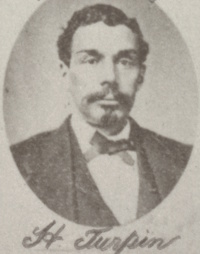
 Henry Turpin (15 November 1836–7 September 1908), member of the House of Delegates, was born into slavery in Goochland County and was one of the nine children of Edwin Turpin, a white planter, and his enslaved woman Mary James. Their father freed all but one of them in a deed dated 13 December 1857 and recorded two days later. His elder sister Martha Catherine, who had been freed the previous year, was the wife of William P. Moseley, later a member of the Convention of 1867–1868 and the Senate of Virginia. In November 1863, Turpin paid his father $400 to purchase twenty-five acres of land adjacent to his father's place of residence in Goochland County.
A house painter by trade, Turpin won the nomination at a raucous Republican Party county convention on 21 October 1871 to replace a white Republican as the nominee for the county's seat in the House of Delegates. In the general election, Turpin defeated a Conservative Party candidate 669 to 647, with six votes going to the original Republican nominee. The Conservative challenged the legality of the election because two election officials at one of the county's polling places had failed to take the required oaths. Conservatives had a majority of seats in the house but ruled that Turpin had been lawfully elected. Appointed to the lowest-ranking seat on the Committees on Counties, Cities, and Towns and on Officers and Offices at the Capitol, Turpin offered one of several amendments to revise a law that provided artificial legs to men who lost limbs during the Civil War. His amendment stated, "Colored men who lost legs as soldiers or employees in the late war shall be entitled to the benefits of this act." The assembly enacted the bill with Turpin's amendment, which permitted veterans of the United States Colored Troops to receive the state benefit and perhaps also men who as enslaved workers or civilians had been wounded after being impressed into working on Confederate defenses.
Turpin also voted in 1872 for a law to prohibit payment of taxes with the interest-bearing coupons on bonds the state issued in 1871 to refinance the antebellum public debt. It was the first of almost three decades of legislative attempts to stop the practice that flooded the treasury with coupons and reduced the amount of revenue the state could devote to the new public school system or other public services. Turpin was not on the floor when the assembly overrode the governor's veto. The Virginia Supreme Court of Appeals later declared the law unconstitutional. In March 1873 during the second session of his term, Turpin joined other African Americans and some Republican delegates who opposed what they believed was a partisan and unconstitutional plan by white legislators to elect county judges, but by vote of a large majority the other delegates refused to receive or record their complaint.
Turpin attended the Republican State Convention in 1873, which elected him to the party's state central committee. He was nominated for a second term in the House of Delegates at the party's October 1873 county convention but lost 736 to 662 to a different white Conservative in the general election. Sometime later, probably before the end of the decade, Turpin moved to the Bronx, New York, where his brother Durock Turpin lived with his family. Turpin worked as a sleeping car porter and about 1886 married a Virginia native named Sarah J. (surname unknown). They had one child who died before 1900. Henry Turpin died of heart disease at his New York home on 7 September 1908. He was buried at Woodlawn Cemetery in the Bronx.
Sources Consulted: Biography in Luther Porter Jackson, Negro Office-Holders in Virginia, 1865–1895 (1945), 30 (portrait), 42; family history in Augustus Turpin Granger, "Edwin Turpin of Goochland County," Goochland County Historical Society Magazine 25 (1993): 21–28, and documented in Creditors of Edwin Turpin v. Administrator of Edwin Turpin, Goochland Co. Chancery Causes, 1902-004, Local Government Records Collection, Library of Virginia (LVA); birth date in Goochland Co. Free Negro Register, 429; Goochland Co. Deed Book, 38:167–168 (emancipation); 40:494–495 (land purchase); U.S. Census Schedules, Goochland Co., 1860 and 1870, and New York Co. (Bronx Borough), 1900, Records of the Bureau of the Census, Record Group 29, National Archives and Records Administration, Washington, D.C.; Secretary of the Commonwealth, Election Records, 1776–1941, nos. 3 (1871) and 2 (1873), State Government Records Collection, Record Group 13, LVA; Report of contested election in Virginia General Assembly, House of Delegates, Journal of the House of Delegates of the State of Virginia, 1871–1872 sess., 47, 212–214; Acts and Joint Resolutions Passed by the General Assembly of the State of Virginia, at its Session of 1871–'72 (1872), 441 (quotation); Richmond Daily Dispatch, 24 Oct. 1871, 11 Oct. 1873; Richmond Daily State Journal, 25 Oct. 1871, 28 Feb. 1872, 10 Oct. 1873; Richmond Daily Whig, 28 Oct. 1871; death date, burial place, and age seventy-two in Bronx Death Certificate, New York City Department of Health; death notice in Richmond Times-Dispatch, 20 Sept. 1908 (with erroneous death date of 6 Sept. 1908).
Photograph in Legislature of Virginia, Session 1871 and '72, Special Collections, Library of Virginia.