
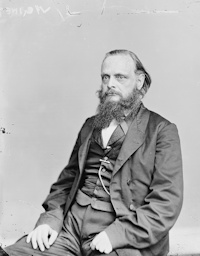
 John Curtis Underwood (14 March 1809–7 December 1873) was born in the town of Litchfield, Herkimer County, New York, and was the son of John Underwood and Mary Curtis Underwood. Nineteenth-century sources that give his middle name spelled it Curtis, but in some twentieth-century reference works his middle name appears as Curtiss, perhaps resulting from mistaking references in a 1913 Underwood family history to a John Curtiss Underwood, of Massachusetts, or to Mary Curtiss, who was not Underwood's mother. Records for the cemetery in which Underwood's mother was buried as well as his own gravestone spell the name Curtis.
Following Underwood's graduation from Hamilton College, in Clinton, New York, in 1832, he traveled to western Virginia and taught children of the Jackson family in Clarksburg for about two years. On his trip to Virginia, the idealistic young man visited the grave of George Washington, who by his will had freed his enslaved workers, and the grave of Thomas Jefferson, who had written that all men were created equal, and he met James Madison, who spoke to him in "calm, mild, but firm deprecation of the evils of slavery." Underwood studied law after teaching and returned to New York to open his practice. On 21 October 1839, in Fauquier County, he married one of his former pupils, Maria Gloria Jackson, the daughter of Edward Brake Jackson who had been a member of the House of Representatives in 1820–1823, and a cousin of Thomas J. Jackson who during the Civil War earned the nickname Stonewall. The Underwoods lived for the next decade in Herkimer County and had two daughters, one of whom died in infancy, and one son.
Antislavery Republican
Throughout his public career, Underwood frequently appealed to the authority of the Bible and the Declaration of Independence for his insistence that all Americans were equally entitled to freedom and to the full rights of citizenship. He had been a Whig but left the party in the 1840s and joined the antislavery Liberty Party. Underwood unsuccessfully ran for the House of Representatives as the Liberty Party candidate in 1846 and for district attorney in 1847. The following year he joined the Free Soil Party. Maria Underwood, although from a family that owned enslaved people, fully shared his antislavery principles when they moved back to Virginia early in the 1850s. A few years earlier, Underwood had begun an enterprise employing men from New York to operate dairy farms and produce cheese in Clarke and Fauquier Counties. In 1849 he and his wife acquired their own dairy farm, where he hoped to demonstrate the superiority of free labor over enslaved labor.
Underwood was one of the first residents of Virginia to become a Republican. On his own and without any official party authorization, he attended the Republicans' first national convention in 1856, where he made such a strong antislavery speech that his wife urged him not to return to Virginia at that time because he would not be safe. Later in the year, the first state convention of the small Republican Party of Virginia nominated Underwood as a candidate for presidential elector. He campaigned for the party's nominees in northern states but not in Virginia, where the Republicans received fewer than 300 votes, most of them in the northwestern counties along the Ohio River. By the end of 1856, Underwood's neighbors had so often threatened his family's safety that he left Clarke County and moved back to New York. He wrote a long account that was printed in the New York Times on 6 February 1857 about his forced exile from his own home because of his antislavery principles.
During the next three years, Underwood worked industriously for the American Emigrant Aid and Homestead Company, which he founded with Massachusetts congressman Eli Thayer, to encourage the migration of antislavery Republicans and emigrants from Europe to the Ohio Valley counties of northwestern Virginia. He also secretly arranged for northern financial support for the Wheeling Daily Intelligencer and one or two other, smaller Republican newspapers in the northern panhandle. Underwood's objectives were to demonstrate that free labor was more profitable than enslaved labor and to create a Republican antislavery stronghold in northwestern Virginia that would eventually gain enough political influence to abolish slavery in the state. His colonization work failed to produce any substantial results, and it collapsed after John Brown's raid on Harpers Ferry in October 1859. By then, however, Underwood was widely known in Northern antislavery and abolition circles.
Underwood's work for the Republican Party was somewhat more successful. The Wheeling newspaper became the most significant Republican newspaper in any of the major slave states, and he met many influential Republicans throughout the country. In 1858 he worked behind the scenes to encourage party leaders to persuade Abraham Lincoln to run for the House of Representatives after failing to win election to the United States Senate. Underwood also took a prominent part in the movement, which John Brown's raid also scuttled, to have the 1860 Republican National Convention held in Wheeling.
Underwood was a delegate to the Republican National Convention in Chicago in 1860 and like most other Virginia Republicans probably favored William H. Seward, United States senator from New York, for president. After Lincoln won the nomination, Underwood campaigned for him in border and western states and made one speech for him in Virginia, perhaps the only major speech made for Lincoln in the state during the 1860 campaign. On 17 October, in Bellton, in Marshall County, near the Pennsylvania border in the northern panhandle, Underwood endorsed Lincoln's candidacy but spoke mostly and at greatest length about the moral and economic superiority of free labor over enslaved labor. The influential and widely read New-York Tribune printed Underwood's campaign speech in full about a week later.
Federal Judge
On 9 July 1861 President Lincoln rewarded Underwood's political support and opposition to secession by appointing him consul at Callao, Peru, and the Senate confirmed him two weeks later. Underwood declined the post and arranged to take the job of fifth auditor of the United States Treasury. From then until the end of his life, Underwood and his wife lived in Washington, D.C., or in a house he owned in Alexandria. On 27 March 1863, when Congress was not in session, Lincoln made a recess appointment of Underwood to fill the vacant seat of judge of the federal court for the eastern district of Virginia. The president submitted the nomination to the Senate on 7 January 1864 and it confirmed the appointment on 25 January. Later that year, Congress created a separate federal district court for the new state of West Virginia and combined the old eastern and western districts of Virginia, making Underwood's the only federal district court in Virginia until 1871, when Congress created a new court for the western district of Virginia. Underwood again became judge of the eastern district, which encompassed most of Virginia east of the Blue Ridge.
Confiscation Cases
During Underwood's early years as a federal judge, he handled hundreds of suits brought under what was known then as the Second Confiscation Act. The 1862 law allowed the government to confiscate and sell the property of people who supported the rebellion. Underwood's court condemned more property under the law than any other federal court. In an openly political speech in Alexandria on 4 July 1863 Underwood linked Union military victory and the abolition of slavery with the destruction of the slaveholding class through the confiscation and sale of estates as essential goals of the war. "We have almost destroyed an aristocracy as much more selfish, insolent, and oppressive than any of the aristocracies of the Old World," Underwood said. He then predicted that following "the extinction of slavery will come the confiscation, sale, and subdivision of the old rebel plantations into farms, owned and cultivated by soldiers and other loyal men who have stood by the country in its hour of trial. And what a signal display of retributive justice shall we see in this."
Underwood's vigorous enforcement of the Second Confiscation Act in pursuit of retributive justice created some important legal controversies. Congress and the president had clearly intended for the confiscations to last only for the lifetime of the original property owner in keeping with the Constitution, which limited such confiscations to the lifetime of the person involved so as not to deprive heirs or other family members of their right to recover the property. Underwood interpreted the act as allowing for the permanent confiscation of property of people who supported the rebellion if the confiscation was completed during the lifetime of the rebel. In 1869 in Bigelow v. Forrest, the Supreme Court of the United States rejected Underwood's interpretation of the law.
Underwood sometimes condemned property in his court because the owners were living in parts of Virginia that were in rebellion and could not or did not appear to defend themselves. The Supreme Court of the United States overruled him in McVeigh v. United States in 1871 when it declared that the purpose of the court proceedings was to establish before the property could be condemned that the owner supported the rebellion, not for the judge to declare that as fact beforehand. In this instance of William N. McVeigh, of Alexandria and Richmond, Underwood also engaged in what many of his contemporaries regarded as an unethical transaction. At the time that he condemned McVeigh's property in 1864, he arranged for Alexandria attorney Samuel Ferguson Beach to aid Maria Underwood in purchasing McVeigh's confiscated property. The Virginia Supreme Court of Appeals overturned that transaction in Underwood v. McVeigh in 1873.
Radical Reconstruction
On 9 December 1864 the General Assembly of the loyal, Restored Government of Virginia elected Underwood to the United States Senate to succeed John Snyder Carlile. Underwood's principal competitors were Beach, a member of the Virginia Convention of 1864, and Lewis McKenzie, who had won election to the United States House of Representatives from the Alexandria district in 1863 but was not seated. On 9 March 1865 the Senate refused to seat Underwood and Joseph Segar, the other senator-elect from Virginia. Underwood never again applied to take his seat and did not resign from the bench.
Underwood's radical court rulings and public pronouncements during the final months of the war and following its conclusion outraged many white Virginians. In a case that came before him in September 1864 he declared that old Virginia laws that prohibited African Americans from testifying against white people in court violated the human rights of American citizens. He regretted that federal laws and the Constitution prevented him from ordering that a Black man from Massachusetts be permitted to testify in a local Virginia court. At a public event a few days after Lincoln's assassination in 1865, he spoke in the presence of President Andrew Johnson and argued for mercy and support for loyal Southerners and punishment of those leaders he considered wicked traitors. At a session of Underwood's federal court in Norfolk on 7 June, the grand jury indicted Robert E. Lee and several other prominent Confederates for treason. General Ulysses S. Grant and others persuaded the federal government to ignore the indictment because it was an impediment to reconciliation and because in Lee's case it violated the terms of the Confederate surrender at Appomattox. Shortly thereafter, Underwood complained to the president that Governor Francis H. Pierpont had been too lenient in endorsing applications from former Confederates in Virginia for presidential pardons, which threatened to throw control of the state government back into the hands of the rebels. In October 1865 Underwood published a letter that he wrote to Thomas Bayne, a prominent African American political leader in Norfolk, enthusiastically endorsing African American suffrage and full citizenship rights for freedpeople.
At the end of January 1866, when Underwood appeared before the congressional Joint Committee on Reconstruction, he was highly critical of former Confederates. Asked whether loyal Union men could get fair trials in Virginia, Underwood answered, "Not unless it is what might be called a packed jury. I do not believe, from what I have seen, that a Union man could expect to obtain justice in the courts of the State at this time; certainly not if his opponent was a rebel. The bitterness of feeling is very great, and I think the jury would be at least nine-tenths rebel." Asked whether a jury of Virginians could be assembled that would convict Jefferson Davis of treason, Underwood replied that only a packed jury especially chosen for the purpose would be able to do that. When pointedly asked whether he could pack one for that purpose, Underwood admitted that he probably could.
In February 1866 the House of Delegates adopted a resolution insisting that Underwood resign as senator-elect. He did not do so, but he remained intensely partisan as a judge and became one of the most prominent and outspoken white advocates in Virginia of full civil and political rights for African Americans. On 11 July 1866 Underwood signed a call for a national union convention to support radical Republicans, and almost exactly a year later wrote to the editor of the Norfolk Union Republican to respond to a charge that "three-quarters of the crimes committed in this State were by colored people." It would be more accurate, Underwood wrote, to state that "the old slaveholding aristocracy were keen to punish every colored or white Union man, and quite willing to let criminals of their own class go free." Former Confederates "being everywhere in this State in power," Underwood concluded, "more colored men than white were prosecuted for petty crimes." In December 1866 the Union League of Norfolk petitioned Congress to impose a new government on Virginia that permitted African American suffrage and also recommended that Underwood be appointed governor in place of Pierpont. The following February other radical Virginians also petitioned Congress asking that Underwood be appointed governor.
Indictment of Jefferson Davis
The most famous controversy that revolved around Underwood and his court involved the indictment of Jefferson Davis for treason. It is possible that at the spring 1865 session of Underwood's district court at Norfolk a grand jury indicted Davis, although any documents were reportedly lost from the court's records. On 10 May 1866 the grand jury then meeting in Norfolk did indict Davis, but for a variety of political and jurisdictional reasons—Davis was in military rather than civilian custody, for example—the federal government did not try him. One year later, Davis appeared in the United States Circuit Court when it met in Richmond, but again there was no trial. At Underwood's court on 13 May 1867, acting largely under orders from the government, he allowed a group of northern and Virginia men to post a bond of $100,000, and released Davis from custody. A grand jury issued another indictment of Davis on 26 March 1868, but for political reasons the government later dropped the prosecution.
Except that Underwood approved of the indictments of Davis, he took no part in the government's decisions not to prosecute. In fact, throughout the three and a half years that prosecution of Davis remained a possibility, Chief Justice Salmon P. Chase and officials of the justice department in Washington worried that Underwood was not qualified to conduct such a politically sensitive trial, that he could not conduct an unbiased trial, and that his testimony before the Joint Committee on Reconstruction about packing the jury would destroy the credibility of the trial. Underwood's charge to the grand jury in Richmond in May 1867, a few days before he released Davis on bail, fully justified the fears and outraged white southerners generally and a large part of the population of Virginia. Underwood made a long and vituperative speech that excoriated secession and Confederates, praised the most radical Republicans in Congress, and heaped contempt on the people of Richmond, the former capital of the Confederacy and the capital of what he regarded as an insufficiently reconstructed state. "Richmond, the beautiful and abandoned seat of the rebellion," Underwood charged, was the primary place where "bloody treason flourished" and where "the slave trade so long held high carnival," although he had hope for a "new era of justice and equality breaking through the clouds of persecution and prejudice," as evidenced by the interracial jury in his courtroom.
The Underwood Convention
The event that gave Underwood's name a permanent place in Virginia history was the Constitutional Convention that met in Richmond from 3 December 1867 through 17 April 1868. Congress required that Virginia and most of the other former states of the Confederacy write new state constitutions before it admitted senators and representatives from those states and fully restored them to the Union. On 22 October 1867, in the first election in which African Americans voted in Virginia and had their votes counted, Underwood won election to the convention as one of the five delegates from the city of Richmond, even though he was not a resident of the city. The convention had a radical Republican majority consisting of about two dozen African Americans, native white Unionists, and a substantial number of men of northern or foreign birth who had settled in Virginia during or after the Civil War. On its second day they elected Underwood president of the convention.
Underwood made several speeches on substantive matters during the convention, which was unusual for a presiding officer. In one, citing his early experience in New York courts, he favored allowing six-member juries instead of requiring twelve-member juries in minor civil cases. He also favored shifting part of the state's tax burden from land and from working peoples' wages to the "accumulated capital" of the state's wealthy people, perhaps intending more retributive justice against the old slaveholding planter class. Underwood also opposed denying the vote to men who had been convicted of minor or petty crimes. During the latter part of the century, disfranchisement for crime became a popular method that white supremacists adopted to disfranchise African Americans on the presumption that they were more likely than white men to commit crimes. On 16 January 1868, in Underwood's longest and most radical speech, he explained that he wanted the new constitution to include provisions "giving the franchise and the right to hold civil office to every citizen of this State of full age, of sound mind and of good reputation." He proposed removing a ban on clergymen serving in the General Assembly that had been in force since the Constitution of 1776, allowing all African Americans to vote, particularly veterans, and granting the vote to "our female citizens."
Many or most radical Republicans agreed with Underwood on the subject of African American suffrage, but he was almost alone among Virginia men of the time in advocating woman suffrage. His speech in the convention was almost certainly the first by an important Virginia officeholder to support granting women the right to vote. On 6 May 1870 John C. Underwood and Maria Jackson Underwood together with a few other white men and women attended the organizational meeting of the short-lived Virginia State Woman Suffrage Association that Richmond resident Anna Whitehead Bodeker had founded. He later declared that the Fourteenth Amendment, ratified in 1868, made women full citizens of the United States and that the Constitution therefore prohibited any state from denying any American woman the most fundamental right of citizenship, the right to vote.
The Convention of 1867–1868 was often referred to then and later as the Underwood Convention and the constitution that it prepared as the Underwood Constitution. It did not grant women the vote, but it did guarantee suffrage for African American men, and it disfranchised a large number of Virginians who had taken part in the government and armed forces of the Confederacy. The constitution included several important democratic reforms. It replaced the old county court system of local government with a new and more democratic form that resembled the New England township and had a large number of popularly elected officials. The constitution also directed that all voting be by ballot rather than by voice vote, and it required for the first time that the state government create a statewide system of free public schools for all children.
Opposition to the constitution and specifically to the proposed public school system brought out the worst in Underwood. He seemed incapable of restraining himself and in typical insulting language revealed his hatred of the leaders of the old South. When he publicly defended the educational clause in the new constitution, Underwood described it as "another frightful feature to those who have only laid down their arms against the United States, against humanity and equality, from compulsion, and would take them up again on the slightest hope of encouragement of the success of their dear 'lost cause.'" Delighted that he had signed the new democratic constitution on 17 April, the anniversary of the vote for secession in the Virginia Convention of 1861, Underwood regarded its provisions as the real reconstruction of Virginia. "In short," he concluded, "all its provisions are thoroughly Republican, excluding no man from equal privileges except for crime, or temporarily for rebellion. Can it surprise reasonable beings that it incurs the hostility of aristocrats and advocates of arbitrary power?"
General John M. Schofield, the commanding officer of the First Military District at the time, disapproved of the disfranchisement of so many white men because of their participation in or support for the Confederacy and delayed the scheduled ratification referendum, which was not held until July 1869. At that time, under a compromise agreement that a committee of veteran Virginia political leaders called the Committee of Nine worked out with leading members of Congress and President Ulysses S. Grant, the clauses disfranchising most of the former Confederates were voted on separately. The voters ratified the constitution that granted African American men the right to vote and defeated the disfranchisement provisions.
Equal Rights
In his federal court Underwood continued to demonstrate his commitment to the radical reconstruction of southern law and culture following the abolition of slavery and the ratification of the Fourteenth Amendment. In December 1868 Underwood granted a writ of habeas corpus to release an African American man who had been convicted in the circuit court of Rockbridge County for shooting at a man with intent to kill him. Underwood ruled that the Fourteenth Amendment disqualified the trial judge from holding his office and ordered the defendant released. The amendment declared that men who had taken oaths of allegiance to the United States before the Civil War and supported the rebellion during the war were ineligible to hold public office. The judge had served in the General Assembly during the 1840s, when he took an oath of allegiance to the United States, and served again in the General Assembly of the Confederate State of Virginia during the war. Underwood ruled that the judge was therefore disqualified from presiding over the court and that the trial and conviction were illegal. On appeal to the United States Circuit Court for Virginia, Chief Justice Chase, the member of the Supreme Court who then presided at that court, overruled Underwood's decision in Griffin's Case. Chase declared that the disbarment from office did not operate automatically to remove from office a judge who was then legally serving under the provisions of the Virginia Constitution of 1864. Chase's opinion also vacated Underwood's release of another convicted African American, Sally Anderson, and required him to decline to issue a writ of habeas corpus to free James Jeter Phillips, a former Confederate soldier who had been convicted of murder and sentenced to death.
In February 1869 Underwood presided in Richmond in the case, Robert Stevens v. Richmond, Fredericksburg, and Potomac Railroad. An African American man from South Carolina had sued the railroad for forcibly placing his wife in a second-class car (presumably with other African Americans) after she had purchased a first-class ticket. In Underwood's charge to a jury composed of five Black men and seven white men, the judge declared, "Distinction on account of color was a relic of barbarism, which had been happily done away with." Such distinctions had not been abolished, but he used his judicial office to eliminate as many of them as possible.
Reputation
John C. Underwood died of apoplexy at his Washington, D.C., residence on 7 December 1873 and was buried in the Congressional Cemetery in the capital. Radical Republican newspapers such as the Washington, D.C., New National Era and Citizen printed complimentary obituaries, and the internationally famous antislavery novelist Harriett Beecher Stowe published a long and glowing memorial to him in TheChristian Union. Many Virginia newspapers condemned him, however. Underwood was more outspokenly political than a federal judge should be, and some of his court decisions that conspicuously reflected his personal political beliefs got overturned on appeal. As if to remind everybody of the ruinous consequences of what Virginia secessionists and Confederates had done, during the final years of Underwood's tenure as a federal judge, he displayed on the wall of his courthouse in Alexandria a signed parchment copy of the Virginia Ordinance of Secession that Secretary of State William H. Seward had lent him. His opinions contrasted sharply in nearly every respect with traditional Virginia practices, particularly in the realm of race. That made him even more unpopular than he might have otherwise been even if he had restrained himself from frequently denouncing Virginians and Virginia practices that he despised. White Virginia politicians, lawyers, judges, and historians for decades heaped scorn on Underwood, who together with the later Readjuster leader William Mahone became one of the most reviled white men in nineteenth-century Virginia.
Sources Consulted: Lucien Marcus Underwood, The Underwood Families of America, 2 vols. (1913), 1:375–377, with names of parents and date of birth; Fauquier County Marriage Bonds and Returns Book 5 (1830–1849), 185; marriage recorded in Alexandria Gazette, 9 Nov. 1839; correspondence and scrapbooks in John C. Underwood Papers, 1856–1898, Library of Congress, Washington, D.C.; John C. Underwood Papers, Robert A. Brock Collection, Huntington Library, San Marino, California, microfilm in Library of Virginia (Accession 41008); Patricia P. Hickin, "John Curtis Underwood and the Antislavery Crusade, 1809–1860" (M.A. thesis, University of Virginia, 1961); Patricia Hickin, "John C. Underwood and the Antislavery Movement in Virginia, 1847–1860," Virginia Magazine of History and Biography 73 (1965): 156–168; Speech of John C. Underwood, at Alexandria, Va., July 4, 1863 (1863), first quotation on 5, second and third quotations on 6; Records of the United States Court for the Eastern District of Virginia, Record Group 21, National Archives and Records Administration, Washington, D.C.; Report of the Joint Committee on Reconstruction, 39th Cong., 1st sess., 1866, House Rept. 30, serial 1273, appended testimony, pt. 2, pp. 6–10 (fourth quotation on 7); The Debates and Proceedings of the Constitutional Convention of the State of Virginia, Assembled at the City of Richmond, Tuesday, December 3, 1867 (1868), esp. 7–8, 349, 425, 458–468 (tenth quotation on 458, eleventh quotation on 467), 527–528, 711 (ninth quotation); Patricia P. Hickin, "Antislavery in Virginia" (Ph.D. diss., University of Virginia, 1968), esp. 617–750; Richard G. Lowe, "The Republican Party in Antebellum Virginia, 1856–1860," Virginia Magazine of History and Biography 81 (1973): 259–279; New-York Daily Tribune, 23 Oct. 1860; Norfolk Post, 2 Oct. 1865; Richmond Daily Dispatch, 7 May 1867 (eighth quotation); New York Times, 28 July 1867 (fifth, sixth, and seventh quotations), 10 Jan. (twelfth and thirteenth quotations), 18 Feb. (fourteenth quotation), 1869; obituaries in Washington, D.C., Evening Star, 8 Dec. 1873, Washington, D.C., New National Era and Citizen, 18 Dec. 1873, and New York Christian Union, 7 Jan. 1874.
Image: Brady-Handy Collection, Library of Congress Prints and Photographs Division.