
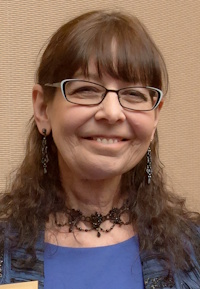
 Karenne Gayle Wood (31 May 1960–21 July 2019), Monacan advocate, was born in Washington, D.C., and was the daughter of Thomas Moore Wood and Gwendolyn Eleanor Dyer Wood. She attended a Fairfax County, Virginia, high school before dropping out. On 10 October 1980 she married Gary Ellsworth Brown, in Asheville, North Carolina. They had one daughter before the marriage ended in divorce on 27 March 1985. She married Lester Boguslaw Oden on 26 November 1985, in Arlington County. They had a daughter before divorcing on 6 May 1991. While earning her bachelor's degree at George Mason University, Karenne Wood edited phoebe, the school's literary journal, using the skills she had gathered from working in a print shop. Wishing to pursue a career in writing, she received a master of fine arts degree in poetry in 2001 from George Mason. In 2016 Wood earned a doctorate in linguistic anthropology from the University of Virginia, becoming the first Monacan to achieve a doctoral degree from the university. Reflecting the personal nature of her work, she studied "language and identity, how my people see themselves as Indian and adjust to the loss of an ancestral language, and how that impacts their sense of identity both politically and spiritually."
Wood's affinity for poetry and language developed at an early age. She began composing fictional short stories before focusing on poetry in high school. Wood knew as a child that she was Native American as her father was a descendant of a Virginia tribe. She became an enrolled member of the Monacan tribe in 1995, finding a sense of home after connecting with her Monacan roots.
Dedicating her life to advocating for Monacans and other Indigenous peoples, Wood led the way in developing the tribe's petition for formal recognition from the United States government, which succeeded in 2018. She also served as the tribe's economic development director. As a research fellow at the National Museum of the American Indian prior to its 2004 opening, she worked on the exhibition Return to a Native Place: Algonquin Peoples of the Chesapeake. During this period she also served as a repatriation coordinator for the Association on American Indian Affairs, which returned sacred objects to their tribal homes.
In 2004, Wood became the first board member of Native American descent for the Virginia Foundation for the Humanities (later Virginia Humanities). She left the board in 2007 to become director of the foundation's new Virginia Indian Heritage Program (later the Virginia Indian Program), which had been established to address the omission and misrepresentation of Indigenous peoples in Virginia's history. In partnership with the Virginia Council on Indians, the foundation published The Virginia Indian Heritage Trail (2007) edited by Wood to document the eight state-recognized tribes (at that time) on the commonwealth's landscape. Wood's work was recognized in 2009 by the Federation of the State Humanities Councils, which awarded the Schwartz Prize, its highest honor, to the foundation for its programs addressing the overlooked history of Virginia Indians.
Continuing her work to educate the public and provide a more accurate representation of Indigenous Virginians, Wood served on a Virginia Department of Education committee to revise the state's Standards of Learning curriculum and worked with textbook publishers to modernize the history of Virginia tribes and update static stories from the state's colonial past. She also contributed a chapter on southeastern tribes to National Geographic's Indian Nations of North America (2010), developed the Monacan exhibit at the Amherst County Museum and Historical Society, and curated the exhibition Beyond Jamestown: Virginia Indians Past and Present at the Virginia Museum of Natural History. In 2011, Wood created the Virginia Indian Archive to digitize and preserve historical content in the possession of Native families and tribal archives and museums. Passionate about revitalizing the Monacan language and culture, she taught courses at the University of Virginia and consulted on the school's Kluge-Ruhe Aboriginal Art Collection.
An activist as well as a scholar, Wood traveled to England with other Virginia tribal leaders in 2007, the 400th anniversary of the English settlement at Jamestown, to address stereotypes regarding Indigenous peoples and their reactions to the first colonists. She protested the depiction of Native Americans on statues located in Charlottesville, one showing Sacagawea crouched under Meriwether Lewis and William Clark on their expedition, and the other showing army officer George Rogers Clark on his horse trampling over Native Americans. Both statues were removed in 2021. Believing that she should speak for her ancestors who could not speak for themselves, Wood spoke publicly, wrote often, and organized events in Virginia and elsewhere related to causes she believed in, including the identity, representation, and rights of Indigenous peoples, as well as such social issues as domestic violence. Wood considered writing a political act, exclaiming "Do we have a responsibility as poets, politically, to articulate our experiences or beliefs? Absolutely. Why else would we bother to write?"
Wood's work appeared in more than a dozen journals and poetry compilations. She published two poetry collections, including Markings on Earth (2001) and Weaving the Boundary (2016). Contextualizing Indigenous identity, both works convey historical and personal themes. Wood often used her poems as a form of cultural revitalization, telling folktales and origin stories from different tribes. She also took opportunities to write in her native tongue, which she considered an act of language revitalization. She was named the 2002 Wordcraft Circle Writer of the Year in Creative Writing for Markings on Earth, which also won the North American Native Authors Award for poetry and the Diane Decorah Award for Poetry from the Native Writers' Circle of the Americas. In 2015 the Library of Virginia recognized her scholarship and advocacy by naming Wood as a Virginia Women in History honoree. Karenne Gayle Wood died of cancer on 21 July 2019 at her home in Fluvanna County. Her ashes were spread over Bear Mountain in Amherst County, the spiritual home of the Monacan tribe.
Sources Consulted: Virginia Foundation for the Humanities, Views (spring 2005), 3–5; Tara D. Causey, "'Past Silence:' An Interview with Monacan Poet Karenne Wood," South Atlantic Review 77 (2012): 192–197 (quotations); "A Conversation with Karenne Wood," Virginia Humanities, 19 Nov. 2013; Marriage Return, Arlington, Co., 1985, Bureau of Vital Statistics, Commonwealth of Virginia Department of Health; Report of Divorce or Annulment, Fairfax Co., 1985, Stafford Co., 1991, Bureau of Vital Statistics, Commonwealth of Virginia Department of Health; obituaries and memorials in Charlottesville Daily Progress, 27/28 July 2019, and Richmond Times-Dispatch, 28 July 2019, and UVA Today, 29 July 2019.
Photograph courtesy of the Library of Virginia.